In this guide
There is a phrase every boatman on this coast will hand you within the first ten minutes: three hundred and sixty-five islands, one for every day of the year. It is the kind of travel fact that is half arithmetic and half poetry, and you should take it in that spirit. Nobody has lined the islands up and counted them to be certain, and the moment you try you run into the question of what counts — the inhabited islands with their own villages, yes, but also the bare humps of granite with a single tree, and the rocks that vanish at high tide. What is not in doubt is the effect. The first time the Baía da Ilha Grande opens in front of you, the water is so thick with islands it looks, in places, almost solid: green shapes near enough to swim to, others far out and hazy, a scatter that genuinely does feel like it could run to the whole calendar.
Island-hopping in Angra dos Reis is one of the great days out on Brazil's Costa Verde, and it is also one of the most misunderstood. People arrive expecting to somehow see them all, or they arrive expecting a pretty town and find a working port, or they book the first boat they are offered and spend the best hours of the day sharing a lagoon with two hundred other people. None of that is necessary. The Angra dos Reis islands reward a little planning and an early alarm more than almost anywhere I know, and the difference between a good day and a mediocre one comes down to a handful of decisions you make before you ever step aboard.
I have spent a large part of my working life on boats in this bay, and what follows is the honest version: which islands actually deserve your time, how to build a route rather than a checklist, the real difference between hopping from the mainland and basing on Ilha Grande, how to choose between a schooner and a speedboat, and how the whole thing pairs with a base further down the coast at Paraty — where the same great bay ends in quieter, wilder water. Get these right and the 365 islands will give you one of the best days of your trip.

What island-hopping in Angra dos Reis actually means
First, a clarification that saves a lot of confusion. "Angra dos Reis" is both a town and a large municipality on the southern coast of Rio de Janeiro state, and the water it sits on is the Baía da Ilha Grande, a deep, sheltered bay protected from the open Atlantic by the long bulk of Ilha Grande itself. That shelter is the entire reason the islands exist as a destination. Because the big island and the surrounding headlands break the ocean swell, the inner bay stays calm and green, and calm green water is exactly what lets hundreds of small islands sit there looking like a painting rather than being pounded by surf.
The name, by the way, means roughly "cove of the kings" — Portuguese navigators entered the bay around the feast of Epiphany in the early sixteenth century, and the "kings" are the biblical Magi. The town that grew up here is a real place, with a port, a naval presence, shipyards and the ordinary business of a small Brazilian city. It is not a polished tourist set-piece, and if you have just come from the cobbled, lamplit lanes of Paraty's historic centre the town itself will feel like a step down in charm. That is not a complaint so much as a map: Angra earns its place the moment you leave the quay and get out onto the water. The town is where you park and board; the bay is the point.
So island-hopping here does not mean wandering a town. It means a day on a boat that strings together three or four islands with swimming in between — a snorkelling stop where the water is clearest, a beach island with sand and shade and somewhere to buy a cold drink, a quiet cove off the standard route, and a great deal of simply moving through the channels watching the next island slide by. That is the shape of a good day, and understanding it upfront is half the battle.
Where the bay sits on the coast
Geographically, Angra is the hinge of the Costa Verde, the green coast that runs between Rio de Janeiro and the border with São Paulo state. Drive in from Rio and the bay appears on your right somewhere near the halfway mark of the journey; carry on and the coast road eventually delivers you to Paraty. This central position is why Angra works so well as a boat day slotted into a longer trip, and why it is the busiest of the several jumping-off points for Ilha Grande. Behind the whole scene rises the Serra do Mar, the coastal mountain range whose Atlantic Forest slopes come straight down to the tide line and give the region both its scenery and its name. You can read how the pieces fit together in our Costa Verde overview.
You do not hop all 365 islands. You choose four, swim at three of them, and let the other three hundred and sixty be scenery.
The truth behind the number 365
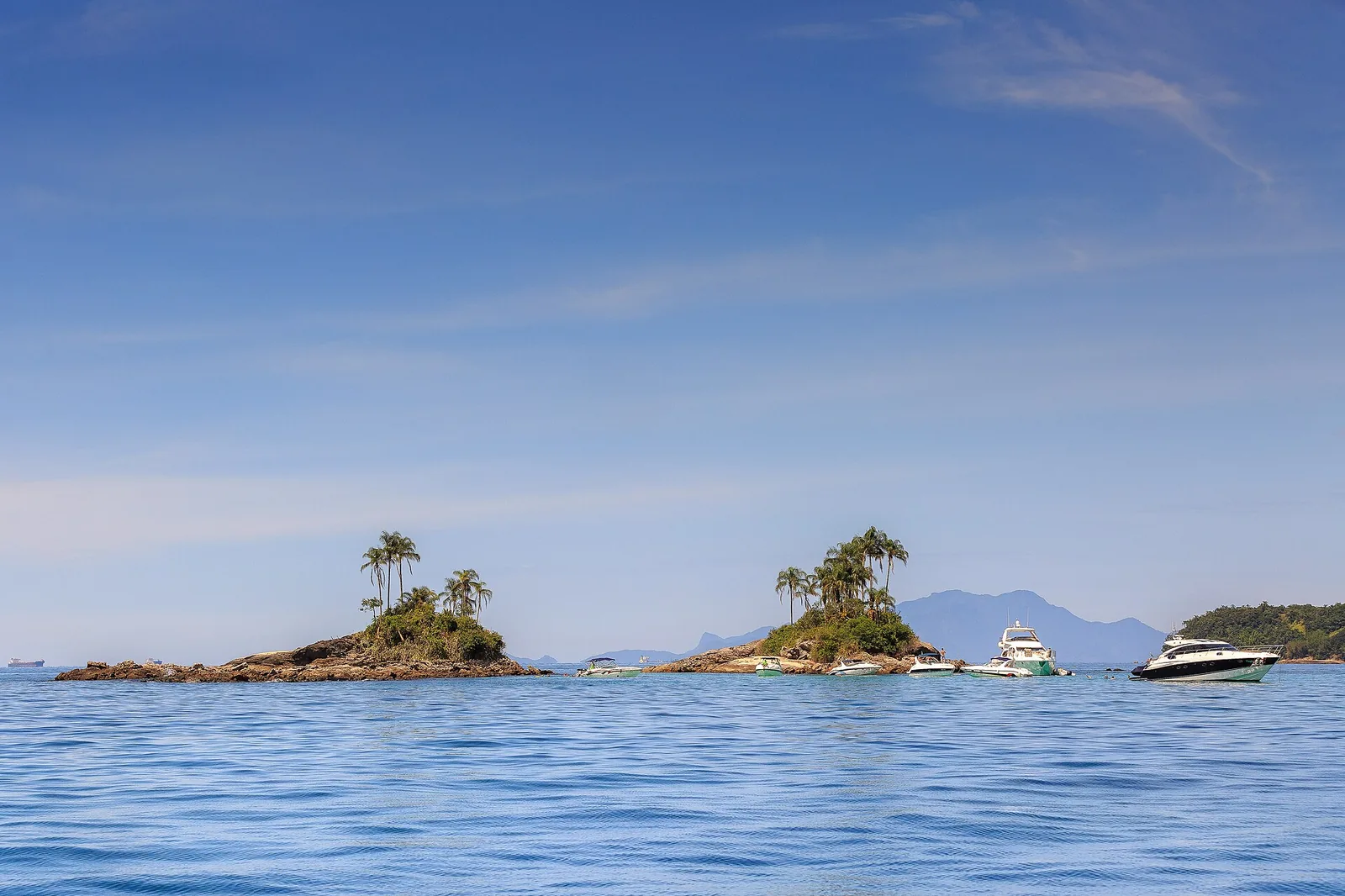
The "one island for every day of the year" line is the sort of thing a skipper delivers with a grin, and it is worth enjoying rather than fact-checking to death. The real count across the whole bay is genuinely large — comfortably into the hundreds — and it spans everything from substantial inhabited islands to rocks barely big enough to stand on. Some carry private houses, a few of them very grand indeed; many are protected and undeveloped; a handful have small beaches that fill with day boats by late morning.
What the number really tells you is how to plan, and the lesson is the opposite of what most people assume. You cannot see them all, and you should not try. The islands worth your time fall into a few clear types: the snorkelling stops where the water is clearest, the beach islands where you can land and linger, and the simply scenic ones you cruise past rather than set foot on. A good day threads three or four of these together and leaves the other three hundred and sixty as backdrop. Every time I have watched a boat try to cram in a fifth and sixth stop, the result is the same — more time motoring, less time in the water, and a group that ends the day tired rather than happy. The count is a promise of abundance, not a to-do list.

The islands worth a day
Let me be specific about the handful of islands that anchor most people's day, and honest about what each is actually like.
Ilha Botinas: the bay's natural aquarium
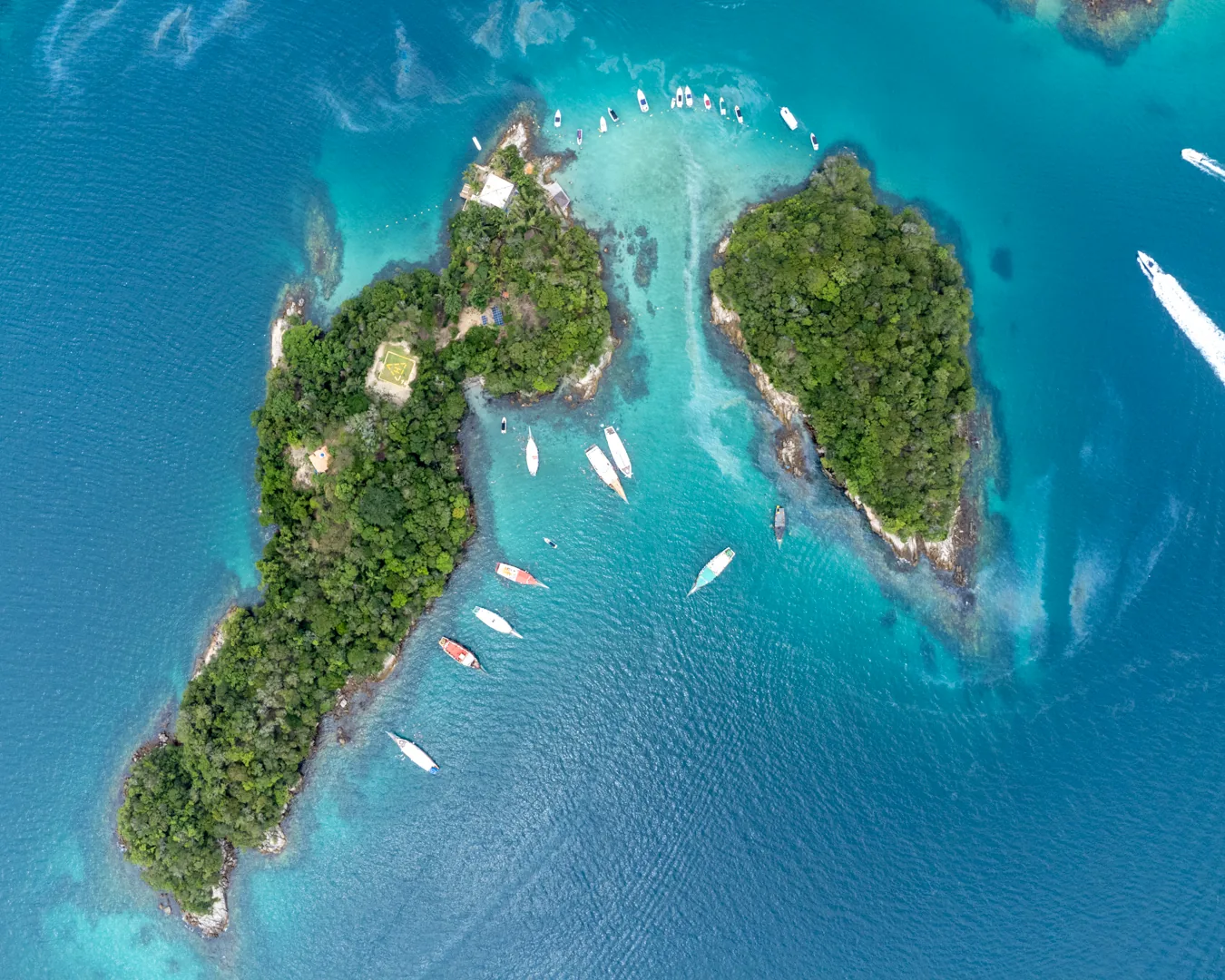
If the Angra archipelago has a single signature image, it is the Ilhas Botinas: two small, matching humps of rock rising side by side out of clear water, usually photographed from above so they look like a pair of green commas on a turquoise page. The appeal is not the islands themselves, which you do not really land on, but the channel around and between them. It is calm, shallow in places, and busy with fish, which makes it one of the best snorkelling stops in the entire bay. Nearly every schooner and speedboat circuit includes it, which is both the good news and the bad. Arrive with the midday fleet and you are sharing the water with a great many other masks and fins; arrive among the first boats of the morning and it can be close to yours alone. The water rewards whoever gets there first.
Lagoa Azul: the blue lagoon
Lagoa Azul sits off the northern shore of Ilha Grande rather than in the cluster of small islands near the town, but it features on every serious bay circuit and deserves its fame. It is a shallow cove sheltered by rocks and islets where the water turns a pale, luminous blue-green over a sandy bottom, and where shoals of small fish gather around the anchored boats — partly, it must be said, because crews and visitors feed them. Bring a mask. On a calm, sunny day the clarity is genuinely striking, and floating there with the green hills of Ilha Grande rising behind you is one of those moments that justify the whole trip. Like Botinas, it gets crowded; like Botinas, the answer is to go early. If you can be anchored at Lagoa Azul by nine, before the fleet arrives around eleven, you will have seen it at its best.
Ilha da Gipóia: beaches and a kiosk lunch
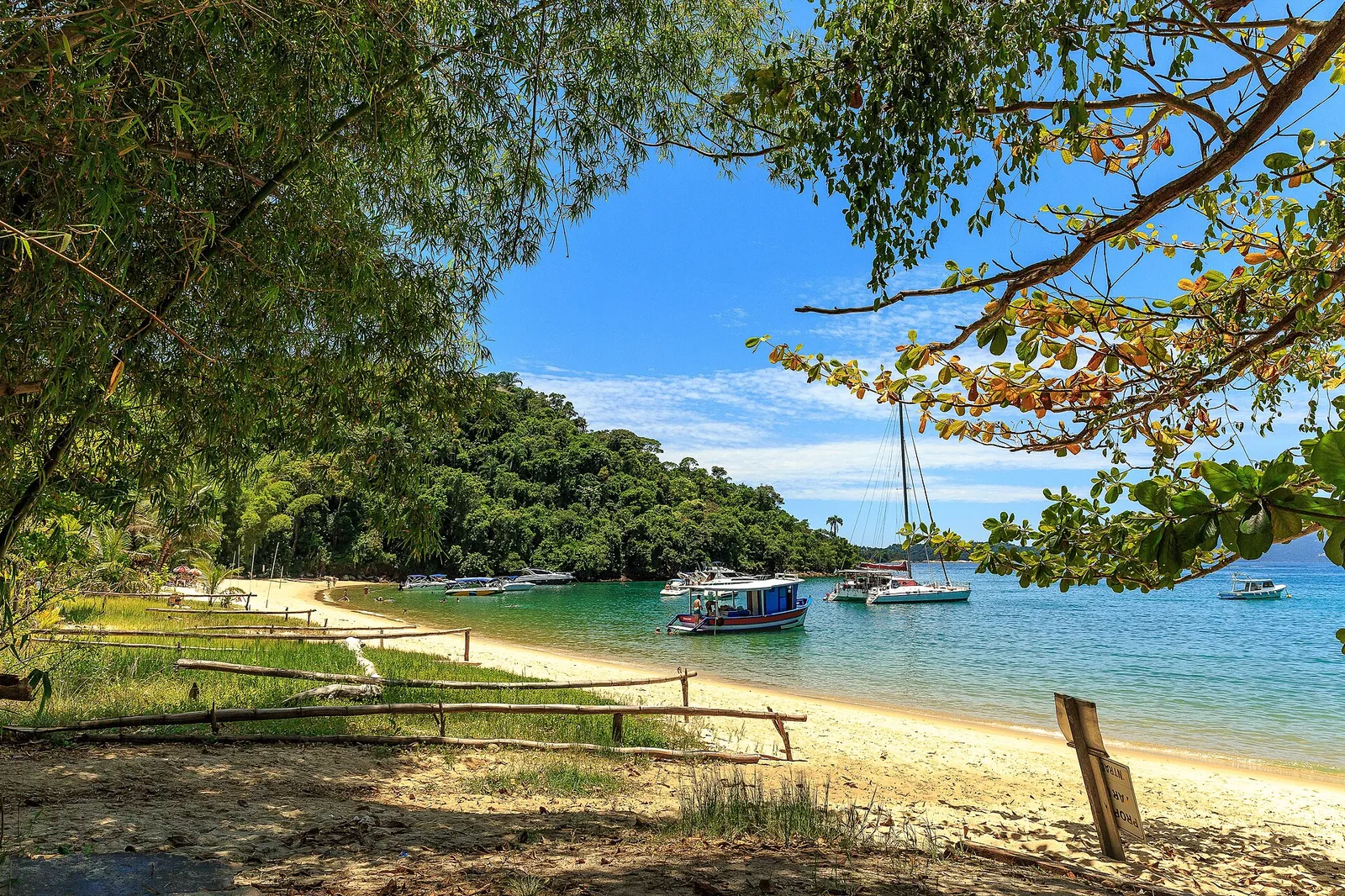
Ilha da Gipóia is the large island closest to the mainland, and it is where you go for actual beaches rather than just swimming stops. It has several coves with sand, calm water and a scattering of beach restaurants and kiosks, including the well-known Praia das Flechas, which gets lively with boats and music in the high season. Gipóia is the sociable, infrastructure-rich side of the Angra experience: somewhere to eat fried fish with your feet in the sand, have a caipirinha, and spend a couple of unhurried hours rather than twenty minutes with a snorkel. If you are travelling with family or a group that wants a base for the afternoon rather than a string of quick stops, Gipóia is the island to anchor your day around. Our guide to Paraty with family makes the same case for slower, land-and-linger days when there are children aboard.
The islands you cruise, not land on
Beyond these headliners, a great deal of the pleasure is simply the passage between islands: the channels where the water shifts from deep blue to jade, the forested slopes coming down to the shore, the occasional remarkable house tucked into a private cove. You will pass islands you never set foot on, and they are all the better for it. Resist the urge to treat the day as a checklist. The best hours on the bay are often the ones spent doing very little except watching the next green shape slide past the bow.
Ilha Grande versus the Angra archipelago
Here is a distinction that trips up a lot of first-time visitors, because the two things are constantly lumped together. Ilha Grande and "the islands of Angra" are not the same experience, and knowing the difference changes how you plan.
Ilha Grande is the single big island — car-free, forest-covered, ringed with beaches and laced with hiking trails — that gives the bay its name and forms its outer wall. It is a destination in its own right, with a main village at Vila do Abraão, famous beaches such as Lopes Mendes, and enough to fill several days. The Angra archipelago, by contrast, is the scatter of smaller islands and islets across the inner bay — Botinas, Gipóia and the rest — which you visit by boat as stops rather than stay on. Lagoa Azul is the confusing overlap: it belongs to Ilha Grande's shoreline but is reached on the same day-boat circuits as the little islands.
So the practical question is not really "Ilha Grande or the archipelago" but "a day on the water among the islands, or time spent on Ilha Grande itself." They answer to different appetites. The archipelago is about the boat and the swimming: clear-water stops, beach kiosks, the cruise between coves, all done in a day and back to your car by evening. Ilha Grande is about the island itself: walking a trail through Atlantic Forest to a beach you reach on foot, an overnight in Abraão, the slower rhythm of a place with no cars. Most travellers with time do both, on separate days, and treat them as complementary rather than as a choice.
If you want the archipelago
For the classic island-hopping day — Botinas, Lagoa Azul, a beach on Gipóia, a quiet cove or two — you want a boat out of the mainland, either from the town quay or from one of the smaller piers along the coast. This is the day that best suits a base further down at Paraty: drive up in the morning, spend the day on the water, drive back. You are hopping the islands, not staying on one.
If you want Ilha Grande
If the pull is the island itself — the trails, Lopes Mendes, the car-free calm — then you are looking at a ferry crossing and, ideally, an overnight rather than a day trip. We have written about it at length: our complete guide to Ilha Grande covers where to stay, the village, the trails and the great beaches, our Lopes Mendes guide gets you to the island's most celebrated stretch of sand, and the Ilha Grande trails guide is for walkers. If you have only a single day, our Ilha Grande day-trip guide is the one to read, and it is honest about how much a day really buys you.

Boat logistics: schooner or speedboat
There are two main ways to get out among the islands, and the choice shapes the whole day more than any other single decision.
The schooners
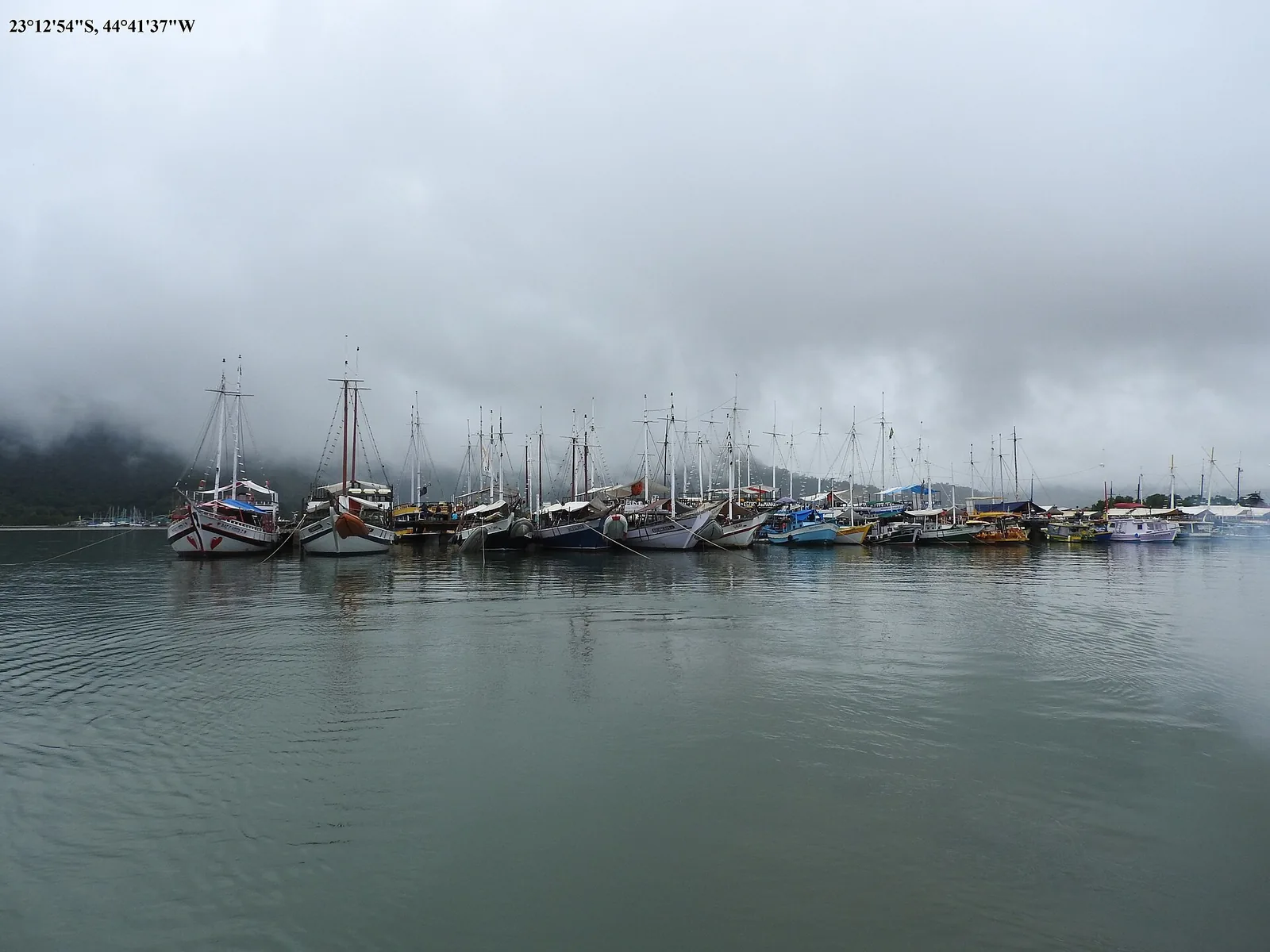
The big wooden schooners — locally called escunas — are the classic, sociable option. They are broad, slow, double-decked boats that leave from the town quay on a set circuit, usually taking in three or four stops over the better part of a day, with time to swim at each. They are good value, often include or sell lunch and drinks aboard, and carry the holiday-cruise atmosphere of music, sun decks and a crowd. The trade-offs are predictable. You go where the boat goes, on its timetable, and you reach the popular stops at the same time as every other schooner, which means the busy hours at Botinas and Lagoa Azul are busy indeed. For first-time visitors who want an easy, all-arranged day and do not mind company, a schooner is a perfectly good choice — and if the budget is the deciding factor, it is the obvious one.
The speedboats
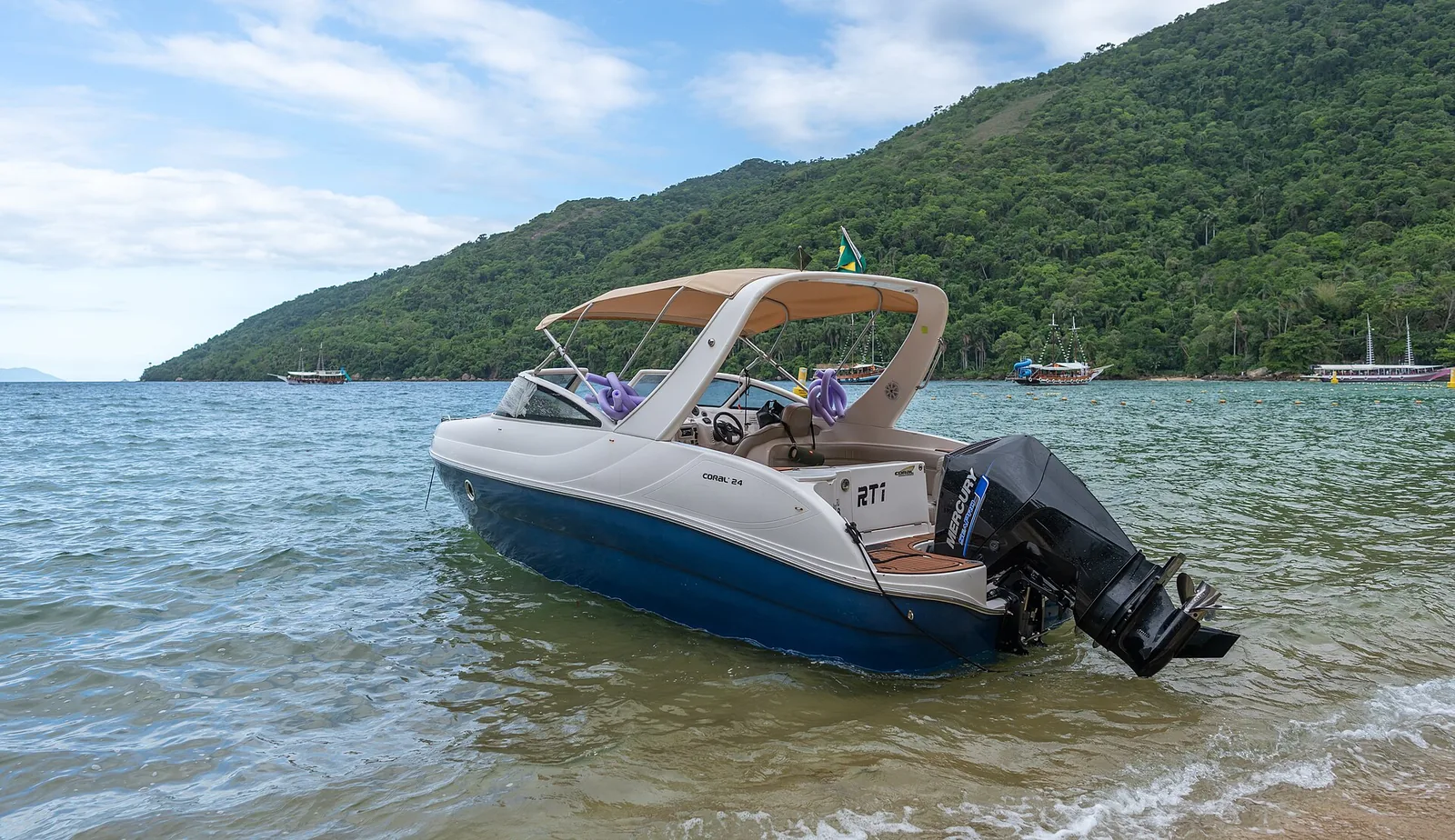
The alternative is a speedboat — a lancha — either shared or private. These are faster and far more flexible. A private boat with a skipper lets you set the route, linger where you like, skip what you do not, and reach quieter coves the schooners cannot be bothered with. Most importantly, it lets you time your arrivals: get to Lagoa Azul at nine rather than eleven and you may have it nearly to yourself. The obvious cost is money — a private speedboat is a serious step up from a schooner ticket — but split between a couple or a small group, and weighed against the difference it makes to the day, many travellers find it well worth it. If you care more about the quality of the water and the calm of the experience than about the price, hire a boat. Our wider Paraty boat tours guide walks through the same choice for the southern end of the bay, and the logic carries over almost exactly.
A simple rule
Schooner if you want easy, cheap and sociable and do not mind crowds; speedboat if you want quiet, flexible and early, and are willing to pay for it. Whichever you pick, the single most useful piece of advice for the whole bay is the same: go early. The day boats and the bus crowds tend to reach the famous stops around the middle of the day. The water belongs to whoever gets there first, and an early alarm is the cheapest upgrade you can buy.
Getting to the island of Ilha Grande
If your plan is Ilha Grande rather than the archipelago, the crossings are worth knowing. Conventional ferries leave from the centre of Angra and take roughly an hour to reach Vila do Abraão, running several times a day; they are cheap, steady and a little slow. Faster speedboats and catamarans do the same trip in about half the time for more money. There is also a smaller departure point further along the coast at Conceição de Jacareí, from which fast boats reach Abraão in around twenty minutes — often the quickest option if you are driving down from a Paraty base and want to leave the car on the mainland. Whichever you choose, remember that Ilha Grande has no road traffic of its own: you arrive on foot at Abraão and continue by boat or trail from there.
Building a route: a sample island-hopping day
To make all of this concrete, here is how I would shape a good single day among the islands, the kind I suggest to guests. Treat it as a template rather than a timetable.
- Early start. Be at the boat by mid-morning at the latest — earlier if you have hired a private one. The whole point is to reach the first clear-water stop before the midday fleet.
- First swim: snorkelling. Make Lagoa Azul or Ilha Botinas your opening stop, while the water is still quiet and the light is good. Mask on, an unhurried half hour or more in the water.
- Cruise and a quieter cove. Move on through the islands, pausing somewhere off the standard route for a second, calmer swim if the day allows. This is where a private skipper earns their fee.
- Lunch on Gipóia. Anchor off one of the island's beaches for a long, lazy lunch at a kiosk — fish, a cold drink, time in the shade.
- Afternoon dip and home. One more swim somewhere on the way back, then in to the quay by late afternoon, leaving you the evening to drive back to your base.
That is a full, satisfying day without a single rushed moment. Three or four good swims, one proper lunch, and a lot of time simply moving through the islands is the recipe for the best version of Angra. The temptation to add more stops is precisely the one to resist. If you are stringing this into a longer trip, our Paraty itineraries show where a boat day sits within three, five or seven days on the coast.

How the day pairs with a Paraty base
Because so many people visit both ends of the bay, and because we are based on the hillside above the water at Paraty, let me be candid about how the two fit together — and why basing at the southern end can make the whole island-hopping day easier rather than harder.
Angra sits roughly an hour and a half up the coast from Paraty, on the same road you would drive anyway. That is close enough to make the archipelago a comfortable day trip: an early start gets you onto the water for the best of the morning and back to your base by evening, without ever moving lodgings. You do not need to sleep in Angra town — which, as I have said, has little to detain you — to enjoy its islands. You can sleep somewhere far more pleasant and simply drive up for the boat.
The two ends of the bay also offer genuinely different water. The Angra archipelago is the denser, busier scatter: more islands, more boat traffic, more of the classic blue-lagoon, fish-around-the-boat experience. The Paraty end is quieter and feels wilder at its edges, with mangroves, secluded beaches and the long fjord-like inlet of the Saco do Mamanguá rather than a dense cluster of islands. Many of our guests do a day on the Angra bay precisely because it offers that aquarium-clear, island-hopping experience the Paraty side does not, and then return to the calm of the hillside and the colonial town. You get both textures of the same great bay on one trip.
From the chalet above the Bay of Paraty, you can actually see north toward the water that Angra opens onto — the same sweep of islands and headlands, read from the southern end. After a day on the water, coming back up the hill to an infinity pool with a view across three arms of the coast at once — Paraty, Angra dos Reis and Ilha Grande — is a particular kind of luxury: the swim you take after the swim. It is the reason a hillside base works so well for this coast. You spend the day out among the islands and return to a place that quietly puts the whole bay back in front of you. If you would like a hand arranging the right sort of boat day, whether a sociable schooner or a private speedboat that reaches the lagoon first, we are a short message away on the contact page.
Beyond the headliners: the quieter bay
The three or four famous stops are not the whole archipelago, and if you have a private boat or a second day it is worth straying off the standard circuit. The pleasure of the larger islands and the quieter channels is precisely that the schooner crowds rarely reach them.
The quiet coves
Scattered around the bay are small beaches the big circuits skip, either because they are awkward to reach or simply because there is not time. Some sit on the far sides of the inhabited islands; others are mainland coves tucked behind headlands. These are where you go for an hour of genuine quiet — a stretch of sand with no kiosk, no music, perhaps a single fishing boat at anchor. A good skipper will know a handful and can read the day's wind to pick one that is sheltered. This is the side of Angra that most rewards the extra spend on a private boat: not the famous lagoons, which everyone sees, but the unremarkable-looking cove that turns out to be empty and perfect.
The mangroves and the forest edge
Where rivers meet the bay there are mangroves, and where the islands are undeveloped the Atlantic Forest comes right down to the tide line. Cruising slowly along these green edges is a different pleasure from the open-water dashes between snorkelling stops — calmer, more attentive, with herons and other birds working the shallows. The state park behind the town, the Parque Estadual Cunhambebe, protects a large swathe of this forest on the steep slopes above the bay. Even from the water you get a sense of how completely the green wraps the coast here; it is the same Serra do Mar rainforest that defines the whole region, seen from sea level. If wildlife is part of the draw, our journal piece on Atlantic Forest wildlife is a good companion read.
Diving and the underwater bay
For those who want to go beneath the surface properly rather than just snorkel at the classic stops, the bay has dive sites too, from easy shallow reefs to a few wrecks. The visibility is weather-dependent in the same way the snorkelling is, so the calm, dry-spell days are again the ones to aim for. Our diving and snorkelling guide covers the practicalities for the wider bay, including what to expect from visibility and when to book.

.jpg)
A little history and culture of the bay
It is easy to treat the archipelago purely as scenery, but the bay has a long human story worth knowing, because it explains the few cultural sights the mainland does hold. The Portuguese named it in the early sixteenth century, entering around the feast of Epiphany. Over the following centuries it became a port and a stopping point on the coastal routes, and like much of this shore it has roots in the colonial economy of sugar and, later, in the gold that came down from the interior to be shipped abroad — the same trade that built nearby Paraty, which we cover in our gold trail guide.
The legacy you can actually see on the mainland is mostly religious architecture: a scattering of old churches above the harbour, of which the Igreja do Bom Jesus do Bonfim is the most prominent, and a couple of former convents and chapels. They are modest beside the riches of Paraty's historic centre, but pleasant to walk among for an hour, particularly if rain has driven you off the water. The deeper cultural thread, though, runs through the caiçara communities — the traditional coastal people of fishers and small farmers whose way of life shaped these shores long before tourism, and whose presence is part of what UNESCO recognised when it listed the wider Paraty and Ilha Grande landscape in 2019. Many of the islands and mainland coves are still home to these communities, and you feel it in the small chapels, the beached canoes and the fish traps. You can read more in our piece on caiçara culture.
Eating around the islands
Food on an island-hopping day comes in two settings, and they suit different moods. Out on the islands, the beach kiosks and simple restaurants — concentrated on Gipóia and the busier coves — do the classic Brazilian beach lunch: fried or grilled fish, prawns, rice, beans, a cold beer or a caipirinha, eaten with sand underfoot and the water a few steps away. It is unfussy and exactly right for the setting. On the mainland, near the waterfront and the old centre, you will find seafood houses serving the day's catch and the regional standards, including the seafood stews the coast does well. As ever, I will not name specific places — they change hands and reputations rise and fall — but the rule of thumb holds: eat fish, eat it near the water, and let the kiosk you like the look of decide it for you.
A practical note: on a schooner, lunch is often included or sold aboard, which is convenient but limits you to whatever the boat offers. On a private boat, ask your skipper to plan a stop at an island restaurant rather than packing sandwiches — the beach lunch is half the fun, and it gives you an hour off the water in the shade in the heat of the day. If you want to go deeper on what to eat on this coast generally, our journal guide to Brazilian gastronomy and our piece on cachaça and caipirinha culture are both worth a read before you travel.
When to go, and how to do it well
When to come
The bay is at its best in the drier, calmer months. The clarity that makes Lagoa Azul and Botinas worth the trip depends on settled weather and an absence of recent heavy rain, which stirs up sediment and run-off. The Brazilian summer, from roughly December to February, brings the warmest water and the most reliable sun but also the biggest crowds and the highest prices. The shoulder months on either side often give you calmer water and fewer boats. If you have any flexibility, a weekday outside the peak holidays will always beat a summer weekend. Our guide to the best time to visit Paraty applies almost exactly to Angra, since the two share a climate, and the wider best time to visit Brazil piece sets it in national context if you are planning a longer trip.
How to do an island-hopping day well
- Go early. The single most important rule. Book the earliest boat you reasonably can and reach the famous stops before the midday crowd.
- Bring your own mask and fins if you have them. The best stops are about what is under the surface, and rental gear on the boats is hit and miss.
- Pick your boat to match your day. Schooner for easy and sociable; speedboat for quiet and flexible. Do not book a schooner and then resent the crowds, and do not pay for a private boat if what you actually wanted was the party atmosphere.
- Watch the weather, not the calendar. A calm, clear day in the off-season beats a windy, murky one in peak summer. If your itinerary is flexible, keep the boat day loose and grab the good weather.
- Pack reef-safe sun protection, water and shade. The sun on open water is fierce, and not every stop has shade. A hat and a light long-sleeved top save the afternoon.
- Decide in advance: archipelago day or Ilha Grande. They are different trips. If Ilha Grande is the real goal, treat the mainland purely as the ferry port and do not dilute the day trying to do both at once.
Getting there and parking
Angra is reached by the coast road from both Rio and Paraty, and by the regular Costa Verde buses that run the length of the coast. If you are driving, the town has paid car parks near the waterfront where you can leave a vehicle for the day or for an overnight on Ilha Grande; arrive in good time, as the spaces near the piers fill up. Coming from the south, Angra is an easy add-on to a Paraty stay: an early start gets you onto the water for the best of the morning and back to the hillside by evening. Travellers coming from São Paulo or Rio will find the drive is the same coast road either way, winding and slow in places but beautiful, and worth breaking with a stop rather than rushing.
Where island-hopping fits in a Costa Verde trip
The way I would frame it for most travellers is this. Rio is the arrival and the icon. Ilha Grande is the wild, car-free island escape. Paraty is the cultural heart and the place to base yourself, especially if you want comfort and a real sense of the coast's history. And the Angra archipelago is the day you give over to islands and clear water — the aquarium day, slotted into the journey because it happens to lie on the road between the others and because its water does something the rest of the coast does not quite manage.
You do not hop all 365 islands. You choose four, swim at three of them, and let the other three hundred and sixty be scenery. That is the honest secret of the place, and once you stop trying to see everything, the bay relaxes into one of the finest days on the Brazilian coast. Do a little planning, set an early alarm, pick the boat that matches the day you actually want, and watch the weather rather than the calendar.
For guests staying with us above the Bay of Paraty, all of this is within comfortable reach, and the chalet gives the day a fitting bookend — you spend the morning out among the islands and come home in the evening to a pool set into the hillside, with Paraty, Angra dos Reis and Ilha Grande laid out below in a single view. If you would like help shaping the trip, our explore Paraty pages map the whole coast, our guide to Brazil's coastlines sets it in a wider frame, and we are always glad to point you to the right kind of boat day when you write to us on the contact page. The islands reward the early riser; be one, and Angra's near-countless scatter will give you a day you remember.

Frequently asked questions
The famous figure is 365 — one for every day of the year — and it is a friendly round number rather than a precise survey. The Baía da Ilha Grande holds hundreds of islands and islets across the whole bay, from inhabited islands with villages to bare rocks with a single palm. The exact tally shifts depending on what you count, but the impression of an almost countless scatter is entirely accurate.
By boat, and the two real choices are a shared wooden schooner on a set circuit or a private speedboat you route yourself. Schooners are cheap and sociable but crowded at the famous stops; a private boat costs more but lets you go early, linger, and skip the busy hours. Either way the golden rule is to start early — the day fleet reaches the best-known lagoons around midday.
It depends on what you want. Day boats from the Angra mainland let you cover the classic snorkelling and beach islands and return to your car by evening, which suits a day trip from a Paraty or coastal base. Basing on Ilha Grande itself puts you closer to the island's own beaches and trails but makes the wider archipelago a longer reach. Many travellers do a boat day from the mainland and, separately, an overnight on Ilha Grande.
From the centre of Angra dos Reis, a conventional ferry takes roughly an hour to Vila do Abraão and fast boats about half that. From the smaller pier at Conceição de Jacareí, further along the coast toward Paraty, fast boats reach the island in around twenty minutes, which is usually the quickest crossing if you are driving down.
The classic three are Ilha Botinas for snorkelling, Lagoa Azul off Ilha Grande for its pale, clear water, and Ilha da Gipóia for beaches and a kiosk lunch. Beyond those, the real reward is the quiet coves and channels a private skipper can reach that the schooners skip. Choose three or four stops for a full day rather than trying to see everything.
In the right places and on the right day, yes. Lagoa Azul and the channel between the Botinas islands are the classic clear-water stops, with calm, transparent water and plenty of fish. Clarity depends on settled weather and no recent heavy rain, which stirs up sediment, so pick a calm, sunny day after a dry spell for the best visibility.
Yes, and many people do. Angra sits roughly an hour and a half up the coast from Paraty, so an early start gets you onto the water for the best of the morning and back to your base by evening. Staying above the Bay of Paraty and driving up for a boat day is a comfortable way to combine the two ends of the same bay without moving lodgings.