In this guide
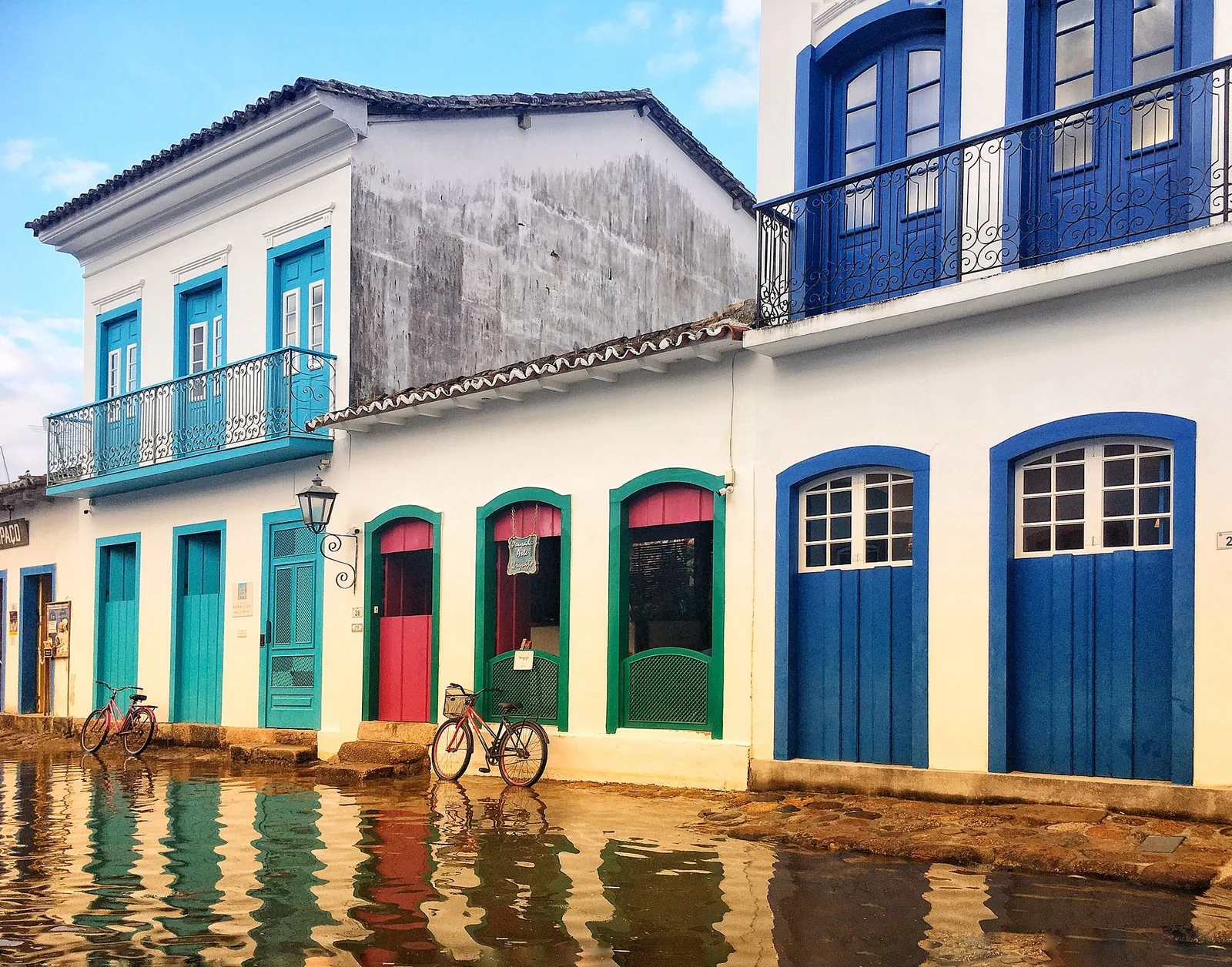
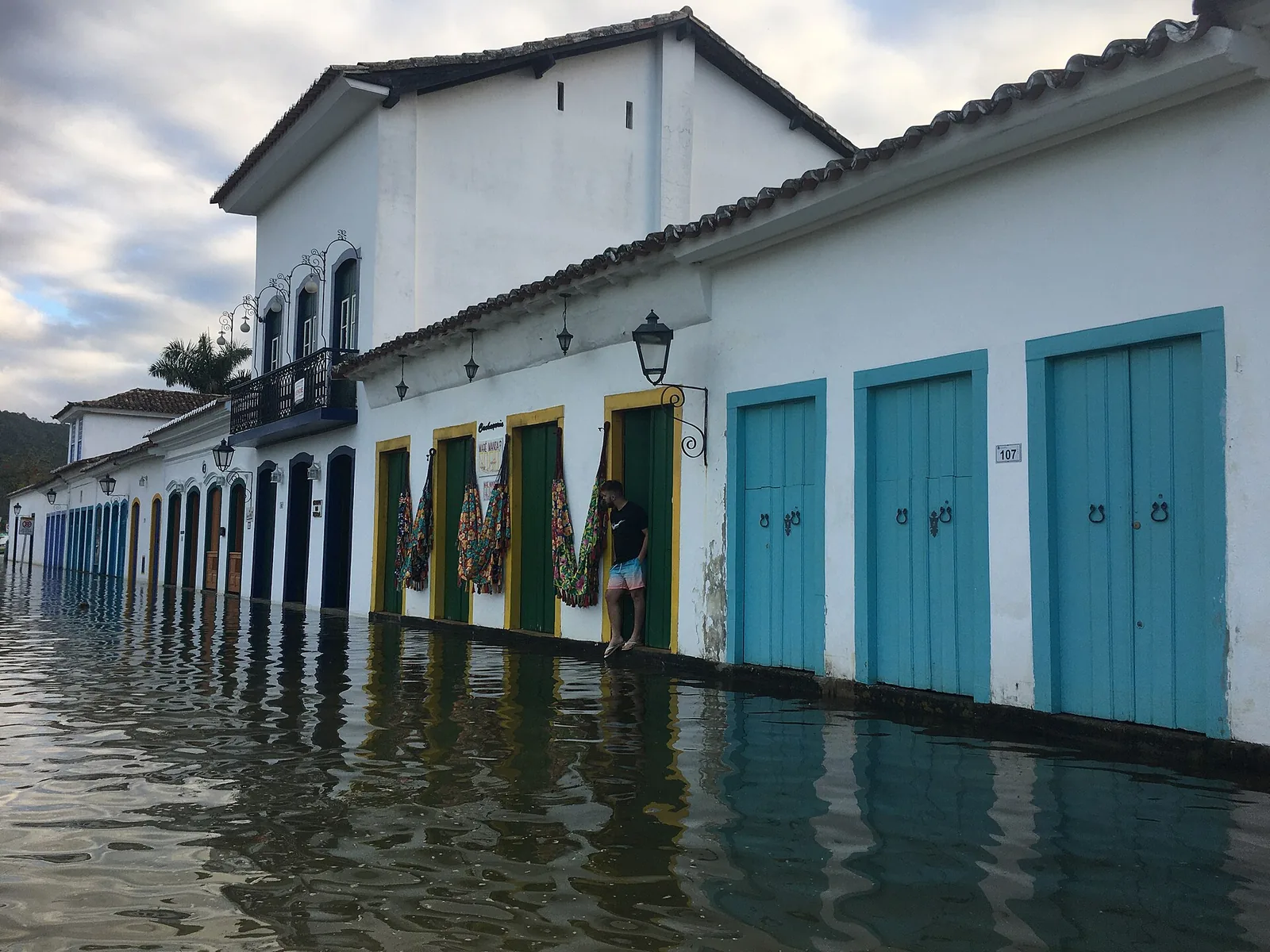
There is a moment, walking the centre of Paraty at dusk, when the town stops being a destination and becomes a kind of argument. The streets are not straight. The stones underfoot — great rounded cobbles the locals call pé-de-moleque, urchin's foot — are deliberately uneven, so that the spring tides can flood up through them and wash the lanes clean before draining back to the bay. The walls are lime-white, the window frames and doors painted in a few sober colours, and almost nothing is taller than two storeys. It does not announce itself. And yet you understand, standing there, that you are looking at one of the most complete colonial towns in the Americas, a place that has changed less in two hundred years than most cities change in twenty.
That completeness is not an accident, and it is not quite preservation in the museum sense either. Paraty survives because, for a long stretch of the nineteenth century, the world simply stopped needing it. The gold that built it found another road; the coffee that might have rebuilt it went elsewhere; the railways passed it by. The town was left alone with its churches and its tides, too poor to modernise and too far from anywhere to bother knocking down. By the time anyone thought to value it, the valuing was easy — there was nothing to undo.
This piece is about Paraty and about the wider family of towns it belongs to: the baroque hill towns of Minas Gerais, the painters' city of Olinda, the Pelourinho of Salvador, the river port of São Luís, the quiet gold town of Goiás. Together they tell a single story — of gold, faith and forced labour, of sudden wealth and slow decline — and that story runs, quite literally, through the mountains behind the chalet. If you are staying with us above the Bay of Paraty, you are not near Brazil's colonial heritage. You are standing at the start of it.
Paraty: the coastal jewel
Begin where you are. Paraty was founded as a parish in the seventeenth century by Portuguese settlers on land long known to the Guaianá people, and for its first decades it was a modest fishing and farming settlement on a sheltered bay. What transformed it was the discovery, in the 1690s, of staggering quantities of gold in the interior mountains of what is now Minas Gerais. Paraty had the rare advantage of a protected harbour at the foot of the only practical mountain pass to the goldfields. Almost overnight it became the place where the wealth of an empire reached the sea.
For roughly a century the town was a true port of the Portuguese crown — gold and, later, diamonds came down the mountain by mule; sugar, cachaça, tools and enslaved Africans went up. The merchants who handled this traffic built the houses and the churches you walk past today. Money has a way of leaving its handwriting on a place, and Paraty's handwriting is here in the thickness of the walls and the number of churches for so small a town.
What to see in the historic centre
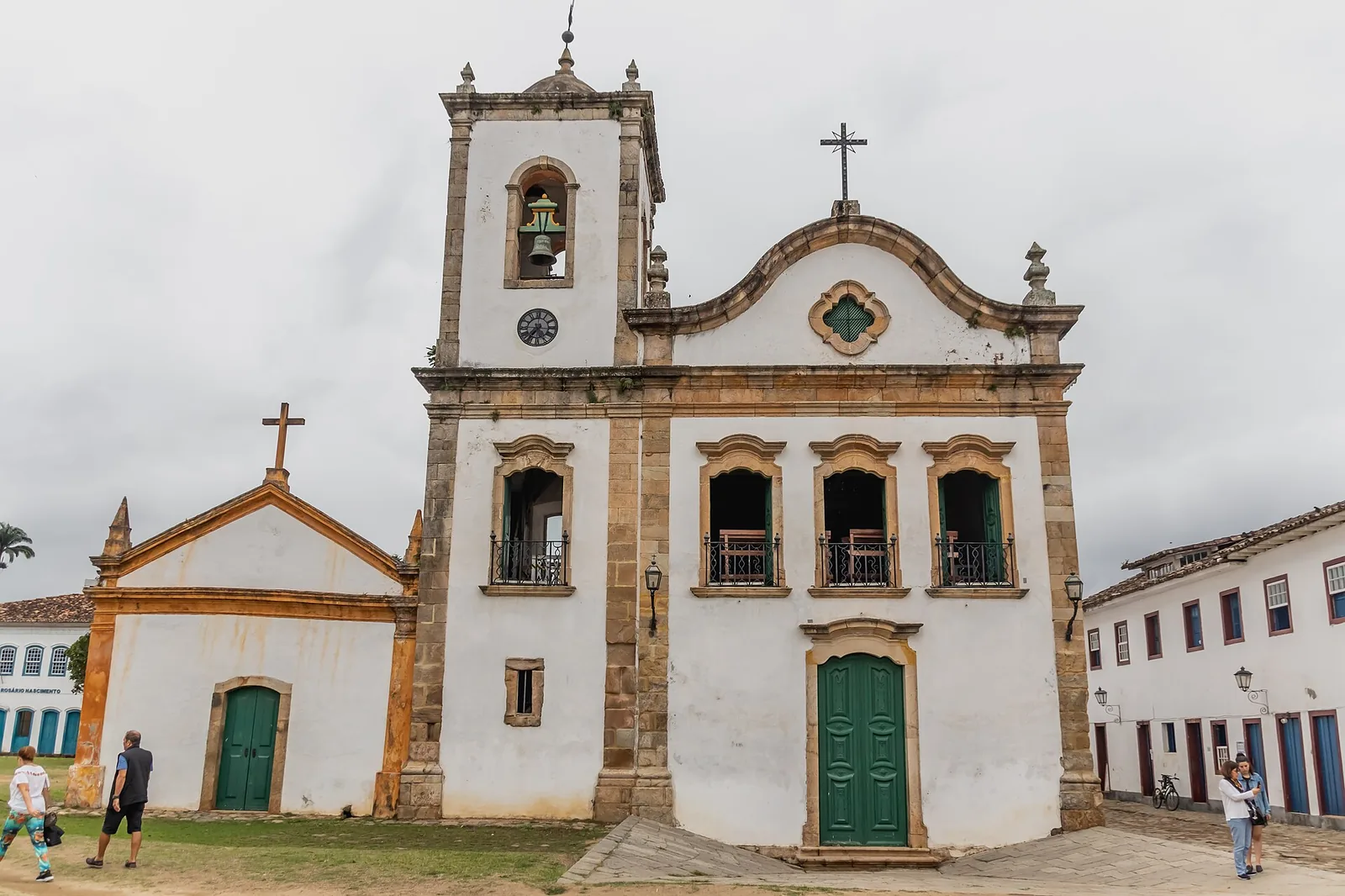
The centre is small enough to cross in twenty minutes and rewarding enough to spend two days in. The four colonial churches reward unhurried looking. The oldest, the Igreja de Santa Rita de Cássia, stands almost on the waterline, its modest baroque front facing the boats — it is the building everyone photographs, and for once the cliché is earned. The grander Matriz de Nossa Senhora dos Remédios anchors the main square, and the small Igreja de Nossa Senhora do Rosário was historically the church of the town's enslaved and freed Black population, a reminder that the elegance around you was built on bondage. We've written a fuller walking route in our guide to Paraty's historic centre, which is the right place to start if you want street names and opening hours rather than mood.
A few honest, practical notes, because the centre has its quirks. Go early or late; the cruise and day-tour groups arrive late morning and the lanes can fill. Wear shoes with a real sole — the famous cobbles are beautiful and genuinely ankle-turning, and after rain they are slick. And do not be surprised, on a high tide near the full moon, to find the streets ankle-deep in seawater; this is not a flood, it is the town working exactly as designed, and the reflections of the white walls in the standing water are, briefly, the loveliest thing in Brazil. For more on the rhythm of the seasons, our note on the best time to visit Paraty is worth a read before you fix dates.
Paraty also keeps its calendar of living tradition, which matters more than any single monument. The Festa do Divino Espírito Santo, with its processions and folk music, fills the streets around Pentecost. In August the town becomes, improbably, one of the literary capitals of the Portuguese-speaking world during FLIP, the Festa Literária Internacional de Paraty, when writers and readers take over the same churches and squares. These are not invented for tourists; they are the town's own life, and you are welcome in it. You can read more about the calendar in our note on FLIP and the town's festivals.
What the streets are actually made of
It pays to look down. Paraty's layout is not the haphazard tangle it first seems. The streets run on a deliberate grid, oriented so that the dominant lines point toward the bay and the four churches sit at the corners of the social order — one for the white merchant elite, one for the Portuguese crown, one for freed and enslaved Black townspeople, one for the brotherhoods. The cobbles themselves were ballast, brought in the holds of ships that arrived empty to carry gold away, then laid by enslaved labourers in the irregular, deliberately drainage-friendly pattern. Knowing this turns a pretty street into a document. The town was not designed to charm; it was designed to work, and the charm is the residue of a machine that has stopped running. That, more than any single monument, is the thing to feel as you walk it.
Paraty was not built to be looked at. It was built to move gold — and the looking came later, once the gold ran out and the town was simply, quietly forgotten.
Paraty's UNESCO listing, and why it is unusual
In 2019, UNESCO inscribed Paraty on its World Heritage List — but not on the terms most people expect. The listing is not 'the colonial town of Paraty'. It is 'Paraty and Ilha Grande – Culture and Biodiversity', and it is a mixed site, recognised for both its cultural and its natural value at once. It was the first mixed site in Brazil, and that combination is the key to understanding the place. UNESCO did not separate the white churches from the green mountains and the blue bay. It treated them as one landscape, because historically they were one: the forest that the gold road climbed, the harbour that the gold left from, and the town that the gold built are a single human-and-natural story.
The inscribed property is what conservationists call a serial site — six component parts rather than one boundary. These include the historic centre of Paraty itself and the dramatic headland of the Morro da Vila Velha, together with four protected natural areas: the Serra da Bocaina National Park, the Cairuçu environmental protection area, the Ilha Grande State Park, and the Praia do Sul Biological Reserve. Taken together they cover a vast stretch of coast, mountain and island. What this means for the visitor is simple and rather wonderful: the World Heritage Site is not a building you queue to enter. It is the whole world around you for several days — the streets, the bay you sail across, the forest you walk into, the island you visit on a day trip to Ilha Grande. You are living inside it the entire time.
The language of colonial architecture
Before going inland, it helps to learn a little of the visual grammar, because it repeats across every town in this piece and recognising it deepens the pleasure enormously. Portuguese colonial building in Brazil is, at its core, a simple and adaptable language. Walls are thick, built of stone or rammed earth and finished in white lime wash, which reflects heat and was cheap to renew. Doors and windows are framed in a single contrasting colour — ochre, indigo, oxblood, green — and that framing, against the white, is most of what gives these towns their look. Roofs are low-pitched and tiled in curved terracotta, the tiles traditionally shaped, it is said, over the thigh. Upper floors, where they exist, often carry a wooden balcony or a row of shuttered windows.
On the grander buildings and especially the churches, this plain shell becomes a stage for the baroque: carved stone portals, bell-towers, and interiors that explode into gilded woodwork and painted ceilings. The contrast is deliberate and very Brazilian — restraint outside, rapture within. The other element to watch for, particularly in the northeast, is the azulejo, the blue-and-white glazed tile imported from Portugal and used to sheathe whole walls in cool, narrative patterns. Once you can read these few elements — the lime wash, the coloured frames, the curved tiles, the gilded interiors, the tiles — every town in Brazil opens up, and you stop seeing 'old buildings' and start seeing a single tradition working itself out across two thousand kilometres of coast.
Why these towns exist: the gold cycle
To understand why a fishing village became a stone town, and why the same baroque grammar then erupts across the mountains inland, you have to understand the Brazilian gold cycle. In the last years of the seventeenth century, prospectors pushing into the highlands of the interior struck gold in quantities the modern world had not seen. The region took its name from the find: Minas Gerais, the General Mines. By the middle of the eighteenth century the gold extracted from these mountains is reckoned to have made up a very large share of the world's production, a flood of metal that filled the treasuries of Lisbon and bankrolled palaces and churches on two continents.
Gold does strange things to a landscape. Towns appeared where there had been forest. The mining settlement of Vila Rica — later renamed Ouro Preto, 'Black Gold', for the dark, iron-stained ore of the area — swelled at its height to a population larger than many European capitals of the day. With the wealth came the Church, and with the Church came the brotherhoods, lay religious societies that competed to build the most magnificent house of God. The result is one of the densest concentrations of baroque architecture anywhere on earth, financed by gold and, it must be said plainly, built by the labour of enslaved Africans and their descendants, who mined the metal, cut the stone and carried the loads.
All of that wealth had to reach the sea, and the road it took ran to Paraty. The connection is not metaphorical. It is a road you can stand on.
The Caminho do Ouro: the road that links it all
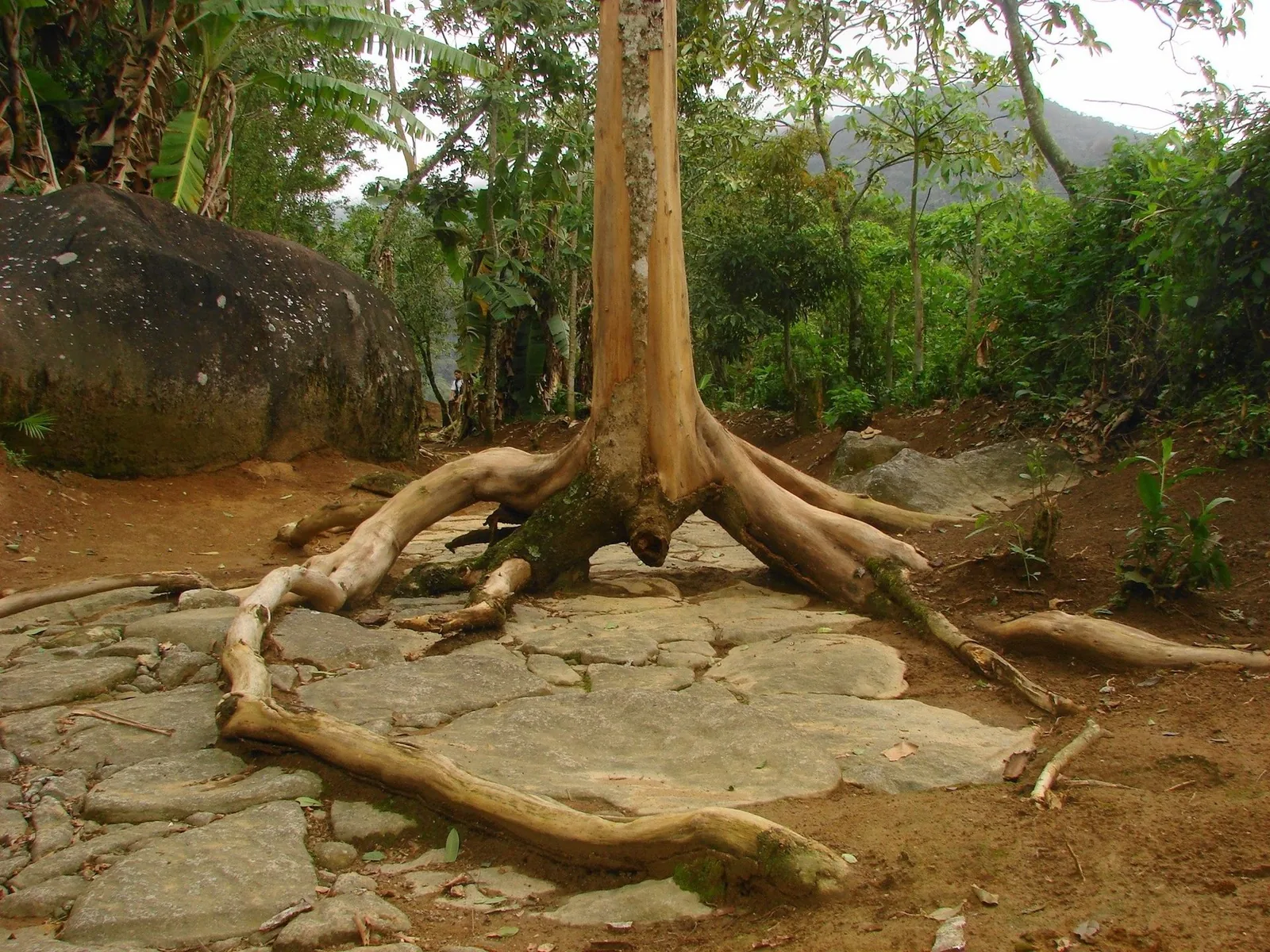
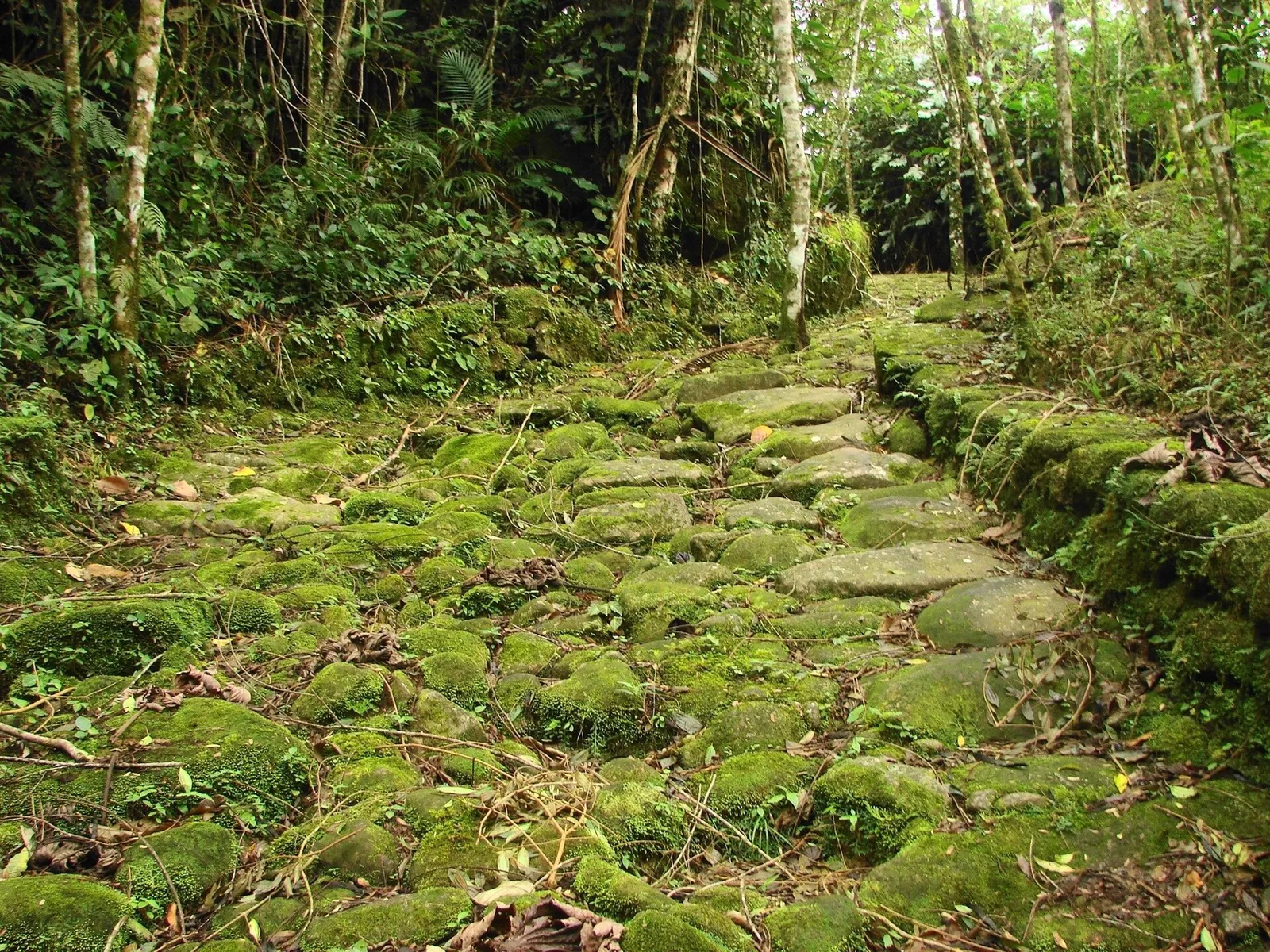
The Caminho do Ouro, the Gold Trail, was the colonial highway that carried the output of the mines down to the coast. In its full extent the network of royal roads, the Estrada Real, ran for well over a thousand kilometres, linking the diamond town of Diamantina and the gold capital of Ouro Preto, through Tiradentes and São João del-Rei, and over the Serra do Mar to the port of Paraty. In the steepest stretches it was paved with large fitted stones to keep the mule trains from sliding in the rain — engineering of real ambition, laid by enslaved hands, much of it still in place.
You can walk a restored section of it in the hills directly behind town, where the old paving climbs through Atlantic forest exactly as the mule drivers found it. It is a short, steep, atmospheric hike, often combined with a swim at a forest waterfall, and it is the single best way to feel the physical connection between this coast and the baroque towns inland. We've laid out the route, the history and the practicalities in our guide to the Gold Trail, the Caminho do Ouro. Standing on those wet stones, with the forest dripping around you and the bay glittering far below, the whole heritage journey suddenly makes sense as one thing rather than a list of towns.
It is also worth pausing on what the road carried in both directions. Up went tools, salt, manioc and the cachaça for which Paraty became famous — the town's sugar mills and distilleries supplied the miners, and that tradition of small-batch sugarcane spirit survives today in the family cachaça distilleries in the hills. Down came the gold, of course. But the road also carried people, ideas, music and faith, and that is why the towns at either end feel like cousins.
Ouro Preto and the gold towns of Minas Gerais
If Paraty is where the gold reached the sea, Ouro Preto is where it came out of the ground, and the two towns are the bookends of the same century. Ouro Preto was the capital of the province of Minas Gerais from 1720 until 1897, the political and artistic heart of the gold country, and in 1980 it became the first place in Brazil to be inscribed on the UNESCO World Heritage List. It deserves the distinction. The town pours down its steep valley in a cascade of red-tiled roofs and stone churches, and the walking is genuinely punishing — these are some of the steepest streets you will ever climb — but every rise delivers another baroque façade or a sudden view across the rooftops to the mountains beyond.
The churches are the reason to come. Where Paraty is restrained, the Minas baroque is exuberant, even theatrical: gilded interiors, painted ceilings that seem to open onto heaven, and stonework of extraordinary delicacy. The two names you will hear repeatedly are Aleijadinho, the sculptor, and Mestre Ataíde, the painter whose luminous ceiling in the church of São Francisco de Assis is one of the glories of the town.
Aleijadinho, the genius of the Brazilian baroque
Antônio Francisco Lisboa — known to history as Aleijadinho, 'the little cripple' — was the son of a Portuguese architect and an enslaved African woman, and he became the defining artist of colonial Brazil. In later life he suffered a degenerative disease, probably leprosy, that cost him the use of his fingers; tradition holds that he had his chisel and mallet strapped to his forearms and went on carving behind screens, away from staring eyes. Whatever the precise truth of that, the work is undeniable.
His masterpiece is not in Ouro Preto itself but a short distance away, at the sanctuary of Bom Jesus de Matosinhos in the town of Congonhas. There, lining the parapets of a grand baroque stairway, stand his Twelve Prophets, carved from local soapstone between roughly 1800 and 1805. They are larger than life, each one caught mid-gesture, mid-speech, with an expressive force that feels startlingly modern. The sanctuary and its prophets were given World Heritage status in their own right in 1985. If you make it into Minas, Congonhas is worth the detour for these figures alone.
Tiradentes, São João del-Rei and Mariana
Ouro Preto is the famous one, but the smaller towns nearby are, for many travellers, more pleasurable. Tiradentes is a jewel-box of a place, its low colonial houses and single grand church set against a green ridge, named for the dentist-turned-revolutionary who became a national martyr. It is small, walkable and full of good cooking, and it makes an easier base than steep Ouro Preto. Neighbouring São João del-Rei, founded in 1713, is a working town as well as a historic one, with two great churches and the rare survival of a regular steam train that still runs between the two on weekends. Mariana, the oldest town in the state and for a time its capital, sits close to Ouro Preto and completes the circuit. Together these towns are the heart of any heritage route through Minas, and they reward slow, unhurried days far more than a checklist sprint.
The northeast: Olinda, Salvador and the Recôncavo
The gold cycle is one strand of Brazil's colonial story, but it is not the oldest. The first wealth was sugar, and the first great colonial towns rose far to the north, on the coast of Pernambuco and Bahia, more than a century before the mines of Minas were found. If your journey can reach that far, the northeast offers a different and in some ways deeper layer of the same heritage.
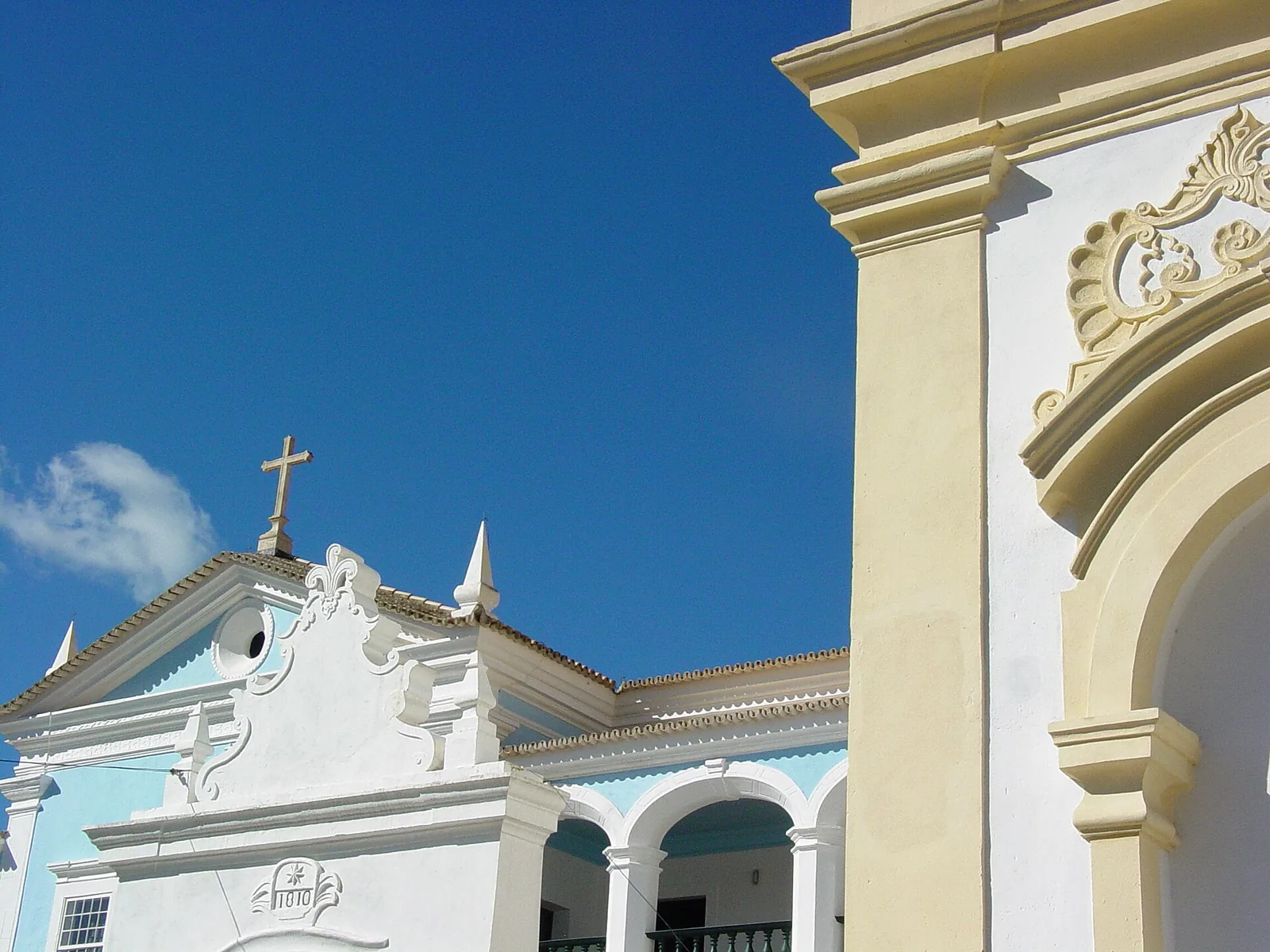
Olinda, founded in the sixteenth century on a string of hills above the sea near Recife, is the painters' town: a tumble of pastel houses, baroque churches and walled gardens, with views down to the ocean from almost every corner. Its historic centre was inscribed by UNESCO in 1982. Sacked by the Dutch and rebuilt in the eighteenth century, it has an artistic, slightly bohemian air, and its Carnival — danced through the steep streets behind giant papier-mâché figures — is among the most joyful in Brazil.
Salvador, the first capital of colonial Brazil, holds the heritage core known as the Pelourinho, listed in 1985. The name means 'pillory', the post where enslaved people were once punished, and the district does not let you forget that the elegance of its tiled churches and pastel mansions was inseparable from the largest forced migration in human history. Salvador is the most powerfully Afro-Brazilian city in the country, and its colonial centre is best understood not as a pretty backdrop but as the living heart of that culture, in its music, its food and its faith. The smaller towns of the Recôncavo, the sugar lands around the Bay of All Saints, carry the same architectural grammar in quieter form.
São Luís and Goiás: the quieter corners
Two further towns round out the picture for travellers who want to go beyond the obvious. São Luís, capital of the northern state of Maranhão, was founded by the French and developed by the Portuguese, and its historic centre — listed by UNESCO in 1997 — is famous for the azulejos, the blue-and-white glazed tiles that sheathe whole façades against the equatorial sun. It is a more melancholy, atmospheric place than the polished hill towns, and the better for it.
The town of Goiás, often called Goiás Velho to distinguish it from the modern state capital, was another gold town, the colonial capital of its region, set deep in the interior. Inscribed in 2001, it is small, hot and beautifully intact, with cobbled streets and simple whitewashed churches, and it sees a fraction of the visitors of Ouro Preto. For travellers who have already done the famous towns and want the same heritage without the crowds, it is a quiet revelation.
Reading the towns honestly: the labour behind the beauty
It would be a kind of dishonesty to write about these towns purely as beautiful objects, and the towns themselves increasingly refuse to let you. Every church, every paved street, every merchant's house in this piece was built on the labour of enslaved Africans and their Brazilian-born descendants. They mined the gold and the diamonds, cut and carried the stone, fired the tiles, raised the walls and, in many cases, carved the very ornament we admire. Aleijadinho himself was the son of an enslaved African woman. Brazil received more enslaved people than any other country in the Americas, and the colonial towns are the physical record of that economy as much as they are works of art.
The good news is that this history is no longer hidden. In Paraty, the small Igreja de Nossa Senhora do Rosário e São Benedito was the church of the town's Black population and is the right place to begin thinking about it. In Salvador, the whole Pelourinho — named, remember, for the post where enslaved people were punished — has been reclaimed as the beating heart of Afro-Brazilian culture, in its music, its Candomblé faith, its capoeira and its food. Across Minas, lay brotherhoods of Black Catholics financed some of the most beautiful churches in the country, and their stories are now told alongside the white elite's. To travel these towns well is to hold both things at once: genuine awe at the artistry, and a clear sight of the human cost. The towns are richer, not poorer, for being seen whole.
The cuisine of the heritage trail
A heritage journey is also, very pleasantly, an eating journey, because each region built a distinct cuisine on the same colonial foundation. On the coast at Paraty the food is of the sea and the forest — fish and shrimp cooked simply, hearts of palm, manioc in a dozen forms, and the cachaça that the town's mills have made for three centuries, best understood over an unhurried meal at one of the seafood houses near the harbour. We've gathered the lay of the land in our note on eating in Paraty.
Inland, the cooking changes completely. Mineiro food — the cuisine of Minas Gerais — is one of the great regional kitchens of Brazil: slow-cooked pork, black beans and the smoky tutu, leafy couve, crumbly cornbread, and the famous cheeses and cachaças of the mountain farms, all served traditionally from a wood stove. It is hearty, generous, rural food, the opposite of the light coastal table, and eating it in a colonial town with the church bells ringing is half the reason to make the journey inland. Up in the northeast the palette shifts again to the African-inflected cooking of Bahia — dendê palm oil, coconut, dried shrimp, the moqueca stews and the street-corner acarajé. Three colonial cuisines, one colonial history; tasting your way through them is as good a thread to follow as any cathedral.
How to weave a heritage route
The temptation, faced with so many towns, is to try to see them all in one trip. Resist it. Brazil is vast, the distances between these places are real, and the pleasure of a colonial town is the pleasure of slowness — of sitting in a square at the end of the day, of letting a church reveal itself, of eating well and walking off the meal on uneven stones. A heritage journey through Brazil is better conceived as two or three deep visits than ten shallow ones.
A natural structure, if you are starting on the Costa Verde, looks something like this:
- Base on the coast first. Begin in Paraty. Walk the historic centre, hike a stretch of the Caminho do Ouro, and let the place set the tone. Two or three nights is the minimum; the bay, the islands and the forest will tempt you to stay longer, and you should let them. Our Paraty itineraries show how to balance heritage, beaches and boat days.
- Then go inland to Minas. From the coast, head into the mountains to the baroque towns. Tiradentes and São João del-Rei make a gentle, beautiful pairing; add Ouro Preto and Congonhas if you want the full baroque drama. Allow three or four nights and accept that the driving is part of the experience — the road climbs through the same forest the gold once descended.
- Add the northeast as its own trip. Olinda, Salvador and São Luís belong to a different region and a different climate, and they reward a dedicated stretch rather than a tacked-on flight. Treat them as the second half of a longer Brazilian journey, or as a reason to return.
A few principles hold wherever you go. Visit the churches in the morning, when the light comes through the eastern windows and the heat is bearable. Eat where the locals eat — the food of Minas, all pork, beans, cheese and cornmeal, is one of the great regional cuisines of Brazil. Hire a local guide for at least one town; the baroque is dense with meaning that is invisible to the untrained eye, and a good guide turns pretty churches into a coherent story. And build in empty time. The towns are not exhibits to be processed; they are places to be in.
Staying above it all
For the coastal chapter of any heritage journey, the chalet makes an unusually good base. We sit roughly four hundred metres above the Bay of Paraty, with the historic centre, the start of the Gold Trail and the boat quays all within easy reach below, and the Atlantic Forest of the Serra rising directly behind. You can spend the morning among the white churches of the town, the afternoon walking the old stone road, and the evening on the terrace watching the light fade over the same bay the gold once crossed. There is something fitting about reading the history of these towns from a hillside that the history itself ran through. You can see the layout, the views and the practicalities on the page for the chalet, and our wider guide to exploring Paraty gathers everything in one place.
If you are drawn to the heritage route and would like help shaping it — the order of the towns, the drives, the time to give each place, the season to come — that is exactly the kind of planning we enjoy. Tell us what moves you, the baroque churches or the quiet streets or the road that links them, and we will help you build a journey that earns its slowness. You will find us, and a real person to answer, on the contact page. The towns have waited three hundred years. They will reward you for arriving unhurried.
Frequently asked questions
Paraty on the Costa Verde, Ouro Preto, Tiradentes, São João del-Rei and Mariana in Minas Gerais, plus Olinda, the Pelourinho district of Salvador, the historic centre of São Luís and the town of Goiás are among the finest. Most are protected as UNESCO World Heritage Sites and carry the same Portuguese-baroque language of whitewashed walls, stone churches and steep cobbled streets.
Yes. In 2019 UNESCO inscribed 'Paraty and Ilha Grande – Culture and Biodiversity' as a mixed cultural and natural site, the first of its kind in Brazil. The listing recognises both the colonial town and the Atlantic Forest and islands around it as a single landscape of outstanding value.
The Caminho do Ouro, or Gold Trail, was the stone-paved colonial road that carried gold and diamonds down from the mines of Minas Gerais to the port of Paraty, from where it was shipped to Rio de Janeiro and on to Portugal. Restored sections can still be walked in the hills behind the town.
Antônio Francisco Lisboa, known as Aleijadinho ('the little cripple'), was the great sculptor and architect of the Brazilian baroque. His soapstone Twelve Prophets at the sanctuary of Bom Jesus de Matosinhos in Congonhas, carved between about 1800 and 1805, are among the masterpieces of the form and are protected by UNESCO.
There is no direct line. Most travellers drive — Tiradentes and São João del-Rei are roughly a long day's drive inland from Paraty, with Ouro Preto a little further on. It is more rewarding as part of an open-jawed trip than a day excursion; we are glad to help plan the route.
Paraty is a coastal merchant town: low, white, restrained, built for trade and tides. The Minas towns are inland mining capitals that grew suddenly rich, so their churches are higher, more theatrical and densely carved. Both are Portuguese colonial, but one whispers and the other sings.
The drier, cooler months from roughly April to September are most comfortable for walking cobbled streets and hill towns. Religious festivals such as the Festa do Divino in Paraty and Holy Week in Ouro Preto are extraordinary but busy; if you want quiet streets, travel just outside them.