In this guide
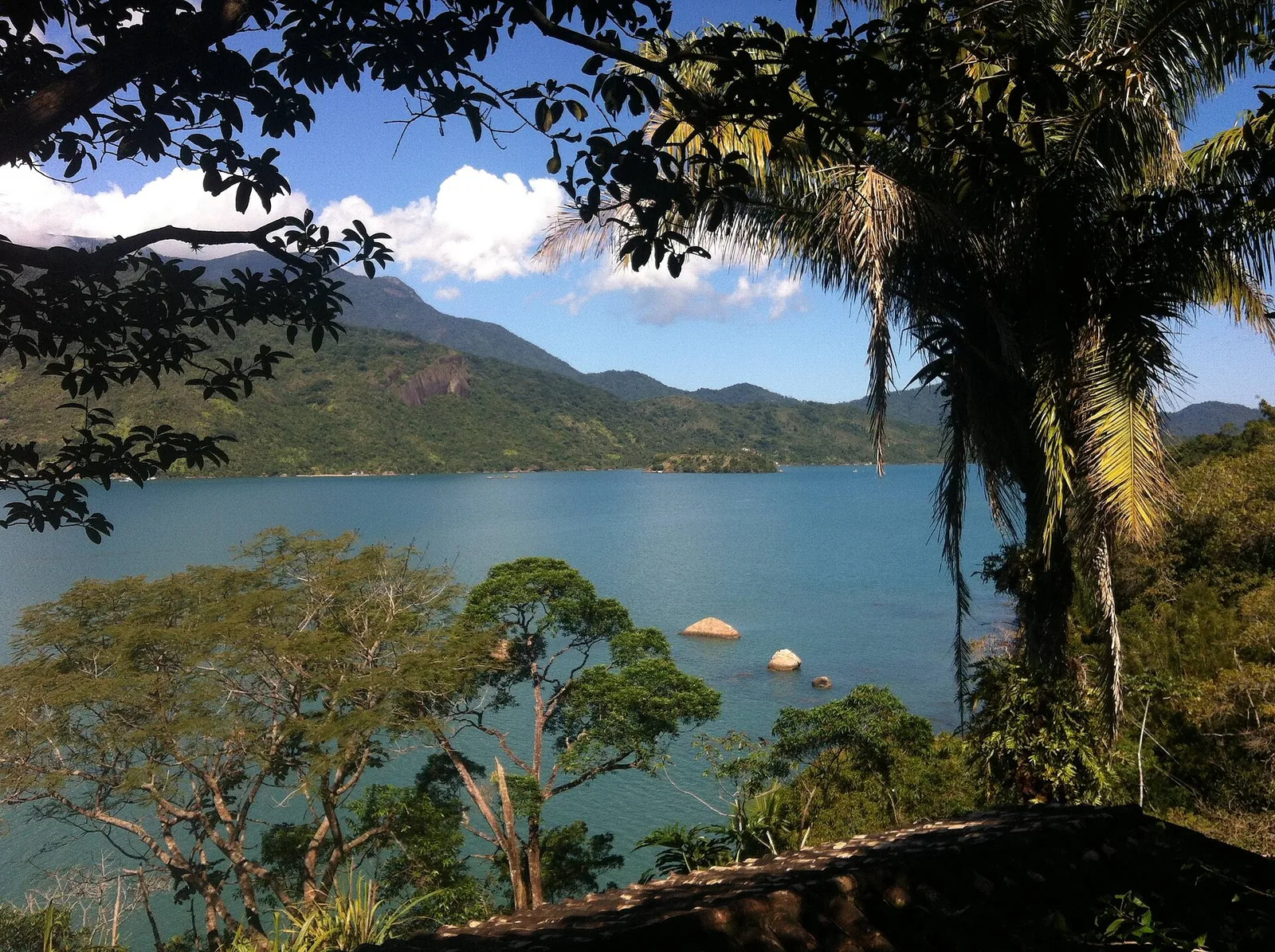
There is a particular hour in Paraty, late in the afternoon, when the heat lifts off the water and the mountains behind the town turn from green to a deep blue-grey. If you are down in the historic centre you will hear it before you see it: the streets empty, the swifts start working the sky, and somewhere a kitchen begins the evening. If you are up on the hillside, four hundred metres above the bay, you get the whole thing at once — the light going soft, the three arms of water flattening to glass, and the forest behind you exhaling after the day's rain. That hour is the argument for a slow trip here in a single frame. You cannot rush it, and it asks nothing of you except that you stop and watch.
Most people arrive in Paraty with a list. There are waterfalls to find, islands to reach, a colonial town to walk, cachaça to taste, and a coastline that keeps handing you one more beach. All of it is worth doing, and we will get to it. But a growing number of guests come for the opposite reason. They want to do less, and do it well. They have read that a Paraty wellness retreat is one of the better ways to reset in Brazil, and they are right — not because the town is full of clinics and treatment menus, but because the ingredients of a genuine reset are already here and free. Forest. Warm water. Quiet. A pace that has not changed much in a couple of hundred years.
This guide is about how to use those ingredients on purpose. It covers the honest case for slowing down on a hillside rather than a beach, what yoga on a deck and an in-villa massage actually look like here, where to walk in the Mata Atlântica without a guide, how to swim in cold forest pools and warm sea in the same day, and how to switch your phone off without feeling like you have lost a limb. Throughout, I will point to the practical trade-offs — the seasons, the drives, the days that are worth it and the ones that are not — because a good rest is a planned one, and false expectations are the fastest way to spoil a quiet week.
.jpg)
What a Paraty wellness retreat actually means
Let us clear up the phrase first, because it carries some baggage. In a lot of the world a wellness retreat means a fixed programme in a dedicated property: set class times, a prescribed menu, a treatment schedule, and a group you did not choose. That model exists in Brazil and some people love it. Paraty is not really that. What the town offers instead is the raw material for a restorative trip that you assemble yourself, at whatever intensity you like.
The setting does the heavy lifting. Paraty sits at the southern edge of Rio de Janeiro state, wedged between the Bay of Ilha Grande and the wall of the Serra da Bocaina, one of the largest surviving blocks of Atlantic Forest, or Mata Atlântica, left in Brazil. That geography means you are never more than a few minutes from moving water, deep shade and birdsong. The historic centre is car-free, cobbled and low-slung, which forces a walking pace on everyone. And the local culture is unhurried in a way that is hard to fake — the fishing boats still go out, the cachaça stills still run, and nobody is in a rush to seat you.
So when we talk about wellness here, we mean something closer to slow travel with intent. You can layer on the formal pieces — a yoga teacher on the deck at dawn, a massage therapist in the afternoon, a breathing session before dinner — and they are easy to arrange. But the frame around all of it is the pace, the water and the trees. Wellness here is not a room you book for an hour; it is the pace the hillside sets and you simply agree to. If you take nothing else from this guide, take that: the treatments are optional, the setting is not.
Who this kind of trip suits
Short answer: almost everyone, which is unusual. A couple after a honeymoon that is actually restful rather than packed will find it here — we go deeper on that in our Paraty honeymoon guide. Friends travelling together can split their days without friction, some walking, some by the pool. Families get gentle beaches, a pool that keeps children happy for hours and short forest walks that do not turn into a march; there is more on that in our family guide to Paraty. And solo travellers, who sometimes struggle to justify a quiet week, find Paraty safe, walkable and easy to be alone in without feeling isolated. The common thread is that a private base lets each person move at their own speed, which is the real luxury.
Wellness here is not a room you book for an hour; it is the pace the hillside sets and you simply agree to.
The case for staying above the bay
Here is a decision worth making deliberately, because it shapes the whole trip: beach level or hillside. Most visitors default to a room near the water, on the logic that closer is better. For a restful stay I would push back on that, and not for the obvious reason.
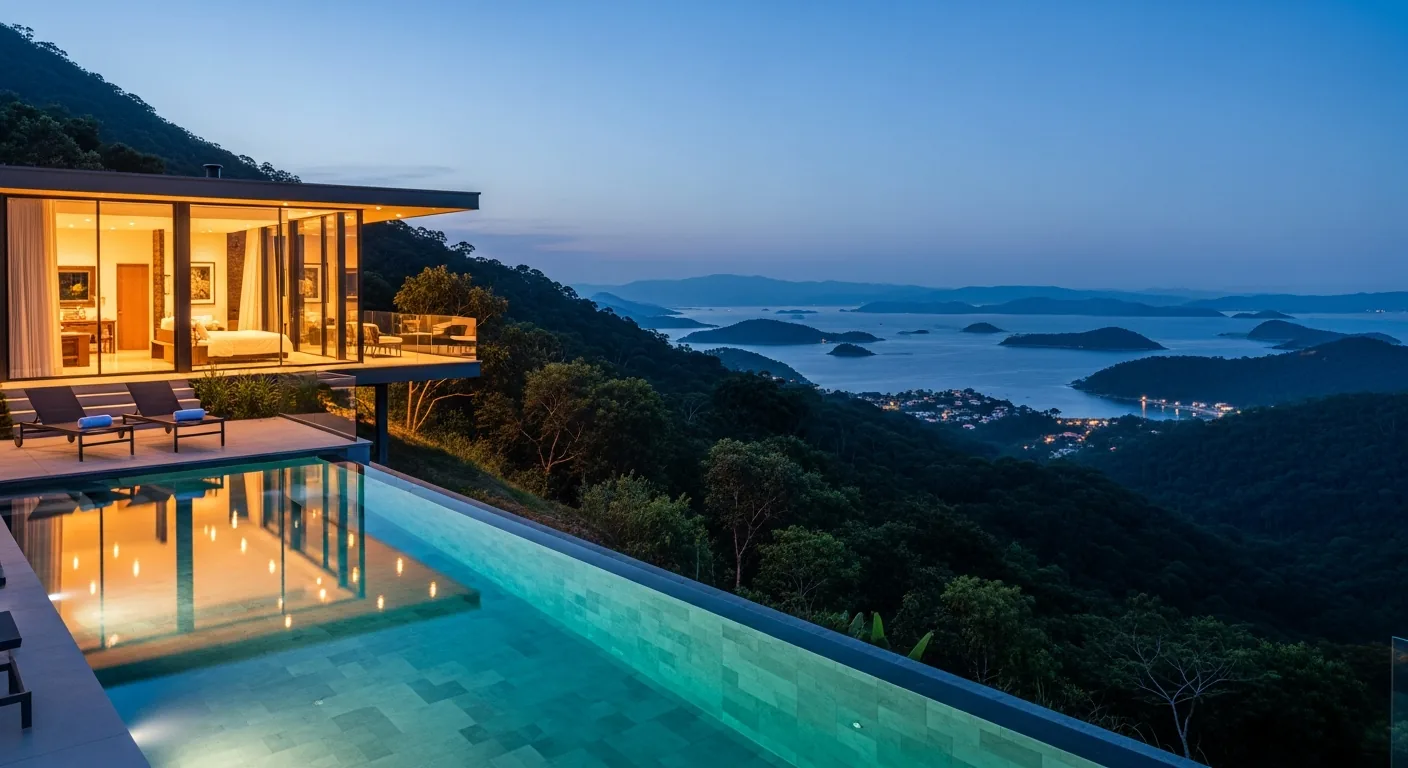
The beaches around Paraty town are lovely but they are also where everything happens — the boats load, the restaurants fill, the day-trippers arrive by bus, and in high season the calm you came for can be in short supply along the shore. A hillside base flips the equation. From four hundred metres up, the noise falls away, the temperature drops a couple of degrees, and the view stops being a strip of sand and becomes the entire bay. The chalet this guide is written from sits on exactly that kind of slope, a short drive above the historic centre, with an infinity pool that reads straight out to a three-way view of Paraty, Angra dos Reis and Ilha Grande. You can be in town in minutes when you want the streets, and back in your own quiet when you have had enough of them. That combination — near but above — is the single most restful arrangement I know here. Our chalet page lays out the layout and the deck in detail.
The trade-off is honest and worth naming. A hillside stay means you drive, or arrange a transfer, to reach the beaches and the boat quay. You are not stepping from your door onto the sand. For some travellers that is a dealbreaker and they should book at beach level with their eyes open. For most, the daily ten-minute descent is a small price for evenings with no crowd, mornings with birdsong instead of engines, and a pool you return to the way other people return to a bar. If your priority is genuine rest, height wins. If your priority is toes-in-the-water convenience, it does not. Decide which you are before you book.

Slow mornings and yoga on the deck
The best hour for a restorative practice in Paraty is the first one after sunrise. The air is cool, the light is coming up over the islands, the town below is still asleep, and the humidity has not yet built into the afternoon heat. A flat deck with a view is all you need, and if you have booked a house with one, you have a better yoga studio than most retreats can offer.
You do not have to be a practitioner to make use of this. Even ten minutes of slow stretching and breathing while the bay lights up does more for a frazzled nervous system than an hour of trying to relax later in the day. If you want structure, independent yoga and movement teachers work throughout the Paraty area and will happily come to a private house for a private or small-group session. Vinyasa, hatha, restorative and yin are all available depending on who is teaching that season, and a few offer breathwork or guided meditation as well. Arrange it a few days ahead — the good teachers are booked, especially in high season — and be clear about your level so the session is pitched right.
A few practical notes for practising outdoors here:
- Go early or late. Between roughly ten in the morning and four in the afternoon the sun is strong and the deck gets hot underfoot. Sunrise and the hour before dusk are the comfortable windows.
- Expect visitors. You are in the forest's territory. Birds, the odd marmoset in the trees, insects at dusk — this is part of it, not an interruption. A light long-sleeved layer helps around sunset when the mosquitoes come out.
- Mind the rain. In the green season a heavy shower can arrive fast and pass just as quickly. A covered corner of the deck lets you keep going or wait it out with a coffee.
- Bring or ask for props. Travelling with a mat is easiest; many teachers carry spares, but confirm when you book.
The infinity pool as a daily ritual
People tend to think of a pool as a nice-to-have, a place to cool down once a day. On a slow trip it becomes something more useful: an anchor. When your days are loose and unstructured, having one fixed pleasure to return to gives the week a shape. Here that anchor is the water, and specifically the way an infinity edge dissolves the line between the pool and the bay beyond it.
The rhythm that guests fall into almost without deciding goes something like this. A swim before breakfast, when the water is coolest and the view is sharpest. A long stretch of doing very little through the middle of the day, in and out of the shallow end, book down, book up. And then the evening swim, the good one, when the light drops and the whole hillside goes quiet and the water holds the last of the warmth. You come back from the beach, from a waterfall, from town, and the pool is the thing that says the outing is over and the rest of the day is yours.
There is a small physiological point buried in this, too. Warm-water immersion in the evening genuinely helps a lot of people sleep, and after a day in the sun and the sea, a slow float before dinner sets you up for the kind of deep, early night that a real reset depends on. You did not come to Paraty to sleep, but sleeping well is half of why you will feel different by the end of the week.
Spa and massage, brought to you
Paraty does not have a strip of big-name day spas, and that is not a shortcoming. What it has is a network of skilled independent therapists — massage, reflexology, some offering aromatherapy or facials with Brazilian botanicals — who travel to where you are staying. For a private stay this is better than a hotel spa, not worse. You do not dress, drive and sit in a waiting room; the treatment comes to the deck or a quiet room, and afterwards you step straight into your own pool or your own bed rather than back into a lobby.
The range is wider than you might expect. Deep tissue and relaxation massage are the staples. Beyond that you will find therapists offering lymphatic drainage, which is popular in Brazil, hot-stone work, couples' sessions where two therapists come together, and the occasional practitioner who brings sound or energy work if that is your thing. Prices are reasonable by international standards and very reasonable compared to a resort spa, particularly for travellers arriving from abroad with dollars or euros.
A few things worth knowing so it goes smoothly:
- Book ahead. Two or three days' notice is usually enough in the shoulder season; in December, January and around FLIP, ask as soon as your dates are fixed.
- Say what you want. Be specific about pressure, focus areas and whether you want quiet or conversation. Language need not be a barrier — many therapists work with international guests — but a clear brief in advance helps.
- Set the scene yourself. The therapist brings the table, oils and often music. You provide the space and the calm. Late afternoon, after a swim and before dinner, is the sweet spot.
- Tip if the work is good. It is appreciated and not assumed.
If you would like help lining up a therapist or a yoga teacher for your dates, that is exactly the sort of thing to raise when you get in touch before your stay — a few messages ahead of time save a lot of scrambling once you have arrived.
Forest bathing in the Mata Atlântica
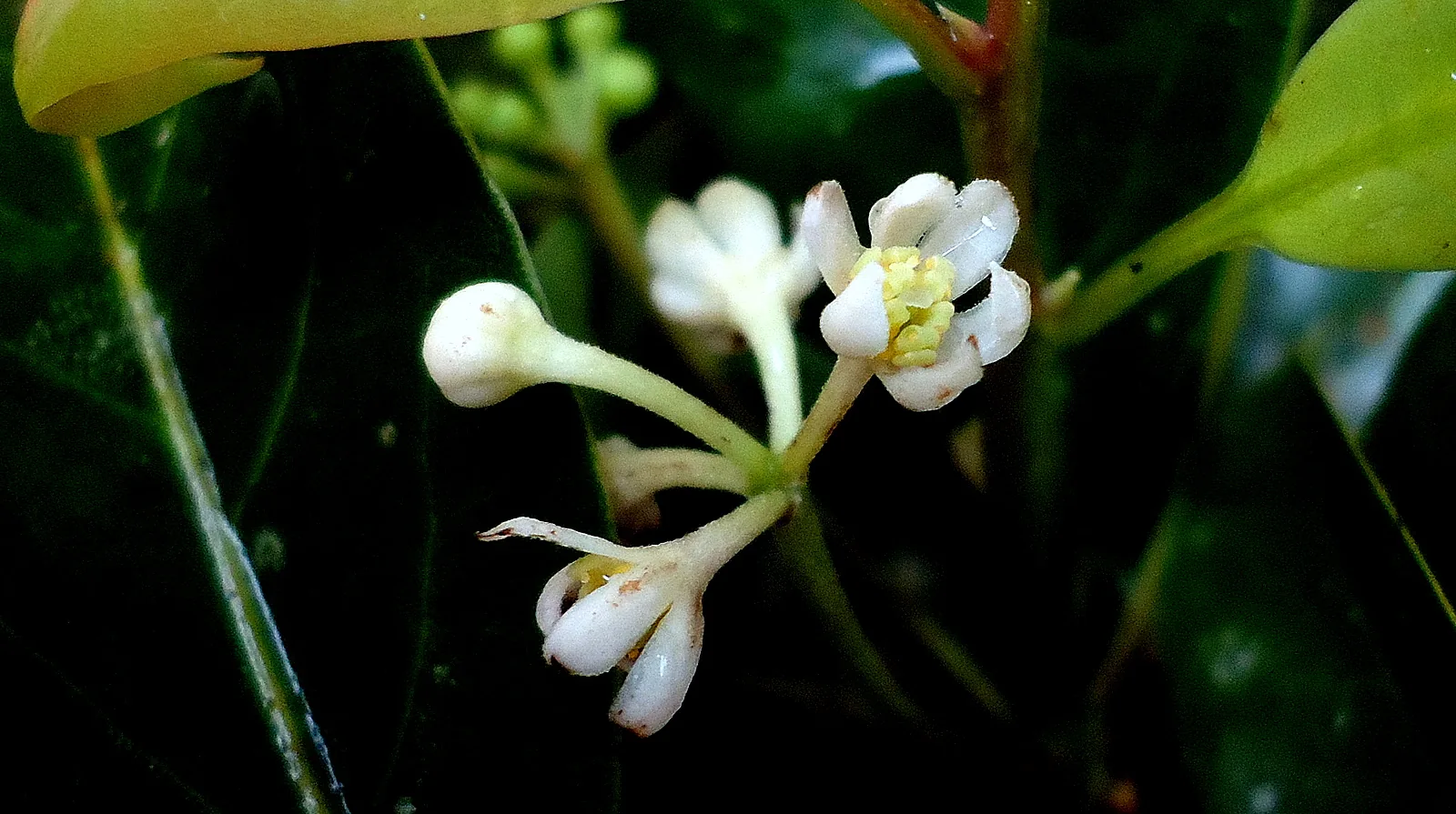
Of everything in this guide, this is the one I would not want you to miss, and it costs nothing. Forest bathing, from the Japanese term shinrin-yoku, is not a hike and not a workout. It is the deliberate practice of spending slow, screen-free time under trees, using your senses rather than counting steps or chasing a summit. The research behind it — lower stress hormones, slower heart rate, a measurable drop in blood pressure — is real, but you do not need the studies to feel it. Twenty unhurried minutes in deep forest does something that twenty minutes anywhere else does not.
Paraty is one of the best places in Brazil to do it, because the Atlantic Forest starts where the town ends. The Serra da Bocaina rises straight behind the coast, and its lower slopes are threaded with quiet trails, streams and small waterfalls. You do not need a guide to sit under the canopy and pay attention. You do need one for the longer, more serious routes into the mountains, and for anything approaching the higher parts of the national park, where getting lost is a genuine risk.
How to do it well
The practice is almost embarrassingly simple, which is the point. Walk in slowly. Stop often. Put the phone away — and up here it will often put itself away, because the signal fades. Notice the temperature change as you go from sun into shade, the sound of water you cannot yet see, the way the light comes down in pieces through the leaves. Touch the bark, smell the wet earth after rain, watch a column of leafcutter ants cross the path. There is no distance to cover and no photo you have to get. If you find a flat rock or a pool, sit and stay a while. That is the whole exercise.
Where to go
For an easy start, the forested lanes and short trails just above and around the town are enough — you can walk out from a hillside base and be under full canopy within minutes. For something with a destination, the streams and cascades on the Serra da Bocaina slopes are ideal, and many are short, well-marked walks rather than expeditions. The old Caminho do Ouro, the Gold Trail, is a beautiful stone-paved route the colonial mule trains used to carry gold down to the port, and a stretch of it makes a gentle, shaded forest walk with real history under your feet. If you want to understand what you are walking through — the birds, the primates, the sheer density of life in this forest — our journal piece on Atlantic Forest wildlife is a good primer to read before you go.

Wild swimming: waterfalls and cold pools
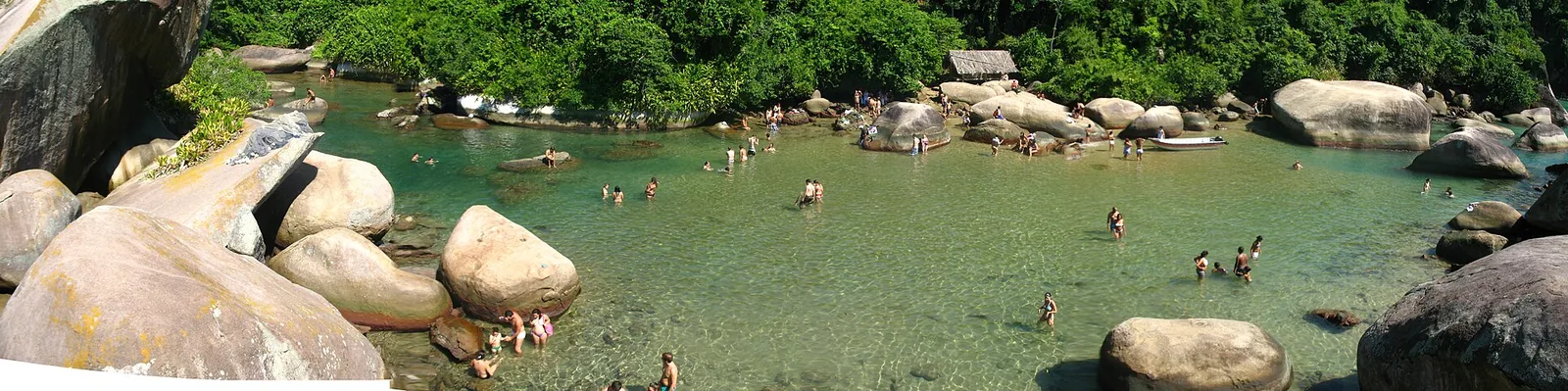
One of the quiet luxuries of a Paraty week is that you can swim in cold, clear forest water in the morning and warm sea in the afternoon. The two do completely different things to a body, and doing both in a day is its own kind of therapy.
The waterfalls are the headline. The Serra da Bocaina sheds a great deal of water, and the slopes above and around Paraty are full of cascades and plunge pools, some a short walk off the road, some deeper in. The water is properly cold, which after the heat of the coast is exactly the shock a tired body wants. A few of the pools have natural rock slides worn smooth over centuries, which are enormous fun and entirely optional. Our dedicated waterfalls guide covers the specific falls, how to reach them and which suit families versus which reward a longer walk, and the broader picture of forest swimming holes is in our guide to natural pools and swimming holes.
A word on cold-water swimming, which has become fashionable for good reason. Immersion in cold water triggers a sharp, clean jolt — faster breathing, a flood of alertness, and, once you are out and warm again, a settled calm that can last for hours. You do not need to make a discipline of it. Wade in slowly, let your breath settle, stay in only as long as feels good, and get warm afterwards. If you have any heart condition, be cautious and sensible; the cold is a real physiological stimulus, not just a nice idea.
Two safety notes that matter more than any of the fun. First, forest rivers rise fast and violently after heavy rain — a pool that is idyllic in the morning can be dangerous by mid-afternoon if a storm has hit upstream. If the water is rising or brown, stay out. Second, wear something on your feet; the rocks are slick and the smooth ones are the slippery ones.
Switching off on purpose: the digital detox
You can rest with your phone in your hand, but not really. A genuine reset needs the low hum of notifications to actually stop, and Paraty is one of the easier places to make that happen — partly by design, partly by accident of geography.
The accident is the signal. On the hillsides and in the forest, mobile coverage is patchy and sometimes absent. The historic centre, car-free and lantern-lit at night, is the kind of place that pulls your eyes up from a screen without you deciding to. The design part is up to you, and I would encourage you to be a little strict about it, because half-measures do not work. A few that do:
- Set an arrival ritual. Send the messages you need to send on the drive in. Then, once you are settled, put the phone on aeroplane mode or in a drawer and agree with whoever you are travelling with when you will next check it — once a day, at a fixed time, is plenty.
- Use a real clock and a real camera if you can. The phone stays away for longer when it is not also your alarm and your only camera.
- Let the view be the entertainment. This sounds glib, but a three-way bay view and a forest change constantly — the light, the boats, the weather rolling in over the islands. It rewards being watched in a way a feed does not.
- Tell people you will be slow to reply. A single message before you disappear buys you a week of peace and stops the low anxiety of feeling unreachable.
The first day is the hard one. By the second most people stop reaching for the pocket that is no longer buzzing, and by the third the quiet has stopped feeling like an absence and started feeling like the point.
.jpg)
Eating well without turning it into a diet
A restorative trip is not a cleanse, and Paraty is emphatically not the place to eat sparingly. But there is a version of eating here that is both a pleasure and genuinely good for you, and it lines up neatly with the local produce.
The coast delivers fish and seafood daily, and the simplest preparations are the best — grilled fish, a moqueca cooked slowly with coconut milk, palm oil and coriander, prawns straight off the boat. The Atlantic Forest and the small farms behind the coast bring an abundance of fruit you may not have met before: jabuticaba, which grows straight off the trunk of the tree, cambuci, native bananas, and more varieties of passionfruit and citrus than you can name. Heart of palm, or palmito, turns up fresh rather than tinned. Eat with the season and you will eat lightly and superbly without trying.
Cooking at your own base is part of the pleasure of a private stay — a morning at the market, an afternoon by the pool, and a slow dinner you made yourself. When you do want to go out, the seafood houses at the harbour end of the old town and the small kitchens tucked into the colonial streets are where to aim; our restaurants guide sorts through them by type and mood. And because it would be strange to write about Paraty and pretend otherwise: the region is one of Brazil's great cachaça areas, and a well-made caipirinha at sunset is not a betrayal of a wellness week. Balance, not abstinence. If you want to understand what is in the glass, the distilleries guide is worth a read, and there is a broader cultural take in our journal on cachaça and caipirinha culture.
Slow days in town and on the water
Rest does not mean four walls. Some of the most restorative days here involve gentle movement through beautiful places, at a pace that never tips into effort. The trick is to pick one thing, do it slowly, and come home to the pool rather than stacking three outings into a day.
The old town at its quietest
Paraty's historic centre is a protected colonial and UNESCO-recognised gem of white walls, blue and ochre trim and cobbles laid to flood clean on the high tides. It is at its best in the early morning and after the day-trippers leave in the late afternoon, when the light goes golden and the streets are near empty. Walk with no goal, look at the churches, sit in a square, watch the tide come up through the streets. Our historic centre guide tells you what you are looking at; the pleasure is in not hurrying past it.
On the water, slowly
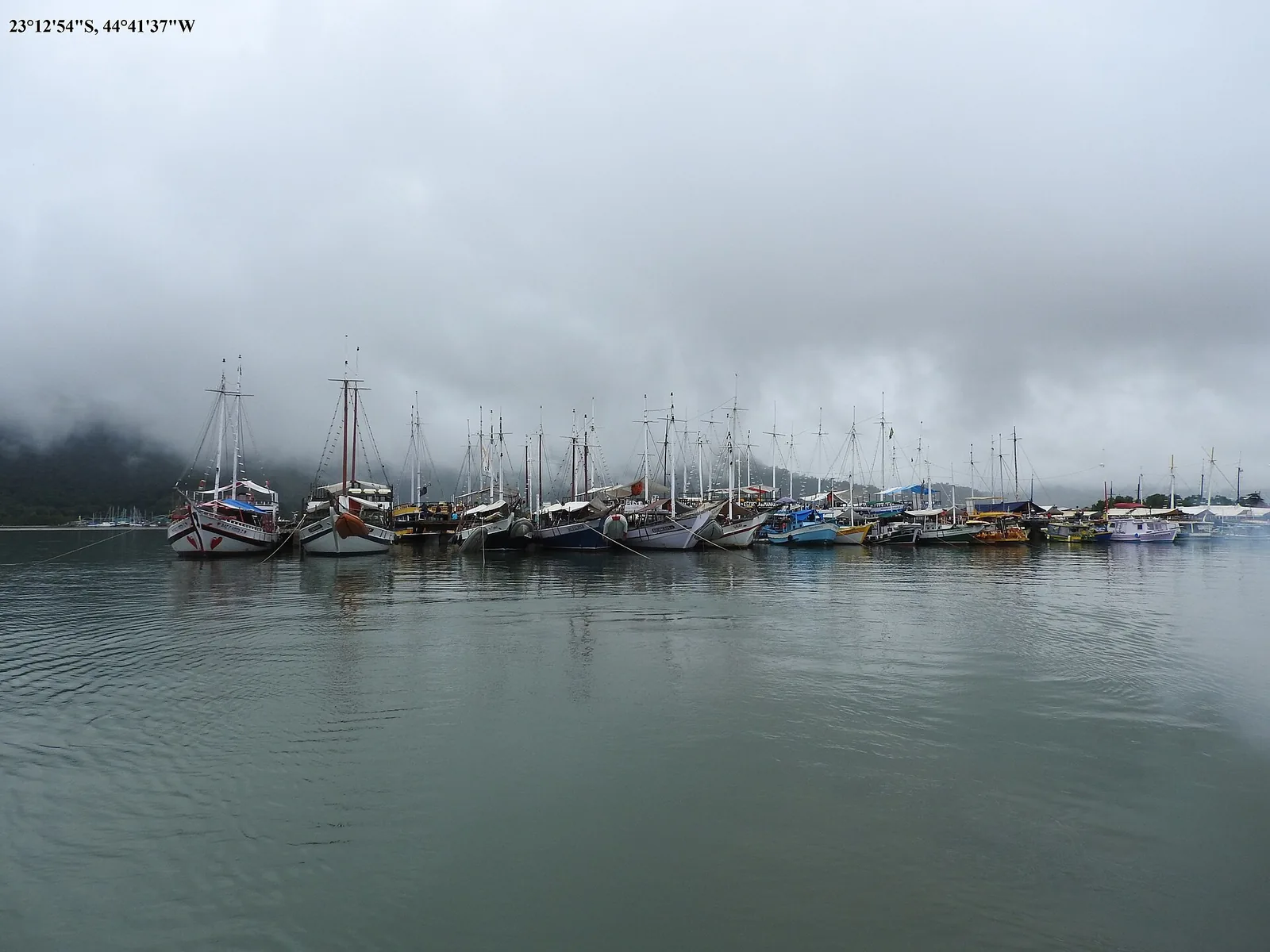
The classic Paraty day out is a boat trip around the bay's islands and swimming stops, and it is deservedly popular — our boat tours guide covers the options from shared schooners to private charters. For a slow trip, though, I would point you at two quieter versions. A sunset sail asks nothing of you but to sit on a deck and watch the light go. And a paddle into Saco do Mamanguá, Brazil's only true tropical fjord, is one of the most peaceful things you can do here — still, mangrove-lined water, best at first light before the wind gets up.
Beaches you have to earn
The beaches near town are easy and busy. The beautiful ones are quiet precisely because you walk to them. Praia do Sono is reached on foot over a headland trail, and the effort is the filter that keeps it calm — the kind of wide, empty beach that resets a nervous system on its own. Further out, the wilder coves toward Trindade reward the same willingness to walk a little. Our overview of the region's best beaches sorts them by how much effort each takes, which for a slow week is exactly the right filter.
Building a slow week: a sample rhythm
You do not need an itinerary for a rest, but a loose shape helps you resist the urge to cram. Here is how a restful seven days tends to fall into place, with the understanding that any of it can be swapped for doing nothing at all.
- Day one — arrive and land. Do the drive, get the groceries, and then stop. A swim, an early dinner you did not have to book, a long sleep. Resist the temptation to go straight into town.
- Day two — the forest. A slow morning walk under the canopy, a cold swim at a waterfall, back to the pool by early afternoon. A first proper night's sleep.
- Day three — treatments. Yoga on the deck at sunrise, an easy day, a massage in the late afternoon. This is the day the shoulders finally drop.
- Day four — the water. A quiet boat morning or a paddle into Mamanguá, home for the heat of the day, sunset from the deck.
- Day five — the town. The historic centre early, a long lunch, the streets again at golden hour. A caipirinha, unhurried.
- Day six — a beach you walk to. Praia do Sono or a wilder cove, a picnic, the swim, the walk back. Tired in the good way.
- Day seven — nothing, on purpose. The pool, a book, the view, one last forest hour. Leave a day with no plan and you will find it is the one you remember.
If you want to stitch this together with harder logistics — transfers, boat bookings, which day to do what given the forecast — our Paraty itineraries lay out several versions, and the broader lie of the land is in our explore Paraty overview.
When to come for a restorative trip
Timing matters more for a quiet trip than for a busy one, because the thing you are protecting is the calm, and the calm is seasonal. The broad strokes:
December to February is the Brazilian summer — hot, humid, gloriously green after the afternoon storms, and busy. The forest is at its most lush and the sea at its warmest, but the town fills up and prices rise, and around New Year and Carnival the calm is largely gone. If you come in high summer, the hillside's slightly cooler air and the pool become even more valuable.
April to June and August to early October are, to my mind, the sweet spots for a reset. The heat eases, the crowds thin, the water is still swimmable, and the prices settle. Mornings can be genuinely fresh, which is perfect for early yoga and forest walks. This is when the town feels most like itself.
July is cooler and dry-ish, popular with Brazilian families on winter holidays, and lively in a pleasant way. Good for walking, a little cool for long swims for some tastes.
Two dates to plan around rather than into if calm is your priority: Carnival in February or March, when the town is joyfully overrun, and FLIP, the international literary festival, usually in the second half of the year, which is wonderful but fills every bed for miles. Both are covered in our guide to FLIP and Paraty's festivals. For a full month-by-month breakdown, see our guide to the best time to visit Paraty. One caveat that applies year-round: Paraty is a wet place, and rain is part of the deal. Do not let a grey forecast put you off — the forest is at its most beautiful in and just after the rain, and a storm watched from a covered deck with a coffee is its own small pleasure.
Getting here, and why the distance helps
Paraty sits almost exactly midway between Rio de Janeiro and São Paulo, and the drive from either is roughly four hours along the coast road. That distance is not an inconvenience to be minimised; it is part of why the town stays calmer than the beaches closer to either city. The places you can reach in ninety minutes from a major city get the weekend crowds. Paraty is just far enough to filter them out.
For travellers coming from Rio, the drive down the Costa Verde is one of the great coast roads, forest on one side and island-studded sea on the other. Give it the morning, stop for lunch, and treat the journey as the beginning of the slowing-down rather than an obstacle before it. For those coming from São Paulo, the approach through the Serra do Mar is greener and more mountainous, and just as scenic. Both Rio's Galeão (GIG) and São Paulo's Guarulhos (GRU) international airports put Paraty within about a four-hour transfer, which for guests arriving from abroad means one long-haul flight, one comfortable transfer, and then you are done travelling for a week.
A few practicalities. A private transfer is the least stressful way in and lets you sleep or watch the coast rather than navigate; a hire car gives you freedom for the waterfalls and beaches but means driving the coast road, which is beautiful but demands attention. Frequent long-distance buses connect Paraty to both cities if you would rather not drive at all. Whichever you choose, our getting around guide has the current detail, and if you would like a transfer arranged to line up with your flight, mention it when you reach out and we can point you to the right people.
The honest version of a wellness week here
Let me end where an honest guide should, with what a slow Paraty week is and is not, so you arrive with the right expectations.
It is not a clinic. There is no doctor, no fixed programme, no scales, no green juice you are made to drink. If you want a structured, supervised wellness regimen, this is not that, and you should book a dedicated retreat elsewhere. What Paraty offers is looser, more self-directed, and to my mind more durable: the conditions for rest, and the freedom to use them however suits you. Some guests do a treatment every day; others never book one and simply swim, walk and sleep, and go home changed anyway.
It is also not effortless in the sense of being handed to you. The best of it — the empty beach, the cold pool, the quiet forest hour, the switched-off phone — takes a small deliberate act on your part. You walk to the beach. You drive down to the town and back up. You put the phone away. The reward is proportional to that small effort, and a hillside base above the bay tilts every one of those choices toward the restful option, because the alternative is always right there: come home, and swim.
By the end of a week most people notice the same thing, and it is not dramatic. They are sleeping earlier and deeper. They have stopped reaching for the phone. The afternoon light, that hour when the heat lifts and the bay goes to glass, has become the part of the day they wait for. That is what a Paraty wellness retreat actually delivers when you build it around the forest and the water rather than a treatment list — not a transformation you can put on a certificate, but a slower pulse you take home and, if you are lucky, keep. When you are ready to plan the dates, the chalet and the deck are here whenever the bay is, and we are glad to help you shape the week — start by getting in touch.
.jpg)
Frequently asked questions
It is a slow, restorative stay built around Paraty's forest, water and quiet rather than a clinical spa programme. The draw is the setting — Atlantic rainforest, empty beaches, warm sea and a town with no fast pace — so days lean toward yoga, swimming, walking and unhurried meals. You can add spa treatments and yoga sessions, but the pace does most of the work.
Yes. Independent yoga teachers and mobile massage therapists work throughout the Paraty area and will come to a private house, so you can practise on a deck at sunrise and have a treatment in the afternoon without leaving. Arrange it a few days ahead, especially in high season, because the good practitioners book up.
It is well suited to one. Mobile signal is patchy on the hillsides and in the forest, the historic centre is car-free and lantern-lit, and the culture is genuinely slow. A hillside base above town, where the view and the pool compete for your attention, makes switching off feel like the natural choice rather than a sacrifice.
Forest bathing, from the Japanese shinrin-yoku, is the simple practice of spending unhurried, screen-free time in woodland, using your senses rather than covering distance. Paraty sits against the Serra da Bocaina, one of the largest surviving stretches of Atlantic Forest, so quiet trails, waterfalls and birdsong are minutes away — you do not need a guide to sit still under the canopy.
For quiet and comfort, aim for the shoulder months — roughly April to June and August to early October — when the heat eases, crowds thin and prices settle. December to February is hot, green and busy; July is cooler and popular with families. Avoid the days around the FLIP literary festival and Carnival if your priority is calm.
Paraty sits about midway between the two cities. From Rio it is roughly a four-hour drive along the coast road; from São Paulo it is a similar four hours or so. Both Rio (GIG) and São Paulo (GRU) international airports are around a four-hour transfer, which is part of why the town stays calmer than the beaches closer to either city.
Yes to both. Families can build slow days around the pool, gentle beaches and short forest walks while adults take turns for a treatment; solo travellers find Paraty safe, walkable and easy to be quiet in. A private house with a pool suits a couple, a family or a small group of friends equally, because everyone can move at their own speed.