In this guide
There is a test I use for any villa that claims a view. I ask for a photo taken from the deck at four in the afternoon, not at golden hour. Golden hour flatters everything. Four in the afternoon, with the sun high and the day boats packed into the coves below, tells you the truth: whether the pool is in sun or shade, whether the deck faces the water or the neighbour's wall, and whether the long view over the bay is really there or just borrowed from the estate agent's drone. A genuine Paraty villa pool view passes that test. Most do not.
This is the money question for anyone choosing where to stay on this stretch of Brazil's Costa Verde, and it deserves a plain answer rather than a brochure. Paraty is a small colonial port roughly halfway between Rio de Janeiro and São Paulo, where the Atlantic Forest comes down to a bay so full of islands you lose count. In 2019 the town and the surrounding forest and sea were inscribed together on the UNESCO World Heritage List, the first Brazilian site recognised for both its culture and its nature at once. You can stay in the old town, you can stay on a beach, or you can stay above it all on the hillside with a pool and the whole bay laid out below. This guide is about that third option — what makes it worth it, what to look for, and where the honest trade-offs lie.
I am going to argue, plainly, that for most people staying more than a couple of nights the view beats the beach. Not always, not for everyone, but more often than the glossy listings would have you believe. And I am going to be specific about what separates a real hillside pool villa from a large house with a lucky camera angle — the altitude, the orientation, the privacy and the infrastructure that decide whether your week feels like a retreat or a series of small frustrations. If you want the wider picture first, our Paraty guides cover the town, the boats and the beaches in their own right; this piece is about the base you return to between them.
What "a view" actually means above Paraty
Everyone sells a view. The word has been worn smooth by use, so it is worth being precise about what you are actually buying when a hillside villa above Paraty promises one.
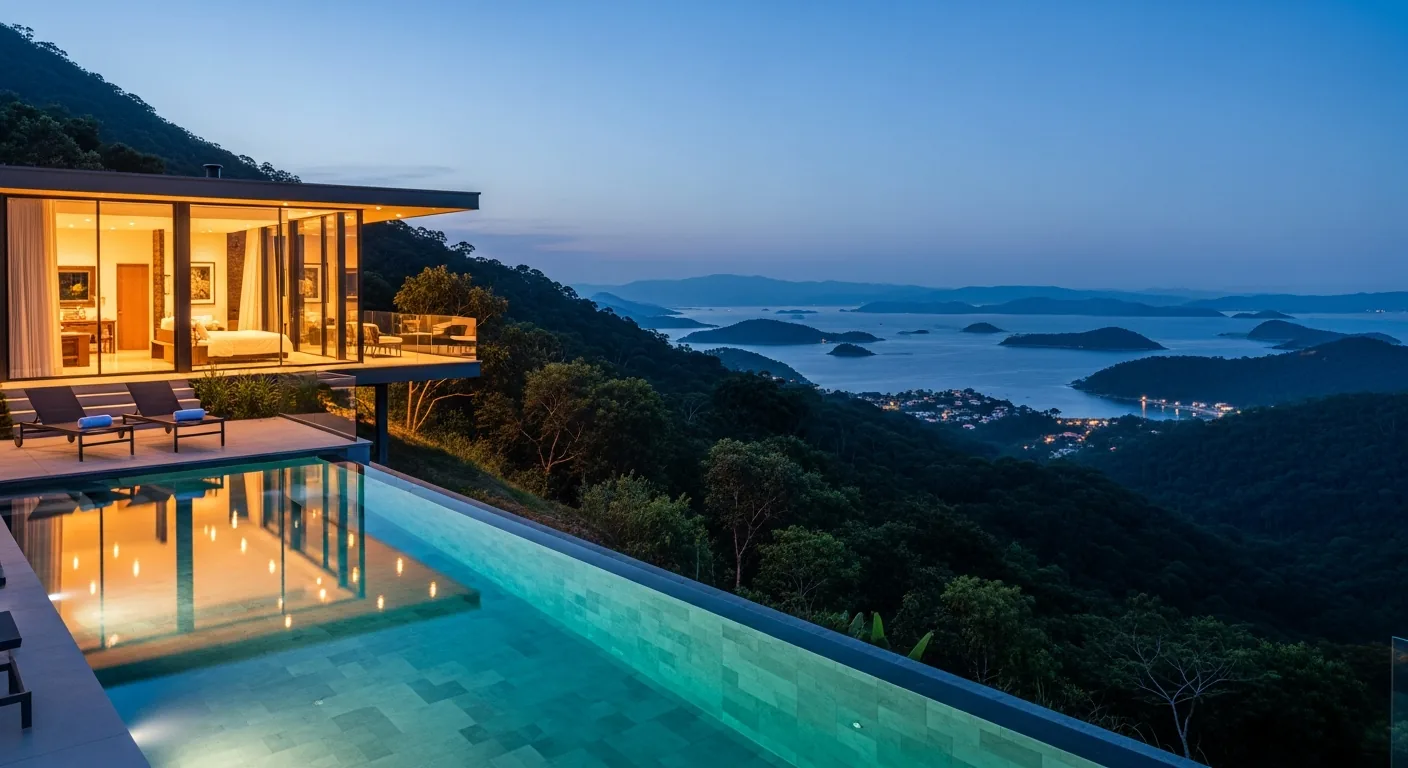
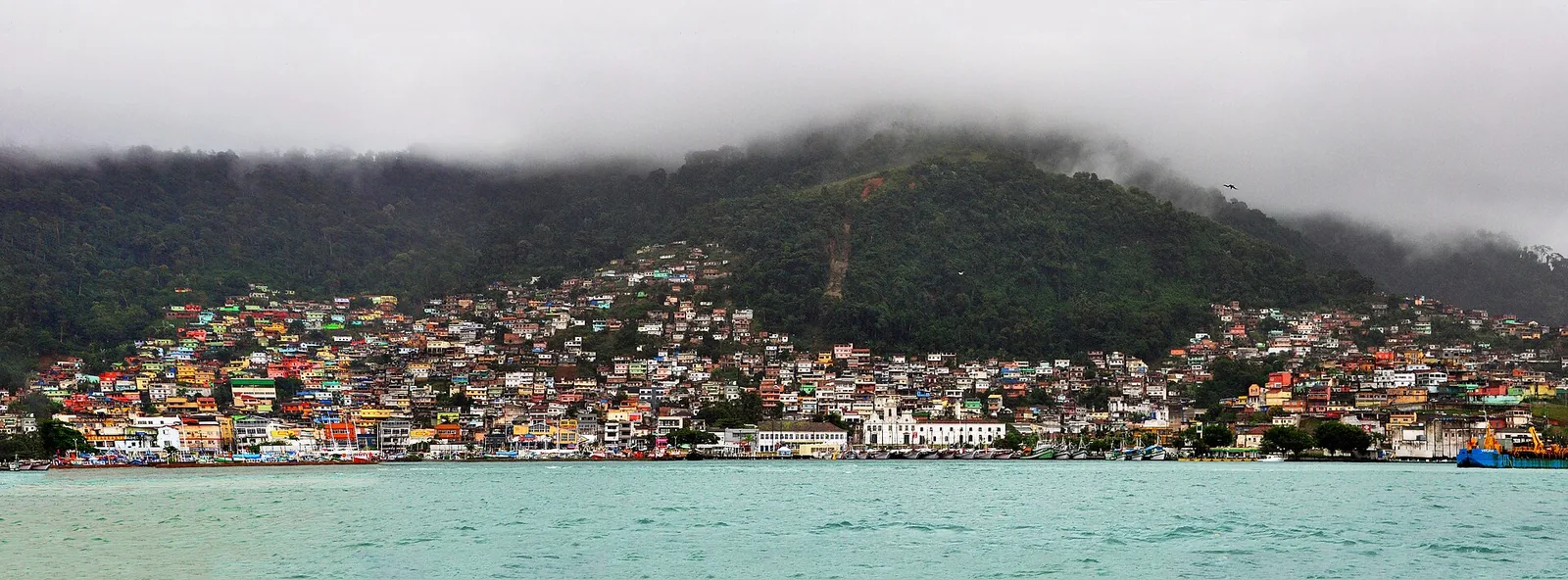
The best of these decks give you three things at once, stacked from near to far. Nearest is the town itself: the tight grid of whitewashed houses and heavy coloured doors, the church steeples, the harbour where the schooners tie up. In the middle is the Bay of Paraty, dotted with wooded islands and threaded with boat wakes, changing colour through the day from hazy silver in the morning to deep blue at noon to gold at dusk. Farthest is the horizon line where, on a clear day, you can make out the low green shapes of Angra dos Reis and, beyond, the bulk of Ilha Grande. Few beaches give you all three. A good hillside villa gives you all three from a sun lounger.
What makes the difference between a view and a great view is depth. A flat panorama is pleasant for a photograph and forgettable by the second morning. A layered view — foreground, water, islands, far coast — holds your attention for a week because it keeps changing. Cloud shadows move across the bay. A squall builds over the mountains and passes. The islands emerge and dissolve in the haze. The town lights come on one by one as the sky goes violet. You do not get bored of it, which is the real test of whether a view is worth paying for.
The other thing a view needs is a frame that works. A deck angled slightly away from the water, a pool with a wall on the wrong side, a stand of trees that has grown up since the photos were taken — any of these can quietly ruin what looks perfect in the listing. This is why I keep pushing people to ask for current photos from the actual deck, at several times of day. The view is the product. Verify it.
A beach gives you the water at your feet; a hillside gives you the whole bay at once. Only one of them is still there at four in the afternoon when the day boats have filled the coves below.
Why the view beats beachfront
Beachfront sounds like the obvious luxury. Sand at your door, the sea a few steps away, the sound of waves at night. For a certain kind of trip it is exactly right, and I will not pretend otherwise. But for most people staying a week in Paraty, a hillside base with a pool and a view quietly wins, and here is the honest reasoning.
First, the heat. At sea level in the Paraty summer the humidity sits on you. A beachfront villa is hot in the afternoon and often still warm at night. Climb a few hundred metres and the air moves; there is a breeze off the bay, the humidity drops, and the nights are cooler for sleeping. Guests who have done both almost always notice the difference in how they sleep.
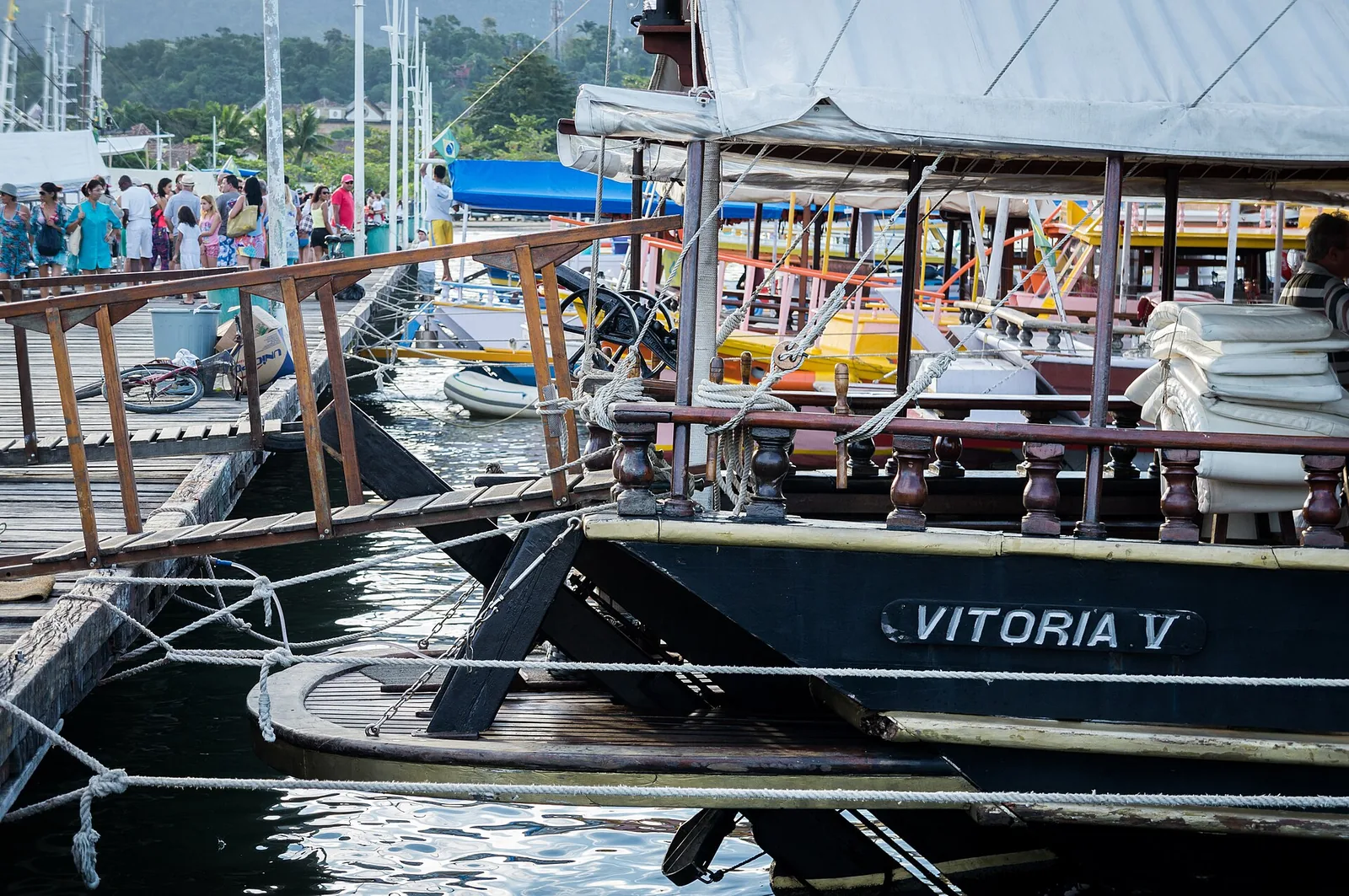
Second, the crowds. Paraty's bay is beautiful and everyone knows it. From mid-morning the day boats fan out and fill the popular coves, and the closest beaches to town see real traffic in high season. A beachfront villa shares its water with all of that. A hillside pool does not empty out at eleven when the first schooner drops anchor — it is yours all day. You look down on the busy bay from your own quiet water.
Third, the view itself. A beach gives you one direction and one middle distance. A hillside gives you the whole bay, the town and the far islands in a single sweep, and the best light in the region at the end of the day. As I put it to guests who are torn: a beach gives you the water at your feet, a hillside gives you the whole bay at once, and only one of those is still there at four in the afternoon when the coves below have filled.
Fourth, and this surprises people, variety. From a hillside base you can reach several different beaches, the town, the waterfalls and the boat harbour in a short drive each. From a beachfront villa you tend to be committed to one stretch of sand and a little further from everything else. The view base is more of a hub; the beach base is more of a destination. If your ideal week is a single beach and nothing else, take the beach. If you want to roam the bay and the forest and come home to a swim, take the hill. Our roundup of the best beaches around Paraty shows just how many options a central hillside base keeps within reach.
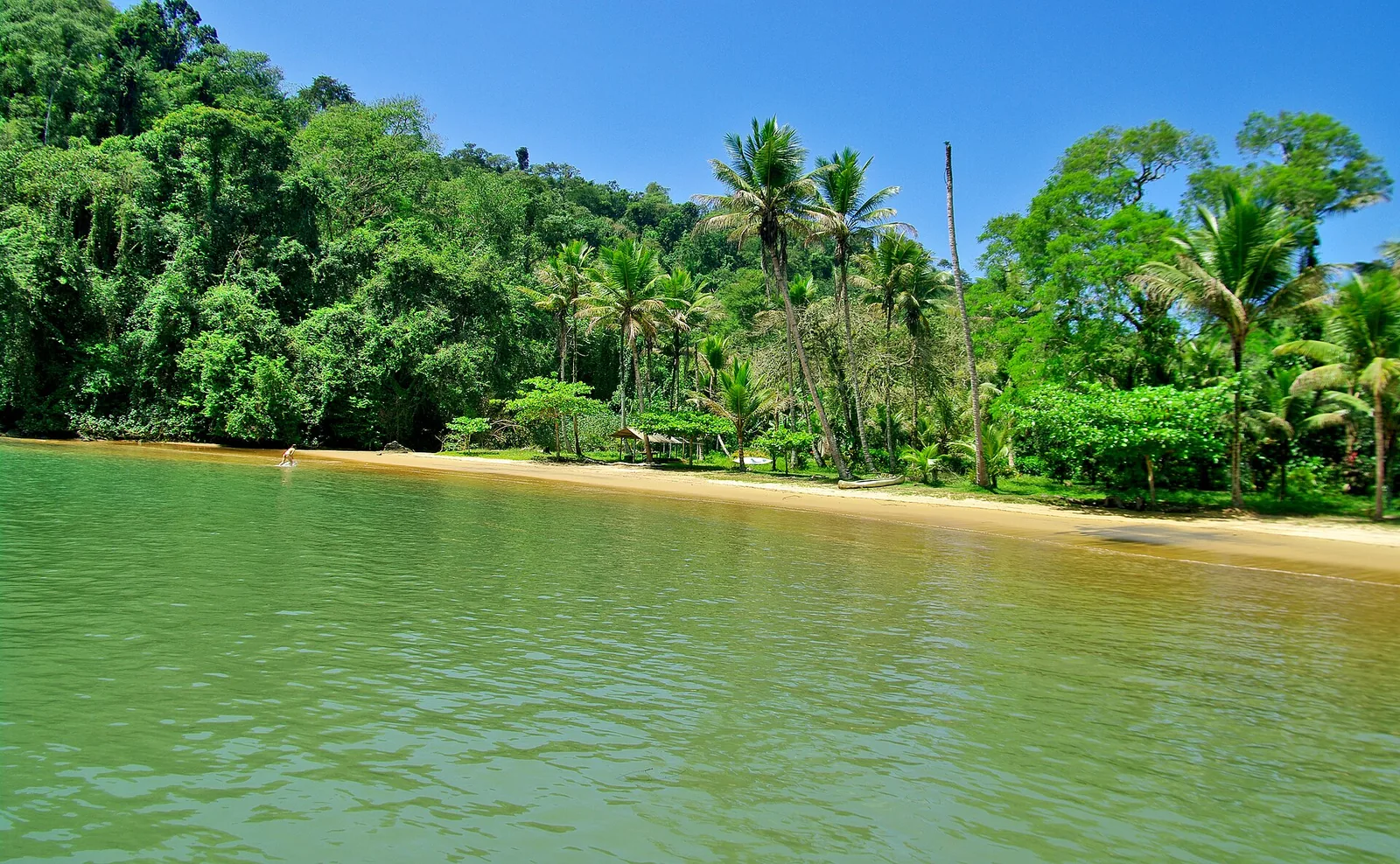
The fair counterpoint: small children who want to toddle straight onto sand, or anyone whose whole reason for the trip is to fall asleep to surf, are better served by the beach. And the wilder Atlantic beaches out toward Trindade and Praia do Sono are worth a base of their own if surf is the point. For everyone else, the view is the better buy.
.jpg)
The case for altitude
Height is the thing that makes a hillside view work, and it is worth understanding why, because more is not always better.
The gains from altitude are real and physical. As you climb above the bay, the temperature drops a little, the humidity drops more, and the wind picks up. At three or four hundred metres you get a breeze that a beachfront villa never sees, which matters enormously in the summer months when sea level is heavy and still. You also get the long sightline — the higher you are, the more of the bay and the far coast you can take in, and the more the town below reads as a whole rather than a wall of rooftops.
But there is a point of diminishing returns. Go too high and two things happen. The drive up gets long and steep, which turns every dinner in town and every boat morning into a small expedition. And the town itself starts to shrink into the distance until you lose the intimacy of it — the church bells, the harbour, the sense of a living place below you rather than a map. The sweet spot, in my experience, sits somewhere around three to four hundred metres above the water: high enough for the breeze, the drop in humidity and the full sweep of the view; low enough that the centre is a short drive and the town still feels close. Our own chalet sits about four hundred metres up, which is a deliberate balance rather than a race to the top.
What altitude does to your day
The practical effect of a few hundred metres is a change in rhythm. You wake to cooler air and a bay still soft with morning haze. The hot middle of the day, which at sea level drives you into the shade or the sea, is far more bearable up here with a breeze and a pool. And the evenings actually cool down enough to want a light layer on the deck — a small thing that makes the difference between sitting out until late and retreating indoors to the air conditioning. Altitude, in other words, buys you more usable hours of the day outside, which is most of what you came for.
Infinity pools, and what makes one worth it
The infinity pool has become shorthand for luxury, and like most shorthand it is half right. Worth separating the real value from the marketing.
The trick itself is simple: one edge of the pool is level with the water surface and drops away, so the water appears to run off into whatever is beyond — in the best cases, straight into the bay below. When it works, it dissolves the boundary between the pool and the view, and a modest pool feels open and endless. It is genuinely lovely, and above a bay like Paraty's it is close to the ideal setting for the effect.
But the infinity edge is the last thing that matters, not the first. What actually determines whether you spend real hours in a pool, rather than photographing it once, is three duller factors:
- Orientation. Does the pool get sun in the afternoon, when you want to swim, or does the house throw it into shade by two? A pool in shadow at four is a cold ornament. This is the single most common disappointment, and it never shows in the photos.
- Aspect. Does the pool look at the view, or at a wall? An infinity edge pointed at the neighbour's garage is a waste of engineering. The edge should fall toward the water.
- Comfort around it. Shade for the hot part of the day, loungers you would actually lie on, somewhere to put a drink, a rinse-off shower, a spot to eat lunch by the water. The pool is a place to live, not just to dip.
A well-sited ordinary pool with afternoon sun and a clear view over the bay beats a poorly placed infinity pool every time. Treat the infinity edge as the bonus it is. If a villa has the orientation and the aspect right and an infinity edge on top — as ours does, with the edge falling toward the town and the bay — then you have the whole thing. But get the fundamentals first.
Heated, or not?
One question worth asking: is the pool heated? Paraty water is pleasant most of the year, but in the cooler, drier months from June to September an unheated pool can be bracing in the morning and only just warm by late afternoon. If you are travelling in winter and the pool is central to your plans, a heated pool turns a quick dip into real swimming. Ask before you book; it is the kind of detail that quietly shapes the week.
.jpg)
Privacy, the real luxury
Ask people afterwards what they loved most about a good hillside villa and they rarely lead with the view or the pool. They say some version of: we had the place to ourselves. Privacy is the luxury underneath the other luxuries, and above Paraty it comes more easily than almost anywhere on the coast.
The reason is geography. Houses on a hillside are spread out by the terrain — separated by slope, trees and garden in a way that beachfront and town properties, packed along a strip, never are. A good hillside villa gives you a pool no one overlooks, a deck where you can sit in a towel without an audience, and the simple, underrated pleasure of coming home salty and tired from a boat day and pouring a drink without performing for anyone.
For couples, this is the difference between a holiday and a retreat — no front desk, no shared pool, no corridor of other rooms, just your own hours. For families it means children can be loud at breakfast and asleep by eight without a single apologetic glance at other guests. For groups of friends it means long dinners on the deck that run as late as they like. And for anyone who works a demanding job the rest of the year, it means the rarest thing of all: a week where no one needs anything from you and no stranger is ever quite in view.
Privacy is also easy to fake in photos and hard to fake in person. A villa can crop the neighbours out of the frame. When you ask your questions before booking, ask directly: what overlooks the pool and the deck? How close is the nearest house? Can you hear a road, a bar, a building site? The honest hillside villas answer without hesitation, because on the hill the answer is usually "nothing and no one."
What to look for in a Paraty villa pool view
Bringing it together, here is the checklist I would use if I were choosing a hillside pool villa above Paraty and did not own one. Send the same questions to any two places you are weighing; the speed and honesty of the replies will usually decide it.
- The view, verified. Ask for recent photos from the deck at morning, midday and late afternoon. You are checking for the layered view — town, bay, far islands — and that trees or a new build have not grown into it.
- The pool, oriented right. Afternoon sun, an aspect toward the water, shade nearby for the hot hours, and comfortable loungers. Ask whether it is heated if you travel in winter.
- Privacy. What overlooks the pool and deck, how far the nearest house is, and whether there is any road or bar noise. On a good hill the answers are reassuring.
- Altitude and access. Roughly how high above the bay, and how long and steep the drive to town. You want the view without a mountain expedition to dinner.
- Real infrastructure. Reliable wifi, hot water, air conditioning in the bedrooms, and a sensible plan for water supply and the occasional power cut. This is the coast; vague answers here are themselves an answer.
- A proper kitchen. A hillside base is not walking distance to a bakery, so you want a kitchen good enough for slow breakfasts and the odd dinner at home by the pool.
- Service that answers. A host who replies within the hour, not the day, and who can arrange boats, transfers and tables so your week is not spent on logistics.
- The terms. Deposit, balance, cancellation, security deposit, minimum stay over peak weeks, check-in and check-out. Settle these before the deposit leaves your account.
The pattern to notice is that only the first two items are about the view and the pool. The rest are about whether someone has thought seriously about living up there. A stunning view attached to unreliable water and a host who answers in three days is a worse week than a slightly plainer view run by someone who picks up the phone. You can see how we approach that on the contact page.

Reading the light and the day's rhythm
A hillside view is not a static thing you glance at. It has a rhythm across the day, and understanding it helps you get the most from a base above the bay — and helps you judge, from photos, whether a villa faces the right way.
Mornings are the quiet, hazy hour. The bay is often soft and silver, the islands half-dissolved, the town below just waking. This is the time for coffee on the deck before the day heats up, and the time most guests do their boat departures, leaving early while the coves are still empty. A deck that catches the morning is a gentle way to start.
Midday is bright and hot, and the view flattens under a high sun. This is pool-and-shade time, the hours a beachfront villa drives you into the sea and a hillside one lets you drift between water and hammock with a breeze. If a pool is going to be in shadow at any point, it is usually not now — it is later.
The late afternoon is when a west- or bay-facing hillside earns its keep. The light goes long and gold, the water lights up, and the whole bay warms in colour. This is the region's best hour and the reason people book the view in the first place. A pool in afternoon sun, a deck pointed at the water, and you have the finest part of the Paraty day to yourself while the town below fills up for the evening.
Then dusk, and the slow reveal of the town lights against a violet sky, the harbour lamps coming on, the islands going black. It is the hour that turns first-time guests into repeat ones. When you assess a villa, the single most useful photo is the one taken from the deck at this moment — not because you will spend every evening staring at it, but because a deck that captures it is a deck that faces the right way.
The three-way view: Paraty, Angra dos Reis and Ilha Grande
The particular magic of the higher decks above Paraty is that they hold three distinct places in a single frame, and it is worth knowing what you are looking at.
Nearest, directly below, is Paraty itself — the colonial grid, the church steeples, the harbour. This is the intimate part of the view, the living town you drive down into for dinner and drive back up from at night. Our guide to the historic centre explains how the old town works, right down to the famous cobbles and the streets that flood at high tide by design.
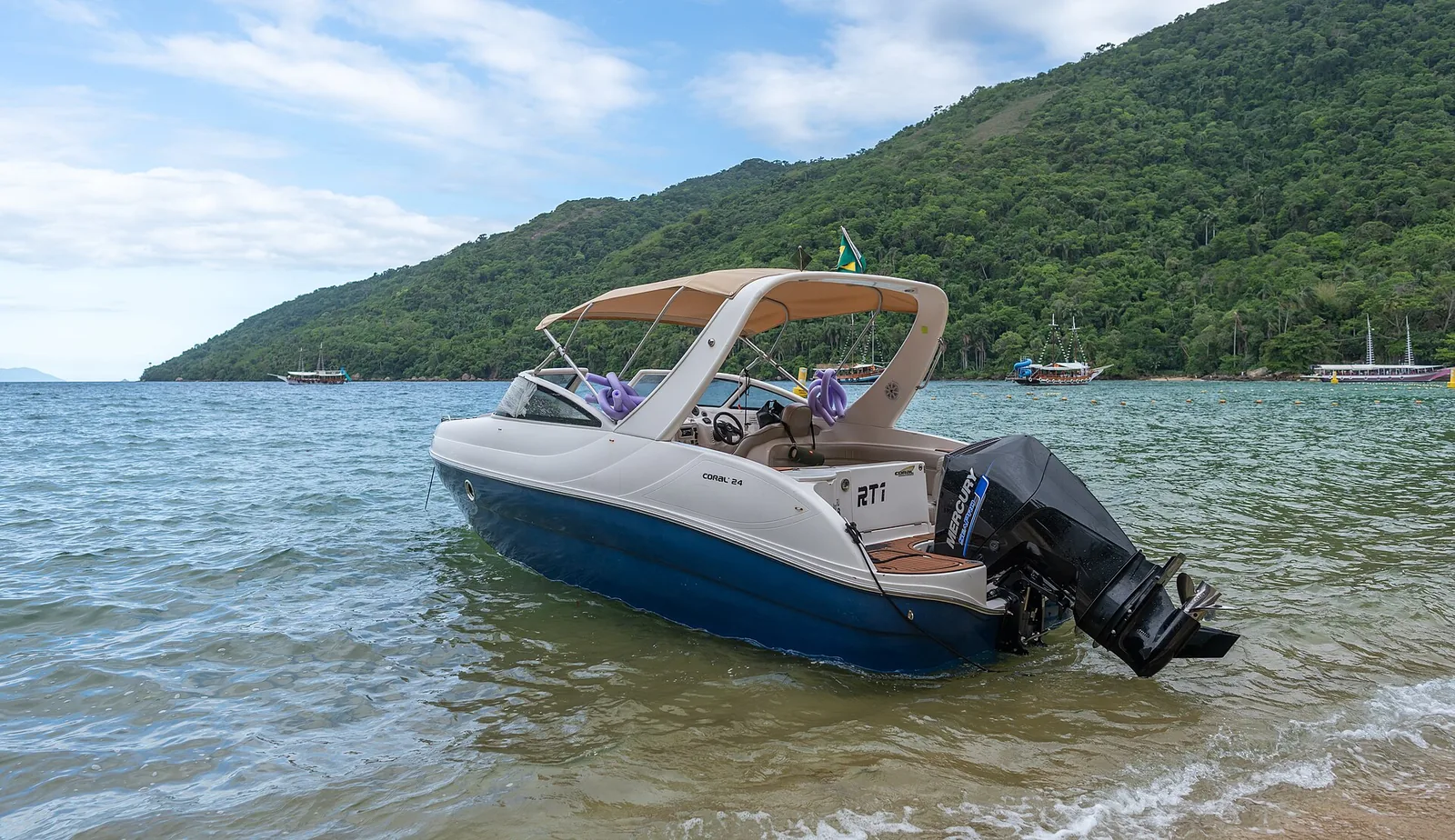
In the middle distance is the Bay of Paraty, part of the larger Bay of Ilha Grande, scattered with wooded islands and quiet coves. This is where your boat days happen — the schooner tours and private charters that thread between the islands, stopping to swim and snorkel. A base above it lets you watch the bay you will spend a day on, and pick your morning by the weather moving across it. Our boat tours guide covers the options, and the tropical fjord of Saco do Mamanguá is the standout for a longer day on the water.
Farthest, along the horizon, on a clear day, are the shapes of Angra dos Reis and Ilha Grande. Angra is the islanded stretch of coast to the northeast, a scattering of hundreds of islands; Ilha Grande is the big forested island beyond it, largely protected, ringed with beaches like the celebrated Lopes Mendes. Both are day-trip country from Paraty — see our Angra dos Reis guide and the complete guide to Ilha Grande — and there is something quietly satisfying about picking out on the horizon the island you will visit later in the week.
Haze and cloud change all of this hour to hour and day to day. Some mornings the far islands are crisp; some afternoons they vanish entirely into a warm blur. That variability is not a flaw. It is why a layered view rewards a week rather than a night.

How the pool anchors the days
The point of a hillside pool villa is not to sit by the pool all week — it is to have a still point you return to, with the bay and the forest as the day's destinations. Here is how the pool and the view tend to shape a typical week, drawn from how guests we have hosted settle in rather than any schedule you should follow.
Boat mornings, pool afternoons
The best shape for a day here is water in the morning, pool in the afternoon. Leave early with coffee while the coves are empty, spend the morning swimming and snorkelling between the islands on a schooner or a private charter, and be back up the hill by mid-afternoon to rinse the salt in your own pool while the day boats crowd the bay below you. You get the best of the water twice — once at sea, once from above — and you avoid the busiest hours in the coves. For a bigger day, a private charter lets you set your own route entirely.
Waterfall mornings
On the days you stay on land, the cool morning hours belong to the forest behind the town. The Atlantic Forest rises into the Serra da Bocaina, threaded with rivers and waterfalls, many of them along the old gold road, the Caminho do Ouro. Swim under a fall, dry off, and combine it with a tasting at one of the cane mills that make Paraty's cachaça, the spirit that carries its own protected origin mark. Real shoes for the slick stones, an early start, and you are back at the pool by lunch.
Town evenings
Evenings belong to the centre. As the heat lifts, the cobbles fill, the lamplight comes on against the whitewash, and the seafood houses at the harbour end set their tables. From a hillside base it is a short drive down and an easy taxi home, which means you can enjoy the town at its liveliest without sleeping above the noise of it. Our restaurants guide points you to the right end of town for what you fancy, and the pattern is a good one: the town for the evening, the hill for the night.
The day with no plan
Every good week needs a day that belongs entirely to the pool and the deck. Swim, read, nap, cook a long lunch by the water, watch the bay change through the afternoon, wander into town for ice cream in the evening if you feel like it and not if you do not. This is the day a hillside pool villa pays for itself — the day a hotel would make you feel you should be out doing something, and a villa lets you simply not. For more ways to fit a week together, our Paraty itineraries lay out several shapes of trip.
The honest trade-offs of staying above town
I have made the case for the hill. Fairness demands the other side, because a hillside pool villa is not the right answer for every trip and you should go in clear-eyed.
The main trade-off is the drive. You are not walking to dinner or the bakery. Every trip into town, every boat departure, every beach run is a short drive down and back up. It is not far — a matter of minutes from a well-placed hillside — but it means you want a car, a driver or arranged transfers, and it means a little more planning than rolling out of a house on the cobbles. If your idea of a holiday is never touching a car, the historic centre suits you better, with the trade-off of noise and crowds that comes with it.
The second is self-sufficiency. A hillside base rewards a bit of stocking up. You want a fridge of cold drinks and the makings of breakfast, because you cannot pop downstairs for a coffee at a café. This is a feature for most guests — the slow breakfast on the deck is half the point — but it means a supply run on arrival rather than living off restaurants.
The third is the very thing that makes it special: you are removed from the bustle. If you came to Paraty to be in the thick of the colonial town, to hear the music spill out of the bars at midnight and step straight onto the cobbles, the hill will feel too quiet and too far. The remove is exactly what the hillside guest is paying for and exactly what the town guest would miss. Know which one you are.
And the fourth, worth naming plainly, is that a great hillside villa is a deliberate spend, not a saving. For a group or a family the per-head maths often compares well with several good hotel rooms, and the pool, kitchen and deck come free on top. For two people it is a choice to pay for privacy, space and a view rather than to economise. That is a perfectly good reason to book one; just be honest with yourself that it is what you are doing.
Getting there, cars and seasons
A few practicalities, because a view is only as good as your ability to reach it and enjoy it.
Arriving
Paraty sits on the coast road between Rio de Janeiro and São Paulo. It is roughly a three-to-four hour drive from Rio — a little over 230 kilometres — and around five to six hours from São Paulo, depending on traffic and the roadworks that are a fact of life on this stretch. Most international guests fly into Rio's Galeão (GIG) or São Paulo's Guarulhos (GRU) and come on from there. The easiest arrival by far is a private transfer arranged in advance, so a driver meets you at the airport and brings you straight to the door; there are also comfortable shared shuttles and frequent intercity buses. Our getting-around guide lays out the options, and the first-trip arrival notes in the journal help if this is your first time in Brazil.
Cars, once you are here
For a hillside base you want wheels of some kind — a hire car, a local driver, or transfers you book as you go — because taxis are not always quick to reach the hills and the town and beaches are a short drive down. In the historic centre itself you will not drive at all; the old town is car-free, open to vehicles only on limited delivery days, so you park at the edge and walk in on the cobbles. None of this is hard, but it is far smoother arranged before you arrive than puzzled out on the doorstep, and a good host will sort it for you.
Seasons
Paraty has two faces. The summer months of December to March are hot, humid and green, with quick afternoon downpours; this is high season, when the town is liveliest and the bay busiest, and a hillside pool with a breeze is at its most valuable. The cooler, drier months from June to September are, for many, the sweet spot — mild clear days, low humidity, wonderful light for the view, and a pool best enjoyed heated. July brings FLIP, the international literary festival that has filled the town since 2003; worth planning around or, if you prefer quiet, planning to miss. Our best-time-to-visit guide breaks the year down month by month, and the wider when to visit Brazil notes set it in context. Whichever season you choose, book the best hillside villas well ahead — six to twelve months for the peak, two to four for the quieter months.
Where Château Portofino fits
If you have read this far, you know which camp you are in. For guests who want the hillside option — the long three-way view, the pool, the quiet, with the town and the boats a short drive away — that is exactly what we built. Château Portofino sits about four hundred metres above the Bay of Paraty, with an infinity pool whose edge falls toward the water and a single deck that takes in the town, the bay and, on a clear day, Angra dos Reis and Ilha Grande along the horizon.
It is the base this guide describes: a pool oriented for the afternoon sun and the view, privacy from the slope and the trees, a proper kitchen for slow breakfasts and the odd dinner at home, and a host on hand to arrange the boats, transfers and tables so your week goes on the water and in the town rather than on logistics. We keep it deliberately personal — we would rather know our guests than process them — and the whole place is organised around one simple idea: a base you return to for a swim, with the best of Paraty fanning out below.
Whether you choose us or somewhere else, the advice holds. Verify the view with real photos at real hours. Check the pool's orientation before its infinity edge. Value the privacy and the infrastructure as highly as the panorama. And give yourself enough days to fall into the rhythm — boat mornings, pool afternoons, town evenings — that makes a week above Paraty feel longer than it is. To see whether the chalet is the right fit, have a look at the chalet, read more of our luxury villa guide, browse the rest of the Paraty guides, or simply get in touch — we are happy to talk through dates, the bay, and what would make your week.

Frequently asked questions
Look past the hero photo. You want a pool that catches afternoon sun and looks at the water, a deck oriented toward the bay rather than the neighbour's roof, real privacy from other houses, and honest infrastructure — reliable wifi, hot water, air conditioning and a plan for the occasional power cut. Ask for photos taken from the deck at several times of day, not just the one golden-hour shot.
The visual trick — water meeting horizon — is real and it does make a pool feel bigger and more open. But what matters more is where the pool sits and which way it faces. A well-placed ordinary pool with afternoon sun and a clear view beats a poorly sited infinity pool every time. Treat the infinity edge as a bonus, not the deciding factor.
A beach gives you sand at your door but usually one view, more heat and humidity at sea level, and more people once the day boats arrive. A hillside base above the bay gives you cooler air, the long three-way view over Paraty, Angra dos Reis and Ilha Grande, real quiet, and a pool that stays yours all afternoon. You trade a short drive to the sand for privacy and a view that does not empty out.
There is no magic number, but somewhere around three to four hundred metres tends to be the sweet spot. High enough for the long view, the breeze and the drop in humidity; low enough that the drive up is short and the town stays close. Our own chalet sits about four hundred metres above the water, which is a comfortable balance of view and access.
For a hillside base, yes — a hire car, a private driver or transfers you arrange as you go. Taxis are not always quick to reach the hills, and the centre and beaches are a short drive down rather than a walk. Inside the historic centre itself you will not drive at all; the old town is car-free, so you park at the edge and walk in.
The best hillside villas are few and they fill from the top down. For the December-to-March high season, and especially Christmas to Carnival, book six to twelve months ahead. For the cooler, drier months of June to September you can often book two to four months out, though the standout places still go first. If you want a specific villa for a specific week, ask early.
On a clear day, yes. From a high deck above the Bay of Paraty you can pick out the town below, the islanded water in front, and the silhouettes of Angra dos Reis and Ilha Grande along the horizon. Haze and cloud change what you see hour to hour, which is part of the pleasure — the view is never quite the same twice.