In this guide
Most people come to Paraty for the daylight. The cobbled colonial streets, the schooners crossing a bay dotted with islands, the waterfalls in the forest behind town. Then the sun goes down, the restaurants fill, and almost everyone stops looking up. That is a small tragedy, because the night sky over this coast is one of the best things it has to offer, and hardly anyone bothers to notice it.
The trick is altitude and dark. Down in the historic centre, the streetlamps and the pousada windows and the warm glow of the harbour make it hard to see much beyond the moon and a handful of the brightest stars. Climb a few hundred metres into the hills, though, turn your back on the town, and the whole thing changes. On a clear, moonless night in the dry season, the Milky Way arches over the Bay of Ilha Grande like a band of smoke, and you can trace the Southern Cross without effort. Good stargazing Paraty is not about equipment or expertise. It is about getting above the lights and giving your eyes time.
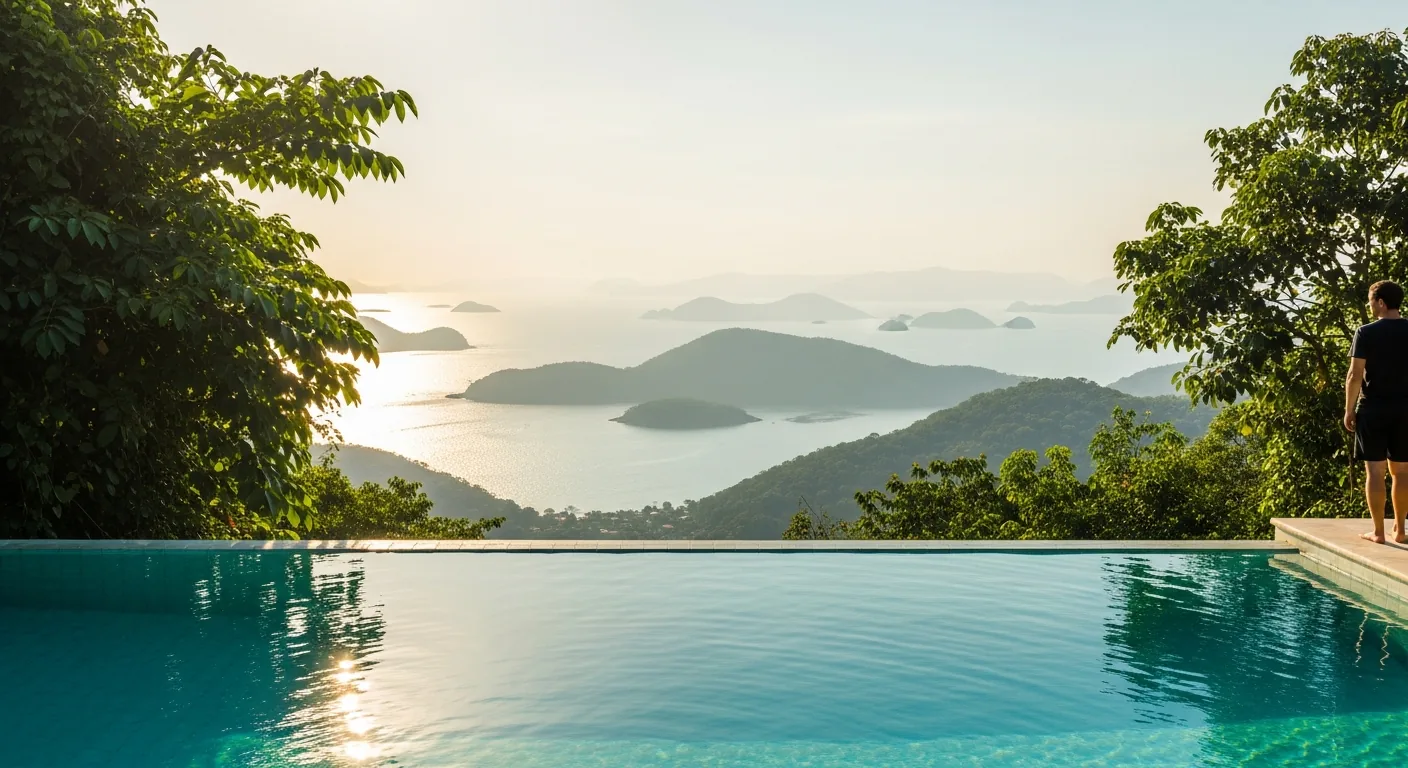
This is a guide to doing exactly that. Why the hills stay dark, what the Southern Hemisphere sky actually shows you, the best months and moon phases, when to reach for binoculars and when to leave them in the bag, and how to turn a clear night into a slow, easy evening rather than a chore. We host guests four hundred metres above the water, on a deck that faces Paraty, the islands of Angra dos Reis and the ridge of Ilha Grande all at once, so a fair amount of what follows we have learned the plain way, by standing outside on cold nights and looking.
Why the hills above Paraty stay dark
Two things make a place good for stargazing: how little artificial light reaches the sky, and how clear and steady the air is. Paraty does well on the first and reasonably on the second, and the reason is geography.
The town sits on a narrow shelf of the Costa Verde, the green coast that runs between Rio de Janeiro and São Paulo. Behind it, almost immediately, the land rises into the Serra da Bocaina, part of the Serra do Mar range, with peaks well over two thousand metres. That wall of forested mountain does two useful things. It stops Paraty from sprawling outward, so the built-up area stays small and compact, and it physically blocks the sky glow that would otherwise drift over from the larger cities inland and along the coast. There is no ring of suburbs here throwing light into the night. There is a small town, then dark water, then dark forest.
Height matters too. Coastal air near sea level holds a lot of moisture, and that humidity scatters whatever light is around, softening the sky and dimming faint stars. Move up the hillside and you climb above the worst of that damp layer. The horizon sharpens, the darkness deepens, and the difference between the view from a beach and the view from a few hundred metres up is genuinely large. It is the same reason serious observatories are built on mountains rather than at the shore.
Put those together and you get the situation on our own deck. At roughly four hundred metres, the town lights are below you and off to one side, the bay spreads out dark in front, and the forest rises black behind. Face away from Paraty and there is very little between your eyes and deep space. You are not in a certified dark-sky reserve, and the coast is not the driest place in Brazil, but for somewhere this easy to reach it is a remarkably good window on the night. To understand how the hillside fits into the wider landscape, it helps to explore Paraty and its setting a little before you arrive.
You do not need a telescope, a course in astronomy, or a plan. You need a dark place, a warm layer, and the patience to let your eyes catch up with the sky.
Stargazing Paraty: what the southern sky gives you
If you have only ever looked up from the Northern Hemisphere, the sky here will feel subtly wrong in the best way. The familiar signposts are missing or upside down, and a whole set of southern sights that most northern travellers have only read about are suddenly overhead. This is one of the quiet pleasures of stargazing in Brazil: you are looking at a different half of the galaxy.
The Milky Way over the bay
The single most striking thing on a dark night here is the Milky Way itself. From the Southern Hemisphere, the bright central bulge of our galaxy, the part crowded with stars and dark dust lanes, passes high overhead rather than skimming the horizon. In the northern half of the world that galactic core stays low and is easily lost in haze. Here it climbs, and in the winter months it stands almost straight up after dark, a broad, mottled river of light running across the sky.
To the naked eye it looks like a faint band of cloud that does not move and does not blow away. Give your eyes twenty minutes to adjust and the detail comes: brighter patches where star clouds gather, and darker rifts where clouds of interstellar dust block the light behind them. Brazilians have a lovely old name for one of those dark patches near the Southern Cross, the Saco de Carvão, the coal sack. From the deck, with the bay below acting as a black floor and no lights in the way, the whole band seems to rise out of the water and pour over the ridge of Ilha Grande.
The Southern Cross and finding south
The constellation everyone wants to see is the Cruzeiro do Sul, the Southern Cross. It is small, compact and genuinely cross-shaped, and it sits on the Brazilian flag, so it carries a bit of national feeling as well as astronomical interest. For most of the year it is visible from Paraty, and in the southern winter evenings it rides high and easy to find.
It is also useful. The long axis of the cross points toward the south celestial pole, the fixed point the whole southern sky wheels around. Follow that line about four and a half cross-lengths and you reach a rather empty patch of sky; drop straight down from there to the horizon and you are looking at true south. There is no bright pole star in the south the way there is in the north, so this trick, plus the two bright Pointer stars nearby, is how sailors and travellers have found their bearings on this coast for centuries. It is a good thing to teach children or first-timers, because it turns a pattern of stars into something they can use.
The Magellanic Clouds and the rest
Lower in the southern sky, on a properly dark night, you may pick out two faint smudges that look like torn-off pieces of the Milky Way. These are the Large and Small Magellanic Clouds, two small galaxies that orbit our own, roughly one hundred and sixty thousand and two hundred thousand light-years away. They are circumpolar from here, meaning they never set, so they are available any clear night of the year, though they show best when they ride higher and the sky is truly black.
Beyond those headliners there is plenty for the wandering eye. Bright planets when they are in season, Jupiter and Saturn and a fierce Venus after sunset or before dawn. Satellites sliding silently across the sky in the hour after dusk. The occasional meteor, and during the known meteor showers, rather more than the occasional one. None of this needs naming or hunting. Half the fun is simply lying back and letting things reveal themselves.

The best months for stargazing above Paraty
The sky is always there. Whether you can see it is down to weather and moon, and on this coast the weather does most of the deciding.
The winter dark-sky window
Paraty has a wet, warm summer and a drier, cooler winter. From roughly December through March the rain is frequent and the humidity high, and while you will still get clear spells, long stretches of cloud are common. The reliable season for clear nights is the southern winter, June through August, which is the driest part of the year on this coast. July in particular is the sunniest month, with the most hours of clear sky, and rainfall drops right off.
Happily, that dry winter window lines up almost perfectly with the best time to see the Milky Way core, which climbs highest and stays up longest between roughly April and September in the Southern Hemisphere. So the two things you want, dark clear air and a well-placed galaxy, arrive together. If your main goal is the night sky, aim for a moonless stretch in June, July or August. May and September are good shoulder choices, a little warmer, with a slightly higher chance of a cloudy night. For a fuller picture of the seasons, our guide to the best time to visit Paraty weighs up weather, crowds and price across the whole year.
One honest caveat about winter nights on the hillside: they get cool. Down in town it stays mild, but a few hundred metres up, with air moving off the water, the temperature can slip to around twelve to fifteen degrees Celsius after dark. That is nothing a sweater and a blanket cannot handle, and the cold, dry air is exactly what makes the stars so sharp, but do not picture a warm tropical evening in shorts. Bring a layer.
Reading the moon
After weather, the moon is the thing that most changes what you see. A full moon is beautiful over the bay, and there is a real pleasure in swimming under it, but it floods the sky with light and drowns the faint Milky Way completely. Under a bright moon you will still get the planets, the Southern Cross, the brightest stars and clean silver light on the water, but the galaxy hides.
For the deep sky, plan around the new moon. The darkest nights fall in the week or so on either side of it. If your dates are fixed and the moon is up, you still have options: the sky is darkest before the moon rises and after it sets, so a late-rising or early-setting moon leaves you a black window at the start or end of the night. A quick check of a moon-phase calendar before you book, or a word with us when you plan, will tell you which nights of your stay are the good ones.
- New moon, clear sky: the full show, Milky Way and all. The prize.
- Crescent moon: sets early or rises late, leaving dark hours at one end of the night.
- Half moon: decent for constellations and planets, the Milky Way muted but not gone.
- Full moon: bright and lovely for swimming and the brighter stars, but no faint detail.
Naked eye, binoculars or telescope
People assume stargazing means gear. It does not. The most memorable parts of a dark sky are best seen with nothing at all, because your eye can take in the whole sky at once and no instrument can. Here is how we think about the choice.
Start with your eyes
The Milky Way, the Southern Cross, meteors, satellites, the slow turning of the whole sky over an hour: all of that is naked-eye work, and all of it is better without a device between you and it. The only equipment your eyes need is time. It takes around twenty to thirty minutes in the dark for your vision to reach its full sensitivity, and a single glance at a phone screen resets much of that in a second. So the real skill is patience and discipline about light, not optics.
A pair of binoculars
If you want to bring one thing, bring binoculars, not a telescope. A modest pair, something like seven or ten times magnification, transforms the night for very little effort. Sweep them slowly along the Milky Way and the faint band dissolves into countless individual stars. The Magellanic Clouds resolve into texture. Star clusters and the odd nebula come within reach. Binoculars are forgiving, quick to use, easy to share and impossible to point wrongly, which makes them ideal for children and for anyone who has never looked properly before. Rest your elbows on a rail or lie back so your arms stay steady, and the view holds still.
When a telescope earns its place
A telescope is a wonderful thing in the right hands, and it does something binoculars cannot: it shows the rings of Saturn, the moons and cloud belts of Jupiter, craters on the moon, and faint deep-sky objects up close. But it also narrows your view to a tiny patch of sky, needs setting up and aligning, and rewards patience and a little knowledge. For a first night under a dark sky, it can actually get in the way of the bigger experience. Our honest advice: enjoy the whole sky with your eyes and a pair of binoculars first, and think about a telescope only if you already love the subject and know your way around one.
.jpg)
Letting your eyes catch up with the sky
This is the single most useful skill, and it costs nothing. When you step outside from a lit room, you are effectively half-blind to the faint sky. Give it time and your pupils widen and, more importantly, the chemistry of your retina shifts to a far more sensitive mode. The change is dramatic. A sky that looked almost empty when you walked out will, twenty minutes later, be crowded with stars and threaded with the Milky Way.
Protecting that adaptation is the whole game. A few practical habits make all the difference.
- Turn off or dim every light you can before you go out, including pool and deck lighting.
- Keep phones face-down and screens off. If you must check something, turn the brightness to its lowest and use a red-light or night mode.
- If you need a torch to move around, use a red one, or tape red film over a white one. Red light barely disturbs your night vision.
- Do not rush. Settle into a lounger, look up, and let the sky slowly fill in on its own.
- Learn to look slightly to the side of a faint object rather than straight at it. The edges of your vision are more sensitive to dim light, an old observer's trick called averted vision.
The reward for that little bit of discipline is the moment, familiar to anyone who has done it, when the sky seems to switch on. Nothing has changed above you. Your eyes have finally caught up.
A night by the pool
Everything above is about seeing more. This part is about doing less. The best stargazing evenings we host are not organised expeditions with charts and alarms. They are slow nights that drift outdoors and simply keep going.
The rhythm tends to look like this. Dinner winds down. The last of the daylight goes out of the sky over the bay, that short blue hour when the first stars appear and the water turns to pewter. Someone dims the lights. The pool, warm from the day, holds its heat while the air cools around it, so floating on your back becomes the most comfortable seat in the house, with the whole sky in front of your eyes and no strain on your neck. The infinity edge drops away toward the dark water below, and there is a genuine sense of hanging between the bay and the stars.
For couples this is, frankly, hard to beat. A warm pool, a black sky, the lights of Paraty small and distant on one side, and nothing to do and nowhere to be. It is the kind of evening that needs no planning, which is why it turns up again and again in what people remember from a stay. If a romantic trip is the point, our notes on a honeymoon in Paraty and on a slower romantic getaway lean into exactly this kind of night.
It works for families and friends too, in a different key. Children who would never sit still for a lecture will happily float and shout out satellites and meteors. A group with a bottle of something and a pair of binoculars passed hand to hand can lose two hours without noticing. A family we hosted one winter came out meaning to look for five minutes before bed and were still on the lounges past midnight, working through the constellations from a printed chart, the youngest asleep in a towel. Nobody had planned any of it. That is rather the point.
.jpg)
What to have on hand for a clear night
You need very little, but a few small things make the evening better. Most of this you will either have with you or find in the house.
- A warm layer and a blanket. The most important item, especially in winter. You cool down fast when you stop moving.
- A reclining seat or a spot to lie back. Craning your neck upward gets old quickly. Lying flat is far more comfortable and lets you take in more sky.
- Binoculars, if you have them. Optional, but the single best piece of gear to bring.
- A red light or a phone with night mode. For moving around without wrecking your night vision.
- A star-map app, used sparingly. Handy for naming what you see. Set the screen to red or dim, and glance rather than stare.
- Something warm to drink. A hot drink on a cool deck is a small, real pleasure.
- Patience. Not packable, but the thing that matters most.
Notice what is not on the list: a telescope, deep knowledge, an app subscription, a plan. You can have a perfect night with a blanket and your own two eyes.
A simple plan for one clear night
If you like a little structure, here is an easy sequence that gets the most out of a single dark evening without turning it into homework.
- Check the moon and the sky. Ideally a new-moon week and a forecast with little cloud. If the moon is up, note when it rises or sets, and plan around the dark window.
- Kill the lights early. Dim the deck and pool, put screens away, and let everyone's eyes start adapting while you finish dinner or settle in.
- Catch the blue hour. Be outside as the last colour leaves the sky. Watch the first bright stars and planets appear over the bay.
- Find your bearings. Locate the Southern Cross, use it to find south, and pick out the brightest planets. This gives everyone a foothold.
- Wait for the Milky Way. Give it twenty minutes of real dark. Then look up and watch the band emerge and the dust lanes appear.
- Sweep with binoculars. Run them slowly along the Milky Way and down to the Magellanic Clouds. Pass them around.
- Stop looking and just be there. The best part is often the last part, when you have stopped trying to see things and are simply lying under it.

Weather, haze and honest expectations
It would be a poor guide that promised a perfect sky every night, so here is the plain truth. This is a humid, tropical coast backed by rainforest, and that means clouds and haze are part of the deal. Even in the dry winter you will get nights when a bank of cloud rolls in off the sea, or a thin haze softens everything and hides the faint stuff. That is normal, and it is why we steer people toward the winter months and toward staying more than a single night. Give yourself three or four evenings and you will almost certainly land at least one clear, dark one, often more.
Coastal humidity also means the sky is rarely as pin-sharp as a high desert. The trade-off is that you are at the edge of a beautiful bay rather than in the middle of nowhere, and for most people that is a very good trade. Manage expectations and the good nights feel like a gift rather than a disappointment. If a night clouds over completely, it is no loss: the pool is still warm, the bay is still there, and there is always tomorrow. For evenings the weather closes in altogether, our rainy-day guide to Paraty has plenty to fall back on.
One more practical note for travellers coming from the big cities. If you live in São Paulo or Rio, you may genuinely have never seen the Milky Way, because urban light pollution hides it entirely. The first clear night here can be a real surprise, even a little disorienting, precisely because the sky looks so unfamiliar. That is not you seeing badly. That is you finally seeing it at all.
Photographing the night sky
You will want to try, so a few honest words on it. The night sky is one of the harder things to photograph, and the gap between what your eye sees and what a quick phone snap captures is wide. But modern phones have closed that gap more than people expect.
If you are working with a phone, the key is the built-in night or long-exposure mode, and the key to that is holding the phone perfectly still, because these modes work by gathering light over several seconds. Prop the phone against something solid or, better, use a small tripod, use the self-timer so you are not touching it during the exposure, and give it a dark subject with the Milky Way above the ridge line. You will not get a magazine cover, but you may well capture the band of the galaxy and the brighter stars in a way that genuinely surprises you.
With a proper camera the door opens further: a wide lens, a sturdy tripod, a high ISO and an exposure of ten to twenty seconds will pull out the Milky Way and its colours, with the dark shapes of the hills and the lights of Paraty anchoring the foreground. The three-way view over the bay gives you an unusually good composition, town lights low on one side, black water and islands, and the galaxy rising above. Our wider notes on photography in Paraty cover daytime as well, but the same patient, tripod-based approach carries straight over to the stars. Just remember to put the camera down at some point and actually look. A night spent entirely behind a screen is a night half wasted.
Beyond the deck: darker places to go
The hillside is the easy option, and for most guests it is more than enough. But if you catch the bug, the wider region has some genuinely dark corners worth a mention, mostly as daytime trips that happen to sit in dark places.
The inlet of Saco do Mamanguá, a long fjord-like arm of the sea ringed by forest, is about as dark and quiet as this coast gets, with almost no permanent light around its shores. It is a superb place for a slow day and, for the adventurous few who stay overnight in the simple lodgings there, an equally superb sky. Our guide to Saco do Mamanguá lays out how to reach it and what to expect. The remote beaches south of town toward Trindade are similarly free of light once the day-trippers leave, though getting to them after dark is another matter and not something to attempt casually.
Out on the water, a night boat trip is a different pleasure again. With the engine off in the middle of the bay, away from every shore light, the sky and its reflection close in around you, and on the right nights the sea itself glows faintly with bioluminescence when you trail a hand through it. Several operators run evening and sunset trips; our overview of Paraty boat tours explains the options. And for the naturalists, the same dark forest that keeps the sky black comes alive at night with its own sounds and creatures, a side of the region we touch on in our journal piece on Atlantic Forest wildlife.
Stargazing with children and first-timers
You do not need to know anything to enjoy this, and children in particular take to it faster than adults expect. The mistake is to make it a lesson. Keep it loose and let the sky do the work.
A few things help. Give young ones a job: first to spot a satellite, first to see a shooting star, first to find the Southern Cross. Teach the one genuinely useful trick, finding south from the cross, because a skill sticks better than a fact. Keep sessions short and warm rather than long and cold, and let them float in the pool while they watch, which turns lying still from a chore into a treat. Bring a printed star chart or a dimmed app so questions have answers. And do not worry about naming everything; a child who simply lies back and says the sky is full is having exactly the right experience. Our guide to Paraty with family has more on making the wider trip work for a range of ages.
For adults who have never really looked, the advice is much the same. Lower your expectations of yourself, not of the sky. You are not meant to recognise everything. Pick two or three things to find, let your eyes adapt, and allow the rest to wash over you. Almost everyone who does this comes away a little changed by it, which is a strong thing to say about lying on your back doing nothing.
The chalet as a base for dark skies
All of this comes back to where you stand when you look up, and that is really the case for staying above the town rather than in it. From the hillside you clear the coastal haze and the town glow in one move, you have a private deck where you control every light, and you have a warm pool to watch from instead of a cold patch of grass. The single deck that faces Paraty, the islands of Angra dos Reis and the ridge of Ilha Grande at once gives you a low, open southern horizon, which is exactly what you want for rising constellations and the Milky Way over the water. You can read more about the setting and the layout of the chalet and its infinity pool if you are weighing it up.
Practically, being above the town also means you can turn a clear night into an evening without going anywhere. There is no drive to a dark site, no packing up in the cold, no negotiating a rough track after midnight. You step out of dinner, dim the lights, and the sky is already there. When you have had enough, bed is a few steps away. That ease is the difference between meaning to stargaze and actually doing it, which is why so many guests who arrive with no interest in astronomy end up spending their favourite evening of the trip flat on their backs by the pool.
Planning your stay around the stars
If dark skies are a real reason for your trip, a little planning pays off. Favour the dry winter months of June through August for the clearest air. Within those months, aim for a stretch near the new moon for the deepest dark, and give yourself several nights rather than one so the weather has room to cooperate. Come with a warm layer and low expectations of your phone camera, and high ones of your own eyes. Everything else, the pool, the deck, the view, the quiet, is already here.
Set alongside the daytime pleasures of the region, the town, the waterfalls, the boat trips and the beaches, a few dark nights round out a stay in a way most visitors miss entirely. When you are ready to fix dates, we are happy to flag which nights of a given week fall closest to the new moon and give you the best odds of a clear one. Feel free to get in touch to plan your stay, and we will help you line up a trip that leaves room to look up.
Frequently asked questions
Yes, when you get above the town and pick a clear night. Paraty sits between the sea and the steep wall of the Serra da Bocaina, so there is little urban sprawl and the mountains block glow from larger cities. From a hillside a few hundred metres up, on a moonless winter night, the Milky Way is visible to the naked eye. Cloud and coastal humidity are the real limits, not light pollution.
The dry winter months of June, July and August are the most reliable. They are the clearest and driest part of the year on this coast, and they coincide with the season when the bright core of the Milky Way rides high in the southern sky after dark. May and September are good shoulder options with slightly higher chance of cloud.
Yes. The Southern Cross, known in Brazil as the Cruzeiro do Sul and shown on the national flag, is visible from Paraty for much of the year. In the southern winter it stands high in the evening sky. Its long axis points toward the south celestial pole, which is how you find true south by eye.
No. Most of what makes a dark sky memorable, the Milky Way, the Southern Cross, meteors, satellites and the brighter planets, is best seen with the naked eye across the whole sky. A modest pair of binoculars adds a great deal for little effort. A telescope is a bonus for planets and deep-sky objects, not a requirement.
A bright moon washes out the faint Milky Way, but it does not ruin the night. The planets, the Southern Cross and the brightest stars shine through easily, and moonlight on the bay is its own reward. For the deepest dark sky, plan around the new moon or watch in the hours before the moon rises or after it sets.
In winter it can be cool after dark, with temperatures often dropping to around 12 to 15 degrees Celsius on the hillside, cooler than in town. Days stay mild and pleasant. Bring a warm layer for evening stargazing even in summer, because the air moves off the water once the sun is down.
Anywhere with a low horizon, no direct lights and open sky to the south. A hillside above the town works well because you clear the coastal haze and the town glow at once. Remote beaches and the inlet of Saco do Mamanguá are also dark, though harder to reach at night. A private deck with the lights off is the simplest option of all.