In this guide
Most people arrive in Paraty for the water — the bay, the islands, the beaches that run north and south along the Costa Verde. Then they walk into the old town on the uneven stone streets, turn a corner, and meet a small white church standing with its back to the sea, and something shifts. Paraty churches are not grand in the way of the great baroque piles of Ouro Preto or Salvador. They are modest, lime-washed, low. But there are four of them inside a few hundred metres of each other, and once you understand why a town this size needed four, the whole place reads differently.
This is a history guide as much as a visiting guide. The four churches of the historic centre — Santa Rita, the Matriz de Nossa Senhora dos Remédios, Nossa Senhora do Rosário e São Benedito, and the little Capela de Nossa Senhora das Dores — were not built by one community for one God in one building. They were built by separate brotherhoods, for separate groups of people, along the hard lines of colonial society: race, wealth, legal freedom. Walk them in the right order and you are reading the social map of an eighteenth-century port straight off its own stones.
You do not need to be religious, or Catholic, or even much interested in architecture to find this worthwhile. What follows is the story of the four churches, what to look for in their baroque sacred art, how the festivals still work, and how to visit without treading on anyone’s morning. We host guests just above the town at a hillside chalet, and this is one of the walks we send people out to do on a soft, overcast morning — then they come back up the hill for a swim. More on that at the end.

Paraty churches at a glance: four buildings, four communities
Start with the fact that surprises everyone. Paraty was never a large town. In its colonial heyday it was a busy but compact port — the point where gold from the Minas Gerais mines came down the mountains along the old trail, was weighed and taxed, and loaded onto ships for Rio de Janeiro and Lisbon. A place like that does not need four Catholic churches for reasons of crowding. It had four because colonial Brazil sorted its people into rigid categories, and religious life was organised around those categories through lay brotherhoods, the irmandades.
An irmandade was a mutual-aid society under the patronage of a particular saint. It collected dues, cared for its sick, buried its dead, and — if it could afford to — built and maintained a church. Crucially, membership followed the divisions of the society around it. White merchants and landowners had their brotherhoods. Free people of mixed race, the pardos, had theirs. Enslaved and freed Africans had theirs. Women of the elite had a devotion of their own. Each group worshipped, in effect, apart. So the churches of Paraty are not four versions of the same thing. They are four different social worlds that happened to share a small grid of streets.
Here is the quick map, roughly in the order they make sense to visit:
- Santa Rita — built by the brotherhood of freed pardos, the oldest surviving church, now the Museum of Sacred Art, and the postcard of Paraty.
- Matriz de Nossa Senhora dos Remédios — the main parish church on the central square, the church of the white townspeople, and the largest of the four.
- Nossa Senhora do Rosário e São Benedito — built by and for enslaved and freed Black people, plain outside, deeply meaningful inside.
- Capela de Nossa Senhora das Dores — a small nineteenth-century chapel by the water, associated with the women of the white aristocracy.
There is also a smaller chapel to Sant’Ana in the wider town, and other minor devotions, but these four are the ones that tell the story. If you only have time for the exteriors, walk them in this order and you will still feel the logic of it. If you have a morning, go inside where you can. Everything sits within an easy stroll of the harbour, and the whole circuit works well folded into a wider tour of the historic centre.
You do not need to be religious, or Catholic, or even much interested in architecture to be moved by what these four buildings say together.
Igreja de Santa Rita: the church of freed men
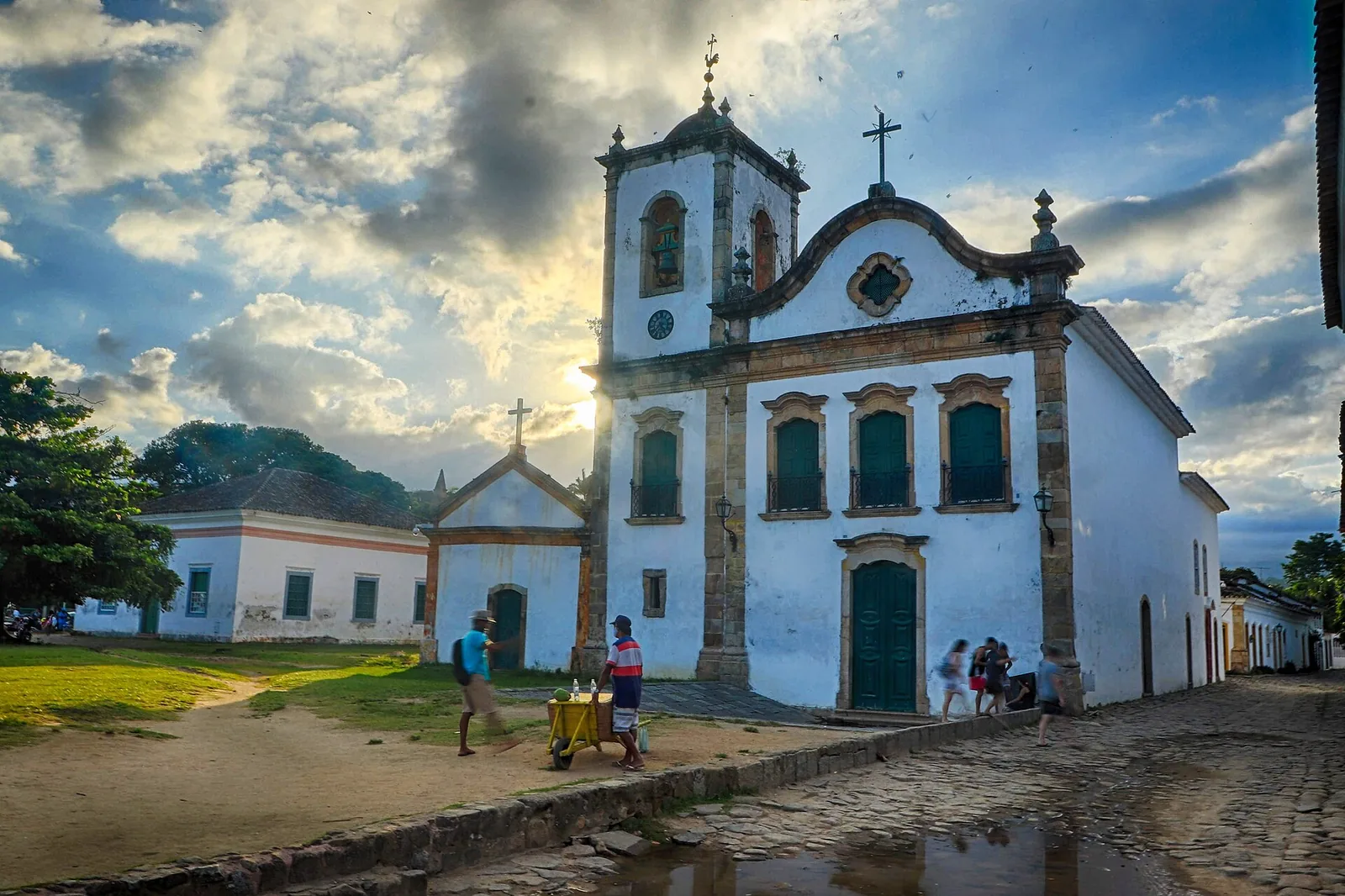
If you have seen one photograph of Paraty, it was almost certainly this one. Santa Rita stands at the seaward edge of the old town, its white front and single bell tower facing the water, framed by fishing boats at the quay when the tide is in. It is the town’s emblem for good reason, and it is also its oldest surviving church, with a founding date on the site of 1722.
Who built it, and why it matters
Santa Rita was raised by the Irmandade de Santa Rita dos Pardos Libertos — the brotherhood of freed pardos, free people of mixed African and European descent. In the rigid caste order of the colony, these were people who were legally free but barred from the white parish church. So they built their own. That single fact reframes the whole postcard. The most photographed, most beloved building in Paraty was made by people who were excluded from worshipping alongside the town’s elite, and they made something more graceful than anything the elite managed for another sixty years.
The architecture is colonial baroque in its calmest register: a symmetrical facade, three doorways, arched windows, a modest tower, and almost no ornament on the outside at all. That restraint is not poverty of imagination. It is the local idiom — lime-washed stone and simple lines, the same visual language you see in the merchant houses along the street. Paraty was a working port, not a gold city, and its buildings say so.
The Museum of Sacred Art inside
Santa Rita no longer holds regular Mass. Instead it houses the Museu de Arte Sacra de Paraty, the town’s Museum of Sacred Art, run under the national museums institute. This is the one church where a small entry fee is normal, and it is worth it. The collection gathers the finest surviving religious objects from the town’s churches into a few cool rooms: carved and polychrome wooden saints, gilded fragments of altarpieces, oil paintings darkened with age, silver processional pieces, and old liturgical books and vestments. It is not a huge museum. You can see it properly in half an hour to forty minutes. But it is the best single place to understand the sacred art of the region, because it lets you stand close to pieces that in a working church would be high on a wall or behind an altar rail.
Pay attention to the wooden saint figures in particular. Many were carved locally, and the faces have a directness — a plainness — that sets them apart from grander imported work. This is folk baroque as much as court baroque, and it is more moving for it. If you only go inside one church in Paraty, and you want to actually look at objects rather than a space, make it this one.

Igreja Matriz de Nossa Senhora dos Remédios: the parish church
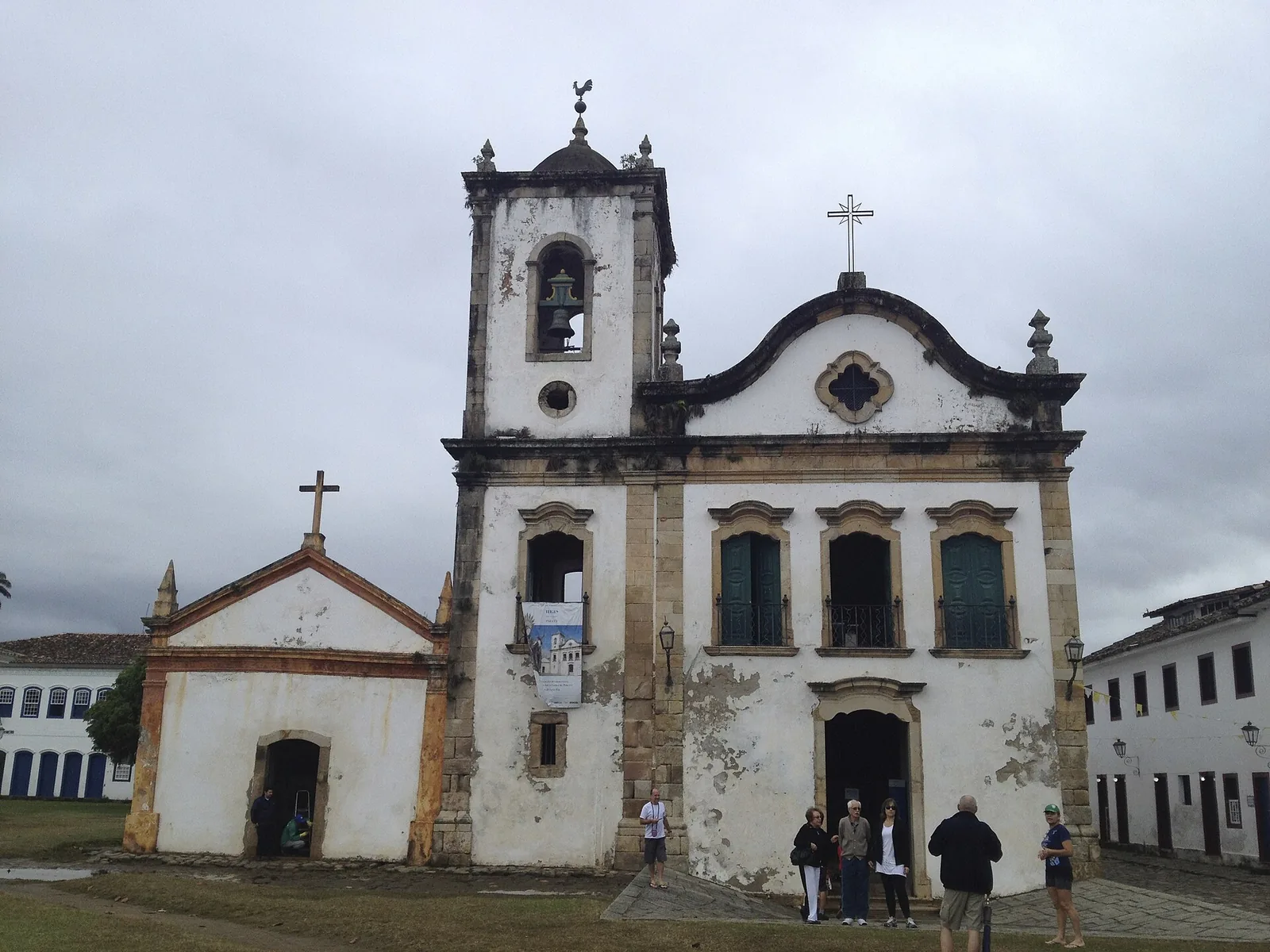
Walk two blocks inland from Santa Rita and you reach the main square, and on it the largest church in town: the Matriz de Nossa Senhora dos Remédios, dedicated to Our Lady of Remedies, the patron of Paraty. This was the church of the white townspeople — merchants, landowners, officials, and the poorer whites too — the parish church at the civic centre of things, taking up most of a block on the square where the town’s business was done.
Its history is a lesson in how slowly a small port could build. There had been earlier churches on or near the site since the seventeenth century, but the present structure was a long, halting project. Work on the church as it now stands stretched across decades, and it was never entirely finished to its original plan — look at the towers and you will notice the front is not quite symmetrical, a sign of money running out before ambition did. It was formally consecrated only in the later nineteenth century. There is a persistent local story that its foundations rest partly on unstable, sandy ground, which is why it was never loaded with the heavy stone ornament its builders first imagined. Whatever the exact cause, the result is a church that is imposing by Paraty’s standards and restrained by anyone else’s.
Inside, the style is more neoclassical than baroque — cleaner lines, paler surfaces, less of the swirling gilt you might expect. It is the busiest of the four for actual worship, so it is the one most likely to be mid-service when you arrive, and the one where you most need to check before wandering in. If a Mass is on, stand quietly at the back or come back later. The square outside is the natural heart of the old town and a good place to sit for a while and watch the day; several of the best places to eat are a short walk from here, tucked into the surrounding lanes.
Igreja de Nossa Senhora do Rosário e São Benedito: built by and for the enslaved
Of the four churches, this is the one that stays with people. Nossa Senhora do Rosário e São Benedito — Our Lady of the Rosary and Saint Benedict — was built by and for the enslaved and freed Black population of Paraty, and it carries that history without any softening. Its founding on the site dates to 1725, only a few years after Santa Rita, which tells you how early and how firmly these communities organised their own devotional life even under slavery.
The dedication itself is the point. Nossa Senhora do Rosário, Our Lady of the Rosary, was the patron the Black brotherhoods of colonial Brazil took as their own across the country, and São Benedito — Saint Benedict the Moor, a Black Franciscan saint — was likewise a figure of particular devotion for enslaved and free Africans. A church dedicated to both is unmistakably an African-Brazilian church. Building and maintaining it was an act of self-organisation by people the wider society treated as property, and it stood as a place where they could worship, bury their dead with dignity, and hold to a devotional life of their own choosing.
Architecturally it is the plainest of the group, and understanding why matters. The Rosary brotherhood had the least money and the least protection, so its church was built slowly, simply, and without the gilded excess a richer congregation might have commissioned. That plainness is not a lack. It is the honest record of who built it and under what conditions. Go inside if it is open — hours here are the least predictable of the four — and give it the same slow attention you would give a grander space. The story it tells is the most important one in town, and it connects directly to the living local culture you feel in Paraty today.
São Benedito in December
The church comes fully alive in the first week of December, when the festivities of São Benedito are held. It is one of the most rooted celebrations in Paraty — less polished and less touristed than some of the bigger festivals, and all the better for it. If you are in town then, this is where to be.

Capela de Nossa Senhora das Dores and the smaller chapels
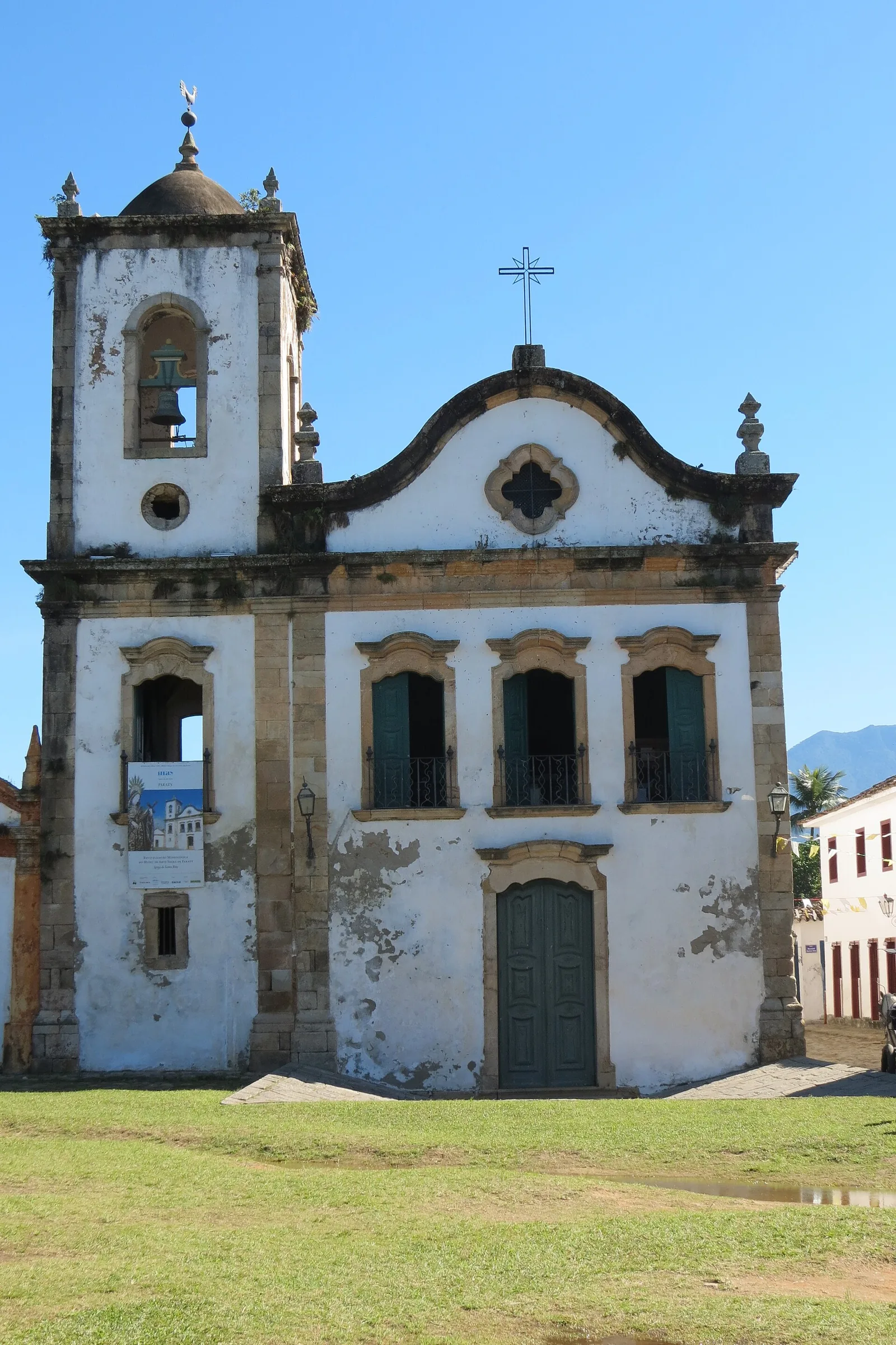
The fourth of the main churches is the smallest and the youngest: the Capela de Nossa Senhora das Dores, Our Lady of Sorrows, a compact chapel near the water dating to around 1800. It was associated with the women of the white elite — a more private, genteel devotion than the public bustle of the parish church. Its scale suits that: this is an intimate space, quietly kept, and it completes the social picture the other three begin. Whites at the Matriz, free pardos at Santa Rita, the enslaved and freed at the Rosário, and the elite’s women at das Dores. Four buildings, four positions in one small society, all within sight of each other.
Beyond these four there are smaller chapels in and around the town, including a modest chapel dedicated to Sant’Ana — Saint Anne, the mother of the Virgin — the kind of small devotional building that colonial towns accumulated over the centuries. These lesser chapels are not always open and are easy to miss, but if you pass one with its doors ajar, step in for a minute. They are part of the same fabric. Do not build your day around finding a specific minor chapel open; treat any that you can enter as a small bonus rather than a fixed stop.
Reading the baroque: what to actually look for
Sacred art can wash over you as a general impression of dark wood and gold. It repays a little structure. Here is what to look for, in plain terms, so that the interiors become legible rather than just atmospheric.
The altarpieces
The carved wooden structure behind and around an altar is the retable, and in Brazilian baroque it is usually the most worked object in the whole church. Look at how the carving frames the central image — the columns, the scrolls, the little carved cherubs — and at how much of it is gilded. Gold leaf was the ultimate statement of a brotherhood’s wealth and devotion, so the amount of gilt you see is a direct reading of how rich the congregation was. Compare the altars across the four churches and you can almost see the money map itself.
The saint figures
The freestanding carved and painted saints — the imagens — are often the oldest and most personal objects in a church. Many in Paraty were carved locally in a plain, direct style, their faces and hands painted in muted flesh tones, their robes gilded or coloured. Notice which saints are present: they tell you what the community feared and hoped for. A fishing and port town leans on protectors of sailors and the sick. Look, too, for signs of age and repair — a repainted face, a replaced hand — which mark the long life these objects have had.
The paintings and the ceilings
Beyond the carved work, look up and look at the walls. Colonial churches often carried painted ceilings and framed oil canvases, and while Paraty’s are modest, they are there. Ceiling paintings were a way for a congregation with limited funds to reach for grandeur with pigment rather than gold — a painted illusion of coffers or clouds standing in for carved stone the brotherhood could not afford. The oil paintings on the walls, usually of saints or scenes from the life of the Virgin, have darkened with two centuries of candle smoke and damp sea air, which is part of their character. Do not expect bright colour; expect the deep, warm gloom of old varnish. Where a painting has been cleaned or restored you will see the difference sharply, and it is a useful reminder of how much brighter these interiors once were.
The overall restraint
The single most useful thing to understand is that Paraty’s sacred art is restrained by design. This was a port on the edge of the Atlantic Forest, not a gold-mining capital, and its churches never accumulated the dizzying, wall-to-wall gilding of the Minas Gerais churches just over the mountains. If you have seen those and expect the same here, adjust your eye. The pleasure in Paraty is in the modesty — in a single well-carved saint in a quiet whitewashed room, in the honest plainness of the Rosário, in the way the light falls through an arched window onto old wood. It is a different, calmer register, and it suits the town.

The festival calendar: when the churches come alive
The churches are worth seeing empty and cool on an ordinary morning. They are a different thing entirely during a festival, when devotion, music and the whole town spill out around them. If your dates are flexible, it is worth knowing the rhythm.
- Festa do Divino Espírito Santo — the biggest of the religious festivals, tied to Pentecost and usually falling in May or June. Paraty fills with folk music, flag processions, food stalls and days of celebration that blend Catholic devotion with deep local tradition. It is the town at its most alive.
- São Benedito — the first week of December at the Rosário church, an African-Brazilian celebration rooted in the community that built the church.
- Nossa Senhora dos Remédios — the town’s patron saint, honoured around early September, centred on the Matriz on the main square.
Dates for the religious festivals move with the church calendar from year to year, so confirm them locally before you plan a whole trip around one. And note that these are living celebrations, not performances put on for visitors. Watch with respect, keep out of the way of processions, and ask before photographing people up close. For a fuller picture of the town’s events, including the literary festival that shares its streets each year, see our guide to FLIP and the festival calendar, and for how the seasons shape a visit, our notes on the best time to come.
Visiting etiquette: how to go in well
These are working churches and, in the case of Santa Rita, a working museum. A little care makes the difference between being a welcome visitor and an intrusion. None of this is complicated.
- Check for a service first. If a Mass or ceremony is in progress, either stay quietly at the very back and do not wander, or come back later. Never walk the aisles or photograph during a service.
- Dress modestly. Covered shoulders and knees are the norm inside. You will have come from the beach or the boat, so carry a light layer to throw on — a shirt or a wrap over swimwear is enough.
- Lower your voice. Sound carries in stone rooms. Speak quietly, and silence your phone before you step in.
- Ask about photography. It is often allowed without flash, but not always, and never during a service. Flash damages old pigment and gilding, so leave it off regardless.
- Leave a donation. The free churches keep a box by the door. A small contribution helps maintain buildings that survive on very little.
- Do not touch the art. Carved saints and gilded altars are centuries old and fragile. Look closely, but keep your hands to yourself.
Opening hours are the real practical challenge. Santa Rita, as a museum, keeps the most reliable hours, though it typically closes one day a week. The others open around Mass times and when a caretaker is present, which is less predictable. The honest approach is to treat the exteriors as the fixed part of your walk and the interiors as a happy variable — you will get into some and not others on any given day, and that is fine. If getting inside a specific one matters to you, ask at your accommodation or at the tourist office in the morning about that day’s hours.
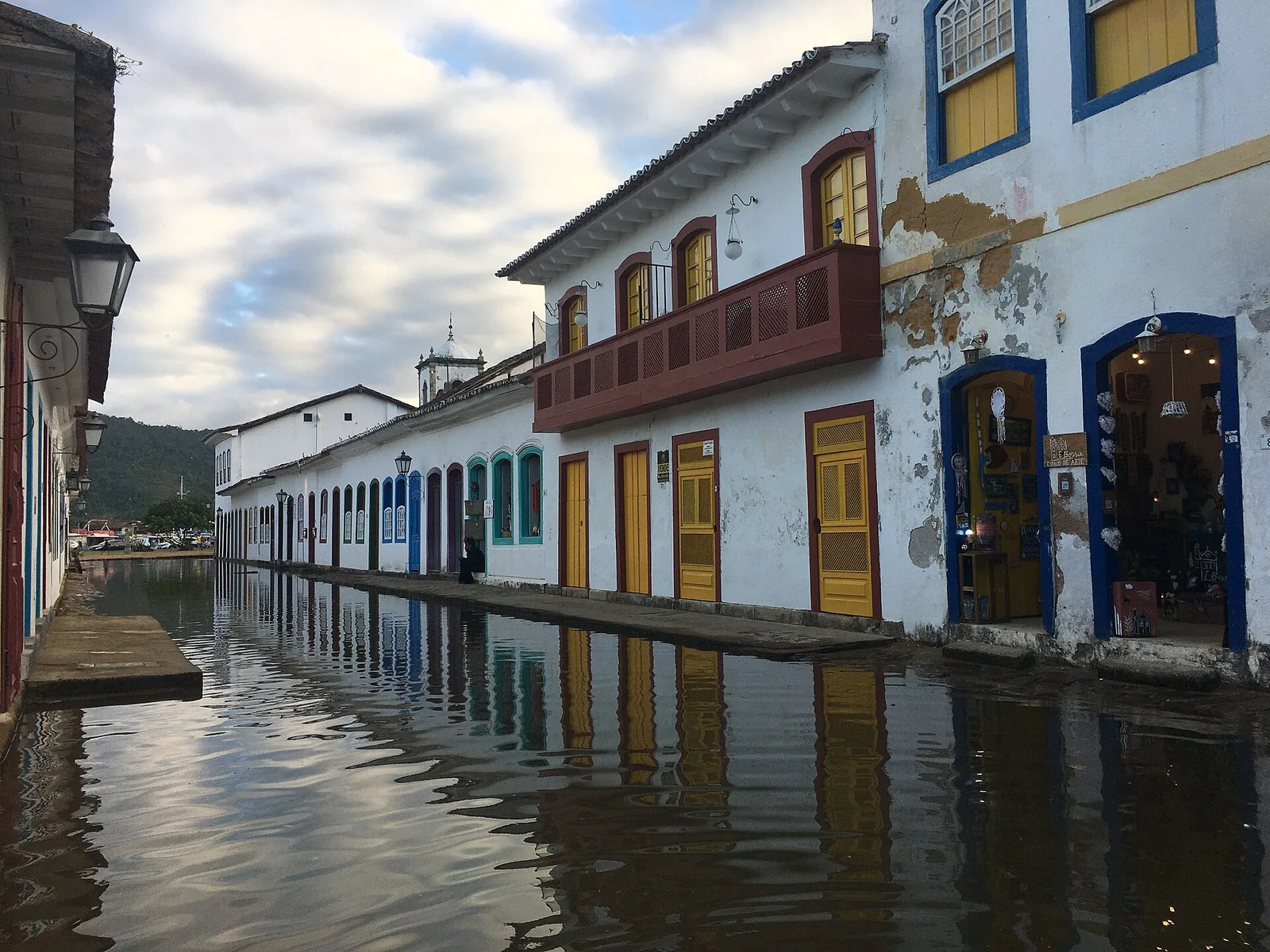

A half-day walking route through the churches
The whole circuit is walkable and flat, on cobbled and stone streets that are hard on smooth soles — wear something with grip and a low heel, especially after rain, when the stones turn slick. Here is a route that follows the social story in order and works with the light.
- Start at Santa Rita, early. Come first thing, before the day-trippers, when the light is soft on the white facade and the quay is quiet. See the exterior from the water side, then go in for the Museum of Sacred Art.
- Walk inland to the Matriz on the main square. Two blocks brings you to the parish church and the civic heart of the old town. Look at the unfinished, uneven towers, step inside if no service is on, then take a coffee on the square.
- Cross to the Rosário. A short walk brings you to the plainest and most powerful of the four. Give it time. This is the emotional centre of the circuit even though it is the least adorned.
- Finish at the Capela das Dores by the water. The small chapel near the sea closes the social picture and puts you back near the harbour, where the seafood houses at the water’s edge make a natural lunch stop.
At an unhurried pace, with the museum and a coffee, this is a comfortable half-day. It slots neatly into a broader plan of the old town — our Paraty itineraries show how to combine it with the harbour, the artisan shops and an afternoon on the water. Because so much of the walk is under cover or quickly done, it is also one of the better things to do when the weather turns; see our guide to a rainy day in Paraty.
Light, weather and photographing the churches
Santa Rita is the most photographed building in town, and getting a good frame of it is partly about timing. The front faces roughly the water, so early morning light is kind, and the classic shot with boats at the quay depends on the tide being in. Come at low tide and you get mudflats instead of reflections. A soft, slightly overcast morning is often better than hard midday sun, which flattens the white facade and blows out the highlights. Late afternoon can be lovely too, with warmer light and fewer people.
Inside, the churches are dim, and flash is both banned and destructive to old pigment. If you want interior shots, bring a camera or phone that handles low light well, brace yourself against a pillar or pew to keep steady, and accept that you will not capture the gilding as your eye sees it. Honestly, some of these interiors are better experienced than photographed — the Rosário in particular asks to be felt rather than filed away. For a wider set of ideas on shooting the town, from the streets to the bay, see our guide to photographing Paraty.
The churches in the bigger story of Paraty
The reason these four small buildings hold so much is that they sit at the exact hinge of Paraty’s history. The town existed because of gold — the metal came down from Minas Gerais along the old paved trail through the mountains, the Caminho do Ouro, and Paraty was the port where it met the sea. That trade brought merchants, officials, and the enslaved Africans whose labour built and carried nearly everything. The four churches are the spiritual record of that population, sorted by the same brutal logic that sorted everything else in colonial Brazil.
When the gold ran down and a new road later carried the trade away from Paraty entirely, the town was left behind — poor, isolated, and, as it turned out, perfectly preserved. That neglect is why the colonial centre survived so intact, and why it is now protected as a national heritage site and part of a UNESCO listing. The churches you walk between today look much as they did because history simply stopped rebuilding around them for a century and a half. If you find the story here compelling, it is part of a wider Brazilian pattern worth reading about in our journal piece on Brazil’s colonial towns.
It is worth holding both truths at once. These are beautiful buildings and they are the product of a slave society. The white parish church and the church of the enslaved stand a few minutes apart by design, not by accident. Seeing them together, in order, is the most honest way to understand Paraty — far more than any single postcard of Santa Rita against the water can tell you.
Making the churches part of a Château Portofino stay
We host guests just above the town, at a hillside chalet with an infinity pool and one deck that looks out over Paraty, Angra dos Reis and Ilha Grande at once. The church walk is exactly the kind of morning the place is built around. Come down early, while the light is soft and the old town is quiet, do the circuit at a proper unhurried pace, take lunch at the harbour, and then drive the short way back up the hill for a swim as the afternoon warms. The chalet is close enough that town is never a production, and far enough up that you return to quiet and a long view. You can see the house and the deck on the chalet page.
A family we hosted one autumn did the churches on a grey, drizzly morning that would have spoiled a beach day, came back up damp and thoughtful, and spent the afternoon in the pool talking about the Rosário. That is the pattern we like: the town for its history and its texture, the hill for its calm. If you want help shaping a few days around the historic centre, the beaches and the bay, our overview of things to do in Paraty is the place to start, and you are always welcome to get in touch and tell us what kind of trip you are after. We will point you at the right morning for the churches, and the right afternoon to be back by the water.
Frequently asked questions
The old town has four main colonial churches within a few blocks of each other: Santa Rita, the Matriz de Nossa Senhora dos Remédios, Nossa Senhora do Rosário e São Benedito, and the small Capela de Nossa Senhora das Dores. There are smaller chapels as well, including one dedicated to Sant’Ana. Each of the four was tied to a different group in colonial society.
Santa Rita is the oldest of the surviving churches, with a founding date on the site of 1722. It was built by the brotherhood of freed pardos — free people of mixed race — and today it holds the town’s Museum of Sacred Art. Its white front facing the water is the single most photographed building in Paraty.
Colonial Brazilian society was organised by race and legal status, and religious brotherhoods followed those lines. Whites, free people of colour, and enslaved Africans each formed their own brotherhoods and built their own churches. That is why a small port ended up with four churches instead of one, and why walking them in order tells you so much about the place.
Yes, though opening hours vary and some are only reliably open for Mass or when a caretaker is present. Santa Rita charges a small entry fee because it functions as a museum; the others are generally free, with a donation box. Dress modestly, keep your voice low, and always check whether a service is in progress before entering.
Mostly Brazilian colonial baroque and later work: carved and gilded wooden altarpieces, polychrome saint figures, oil paintings, silver liturgical pieces and a few older Portuguese imports. Santa Rita’s museum gathers the finest surviving objects in one place. The style here is restrained rather than lavish — this was a working port, not a gold-rich mining town.
A focused walk covering all four exteriors and the interiors that are open takes about ninety minutes to two hours at an unhurried pace. Add the Museum of Sacred Art inside Santa Rita and you can fill a half-day, especially if you stop for coffee between them. It pairs naturally with a wider wander of the historic centre.
The best known is the Festa do Divino, tied to Pentecost and usually falling in May or June, when the town fills with music, processions and food. São Benedito is celebrated at the Rosário church in the first week of December, and Nossa Senhora dos Remédios, the town’s patron, is honoured in early September. Dates shift with the church calendar, so confirm locally before you plan around one.