In this guide
Rio de Janeiro is the rare great city that lives up to its own postcard. You arrive braced for the famous things to disappoint — the statue, the mountain, the curve of Copacabana — and instead they turn out to be exactly as extraordinary as advertised, set in a landscape so theatrical that the city seems half-invented. Green peaks rise straight out of the sea in the middle of a metropolis of millions; forest runs down to the beach; and over all of it stands a figure with its arms open, which from certain streets appears to be blessing the traffic. For a great many of our guests, Rio is the first chapter of a Brazilian trip and the gateway to the coast we call home, the Costa Verde, which begins just down the road. This guide is about doing that first chapter well.
And doing it well is the whole point, because Rio is a city that rewards judgement. The icons are genuinely worth your time — anyone who tells you to skip Christ the Redeemer to seem sophisticated is performing, not advising — but they reward the traveller who does them at the right hour and at the right pace, who knows to be on the mountain before the cloud and the coaches arrive, who treats the beach as a place to live rather than a sight to photograph, and who balances the headline attractions with the quieter pleasures that make Rio more than a checklist. What follows is the discerning traveller's version: the icons done properly, the neighbourhoods worth your nights, the food and bars, when to come, and how to carry on to Paraty when the city has done its work.
I write as the editor for a chalet above the Bay of Paraty, four hours down the coast, so I will be candid: I think the deepest pleasures of this region lie on the Green Coast rather than in the city. But Rio is the front door, and a marvellous one, and most trips are richer for a few days here first. Give it three days at least; four or five if you can. Then let the coast take over.

The icons, done well
Rio's great sights are great for a reason, and the discerning approach is not to avoid them but to time them. Crowds and cloud are the two enemies, and both are beaten by going early and watching the weather.
Christ the Redeemer and Corcovado
The statue — Cristo Redentor — stands on the peak of Corcovado, around 710 metres above the city, and up to its outstretched hands it rises some 38 metres, an Art Deco figure that has become the emblem of Rio and of Brazil itself. The classic way up is the cog train that climbs through the Tijuca forest, a journey of around twenty minutes that is itself part of the pleasure, threading up through genuine rainforest in the middle of the city; official vans are the alternative. Either way, book your slot in advance and go as early in the day as you can. The reasons are practical: the summit clouds over readily, often by mid-morning, and a fogged-in Redeemer is one of travel's flatter experiences, so early gives you the best odds of the clear, vast view that makes the trip; and the crowds thicken as the day goes on, so the early visitor gets both the weather and the space. Check the forecast and be willing to flex your day to a clear one — the view is the entire point, and it is worth the small inconvenience of rearranging around the sky.
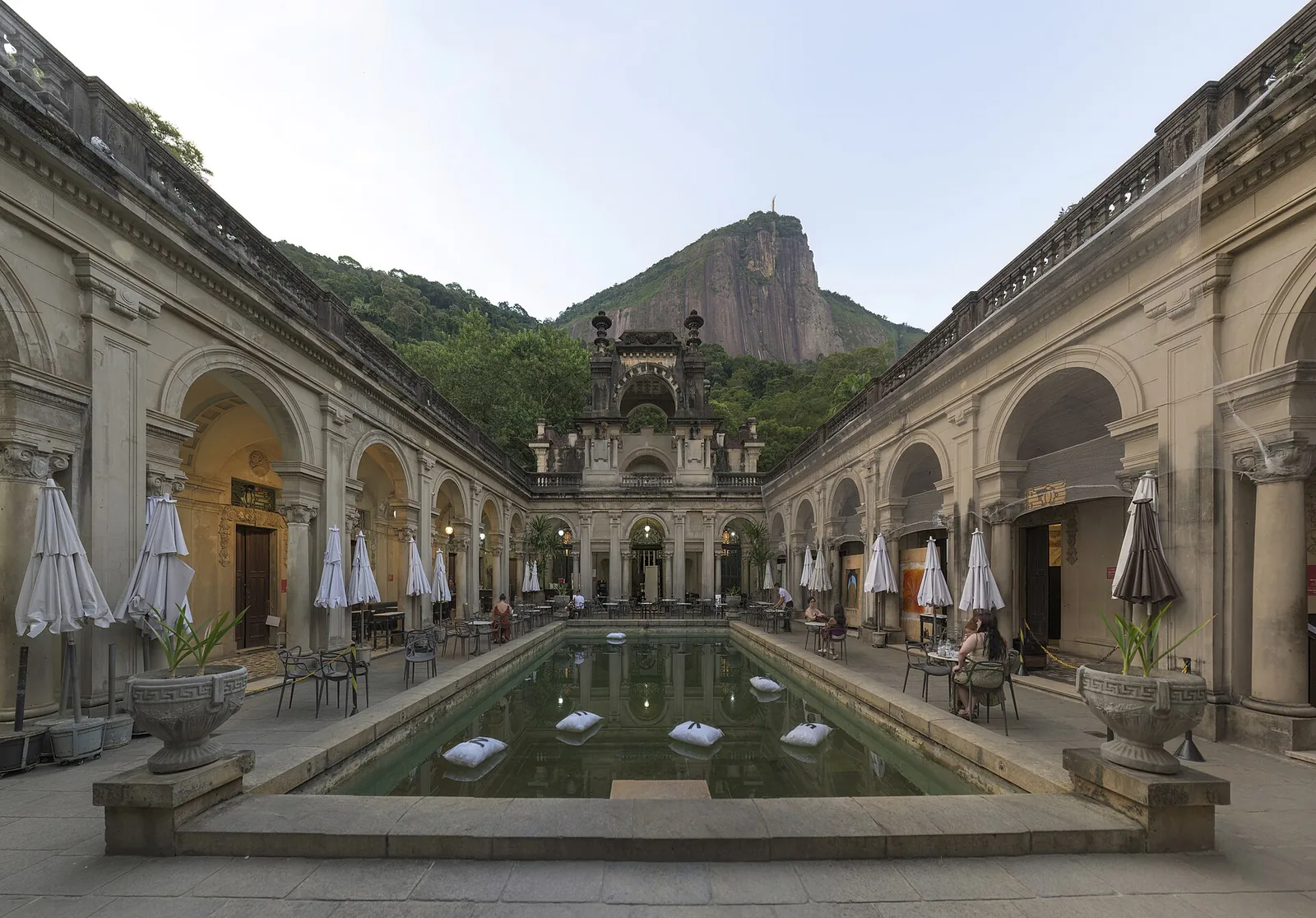
At the base of Corcovado, and worth pairing with the visit, is Parque Lage, a graceful old estate with a grand mansion and a courtyard café framed against the mountain rising behind. It is free, calm, beautiful, and a complete change of register from the summit — a place to sit with a coffee and look up at where you have just been, or are about to go.
Sugarloaf — Pão de Açúcar
The city's other essential height is Sugarloaf, the smooth granite dome guarding the mouth of Guanabara Bay. You reach it by two cable cars in sequence, pausing at the lower peak of Morro da Urca before the final glide to the summit at around 396 metres. The view is the complement to Corcovado's: from here you look back at the city and across the bay, with the beaches curving away, the peaks crowding the shore, and Christ the Redeemer visible on his distant hill. Sunset is the celebrated time to go, when the city lights come up beneath you and the rock glows — though it is also the busiest, so weigh the spectacle against the company. Sugarloaf and Corcovado together give you the two definitive perspectives on Rio, and I would space them out, either on separate days or one in the morning and one toward dusk, so that each gets your full attention rather than blurring into a single exhausting day of summits.
The beaches: Copacabana and Ipanema
Rio's beaches are not sights to be ticked but a way of life to be joined, and understanding that is the key to enjoying them. Copacabana is the grand old crescent, some four kilometres of sand backed by its famous wave-patterned mosaic promenade, busy and democratic and endlessly alive. Ipanema, around the headland, is the more refined stretch, framed at its western end by the twin peaks of Dois Irmãos, the Two Brothers, with a beach culture organised by sections, each with its own crowd. The thing to do is not to march along photographing but to settle: rent a chair and umbrella from a vendor, order a coconut or a cold drink, swim, watch the football and the volleyball, and let an afternoon go. That is how Cariocas — the people of Rio — use their beaches, and it is the single most pleasurable thing the city offers. Ipanema at the end of the day, when the whole beach turns to face the sunset behind the Two Brothers and applauds it, is one of those moments that justifies the trip on its own.
Rio rewards the traveller who does the famous things, but does them at the right hour and at the right pace.
Beyond the icons: the quieter Rio
The traveller who only does the four famous things has seen Rio's face but not its character. A day given to its gardens and its old hill neighbourhoods is what turns a sightseeing trip into an acquaintance with the city.
The Botanical Garden
The Jardim Botânico is one of Rio's loveliest and most restful places, and a piece of its history besides. It was founded in 1808 by the Prince Regent, the future Dom João VI, originally to acclimatise plant species brought from across the world, and it grew into the great green institution it is today. Its signature is the avenue of towering imperial palms, planted in the garden's earliest years and now run to extraordinary height, marching in a grand colonnade through the grounds. Beyond them are orchid houses, lily ponds, a patch of preserved Atlantic Forest alive with small monkeys and birds, and shade enough to escape the midday heat entirely. It is the antidote to the city's intensity — an hour or two of quiet, green order at the foot of the same mountains that hold the Redeemer aloft. A morning here, before the heat builds, pairs naturally with the nearby Parque Lage and the lower slopes of Corcovado, making an easy half-day that asks nothing strenuous and gives a great deal of calm.
Santa Teresa and Lapa
Up in the hills above the centre, Santa Teresa is Rio's bohemian quarter: a neighbourhood of cobbled lanes, faded colonial mansions, artists' studios and small restaurants, with views down over the city and the bay. It has the feel of a hill village improbably attached to a metropolis, and it is the place to wander without a fixed plan — to follow a street uphill for the view, stop for lunch with the whole bay laid out below, and browse the workshops. At its edge, the celebrated Selarón Steps tumble down toward Lapa, a long staircase encrusted in coloured tiles from around the world, a work made over decades and now one of the city's most photographed corners.
Below, at the bottom of the hill, Lapa is Rio's nightlife and music heartland, the home of samba and live performance, framed by its grand white arches. By day it is unremarkable; by night, particularly toward the end of the week, it comes alive with bars and clubs and the sound of live music spilling into the street. It is best approached with sensible caution and, ideally, with a plan for getting home by ride app, but for a night of genuine Carioca music it is the address. Santa Teresa by day and Lapa by night, taken together, give you the artistic and musical soul of the city that the beaches and the summits do not.
The Tijuca forest and the lagoon
Two more pieces complete the quieter Rio, and both speak to the city's unusual marriage of metropolis and wilderness. The Tijuca forest, through which the Corcovado train climbs, is one of the largest urban forests in the world — a vast tract of replanted Atlantic Forest draped over the mountains in the middle of the city, with trails, waterfalls and viewpoints that feel a world away from the beaches a few kilometres below. You can drive or be driven up to its lookouts, walk a forest path, and stand on a peak with the whole city and sea spread beneath you, having seen barely another soul. It is the clearest demonstration of what makes Rio singular: a genuine rainforest inside the city limits.
Down at sea level, the Lagoa Rodrigo de Freitas, the lagoon set behind Ipanema and Leblon and ringed by mountains, is where Cariocas come to walk, run, cycle and eat at the waterside kiosks in the cool of the evening. A circuit of the lagoon at dusk, with the Christ statue lit on the hill above and the water still, is one of the city's gentler pleasures and a fine way to spend a late afternoon between beach and dinner. Neither the forest nor the lagoon makes the standard highlight reel, and both are the better for it.

Where to stay: the neighbourhoods that suit you
Where you base yourself shapes your Rio more than any single sight, so it is worth matching the neighbourhood to the kind of traveller you are.
- Ipanema is the all-rounder, and the default for most first-time visitors who want it all in walking reach: a beautiful beach, handsome streets, the city's best concentration of restaurants and shops, and a metro link. If you are unsure, stay here.
- Leblon, just beyond Ipanema, is the quieter, more polished sibling — greener, calmer, residential, with excellent dining of its own. It suits couples and families who want the Ipanema lifestyle a notch more serene, and it is where many travellers seeking refinement settle.
- Copacabana has more energy, more variety and generally better value, with the grand sweep of its beach and the famous old hotels along it. It is busier and more mixed than Ipanema, which some love and some find too much; for many it is the lively, central choice.
- Santa Teresa, up in the hills, is for travellers who prize character and views over beach access — boutique stays in old mansions, a village feel, and a short ride down to the sand. Choose it if atmosphere matters more to you than being on the beach.
Across all of these, the same gentle safety sense applies as in any large city: keep valuables discreet, especially on the beach, use ride apps or registered taxis after dark, and ask your hotel which streets and times to favour. We treat the practical side of a Brazilian trip in full in our guide to planning a luxury trip to Brazil, which covers money, safety and the rest without the fear-mongering the subject usually attracts.
Doing the icons without the queues
Since the famous sights are where time is most often lost, a few specific habits are worth gathering in one place. Book the timed entries — for Corcovado and Sugarloaf both — online and in advance rather than queuing on the day; the slots sell out at peak times and the saving in wasted hours is considerable. Take the first slots of the morning wherever you can: the light is clearest, the cloud has not yet built on the summits, and the coaches have not yet arrived. Watch the forecast and keep a degree of flexibility, so that you can move your mountain day to the clear one — a fixed booking on a fogged-in morning is the one avoidable disappointment. Travel light to the sights, since large bags are not allowed on the Corcovado train. And consider the counter-intuitive timings the crowds miss: a weekday over a weekend, the late afternoon over the midday rush, the shoulder season over the peak. The icons are not the problem; doing them at everyone else's hour is.
The food and bar scene
Rio eats well, and eating is one of the real pleasures of a stay. The city's signature is informal and convivial rather than fussy, and the best approach is to lean into how Cariocas actually eat rather than chasing only the formal restaurants.
Start with the institutions of the everyday. The botequim — the neighbourhood bar-restaurant — is the soul of Rio dining: cold beer, simple plates, croquettes and grilled fish, tables on the pavement, the football on. The churrascaria, the all-you-can-eat grill where waiters circulate with skewers of meat, is the city at its most generous, best approached hungry and unhurried. The juice bars on every corner turn Brazil's astonishing range of fruit into a ritual of their own. And the beachfront kiosks, where you can eat and drink with your feet near the sand, are a pleasure in themselves. For something more refined, Rio's upper end has grown serious in recent years, with kitchens reinterpreting Brazilian ingredients and traditions at a high level, particularly across Ipanema and Leblon — your hotel will know the current names, which is the right way to find them, since the best tables change.
To drink, the caipirinha is the national cocktail and Rio's default — cachaça, lime and sugar over ice, deceptively strong and properly made everywhere. Brazil's craft beer scene has blossomed too, and a chilled chope, the local draught, on a hot afternoon is a small perfect thing. We go deeper into the spirit behind the caipirinha, and the cane spirit at its heart, in our journal piece on cachaça and caipirinha culture, and into the wider table in our guide to Brazilian gastronomy — both worth reading before you come hungry. The single best piece of advice on Rio food is to eat where it is busy and casual, drink the caipirinhas with respect, and not over-plan; the city's pleasures here are spontaneous.
A Carioca weekend habit worth borrowing
If your stay takes in a weekend, two local rituals reward the visitor who joins in. The first is the feijoada, the slow-cooked black-bean and pork stew that is the closest thing Brazil has to a national dish, traditionally eaten at a long, leisurely lunch — many places serve it on Saturdays, and a feijoada lunch that drifts into the afternoon is the city at its most contented. The second is the weekend market: Rio's neighbourhood feiras, the open-air produce and craft markets that appear on set days, and the larger artisan markets, are where the city shops, eats and lingers, and a slow wander through one — a fresh juice in hand, the stalls of tropical fruit you have never seen — is worth more than another monument. Ask your hotel which market falls on which day near you; it is the kind of local knowledge that turns a good day into a memorable one.
When to go
Rio's seasons matter, because so much of what you have come for is the view, and the view depends on the sky. The dry winter, roughly May to September, is the most reliable time: warm days, cooler evenings, clearer skies and the best odds of an unclouded Christ the Redeemer and a sharp panorama from Sugarloaf. The sea is cooler than in summer but swimmable, and the crowds outside the holiday peaks are kinder. The summer, December to March, brings the warmest water, the longest days and the most electric atmosphere — the beaches at their fullest, the city at its liveliest — but also the heaviest rain and the biggest crowds, climbing to their expensive peak around New Year and, soon after, Carnival.
For many travellers the shoulder months on either side of summer are the sweet spot: warm enough, clearer than the wet season, and quieter than the peaks. Two dates deserve a deliberate decision rather than an accident: Réveillon, the vast New Year's Eve celebration on Copacabana, and Carnival, which moves with Easter and usually falls in February — in 2027, the main Rio parades land on the 7th, 8th and 9th of February. Both are extraordinary and both are the busiest, priciest moments of the year; decide to be in them or well clear of them, but do not stumble into them unprepared. We lay out the whole national calendar, region by region, in our companion guide to when to visit Brazil.
A suggested rhythm for three or four days
To put the pieces together, here is the shape I would give a city stay of three or four days — not a rigid schedule but a sensible rhythm, built around the weather and the crowds rather than against them.
- Day one. Arrive, settle into your neighbourhood, and spend the afternoon on the beach the gentle way — a chair, a coconut, a swim, the sunset at Ipanema. Let the city introduce itself slowly while the jet lag fades.
- Day two. The Redeemer, early. Take the first slots up Corcovado for clear skies and space, then come down to Parque Lage at its foot for a quiet coffee, and give the rest of the day to the Botanical Garden and a long lunch. A calm, green day after the summit.
- Day three. Santa Teresa in the day — wandering the lanes, the Selarón Steps, lunch with a view — then Sugarloaf toward sunset for the city lighting up beneath you. If the energy holds, Lapa for live music in the evening, with a ride app home.
- Day four, if you have it. The unhurried day: the Tijuca forest or the lagoon, more beach time, the shops and cafés of Leblon, a final dinner. Or use it as your weather buffer, moving the mountain days around a clear sky.
Keep one principle above the plan: hold a day in reserve for the weather, and be willing to swap a beach day for a summit day when the sky is clear. Rio rewards the flexible far more than the rigidly scheduled.

Getting around the city
Rio is bigger and more spread out than first-time visitors expect, and the smart move is to match the transport to the moment rather than commit to one method. The metro is the unsung hero of the Zona Sul: clean, air-conditioned and quick, it links Copacabana, Ipanema, Botafogo and the centre, and on a hot afternoon it beats sitting in traffic along the beachfront. Ride-hailing apps are widespread, inexpensive by international standards and the easiest way to reach a restaurant in Santa Teresa or a viewpoint after dark; they spare you the parking and the navigation, and most drivers are used to visitors. Keep a little cash for the small things and use the app for the rest.
A few habits make the city easier. Travel light on the beach and in crowds, keep your phone away from the open window of a stopped car, and treat the late-night walk home the way you would in any large city — take a car instead. The hop-on tram up to Santa Teresa (the bondinho) is a pleasure in itself and worth doing for the ride, not just the destination. For Corcovado, the cog train through the forest is part of the experience; for Sugarloaf, the two-stage cable car is the whole point. Hiring a car inside the city is more trouble than it is worth — save the rental for the drive south to the coast, where you will actually want it. Plan around the light and the traffic, keep your days unhurried, and Rio rewards you for it.
From the city to the coast: Rio as gateway
Here is where Rio's role in a wider trip comes into focus. For all its pleasures, the city is, for our guests, the gateway rather than the destination — the brilliant overture before the coast. South and west of Rio begins the Costa Verde, the Green Coast, where the Atlantic Forest tumbles to the sea and the colonial towns and islands wait. After three or four days of the city's intensity, the move to the coast is a change of gear that most travellers find they have been quietly craving.
Day-trip framing
It is tempting to try to see the coast as a day trip from Rio, and I would gently steer you away from it. Paraty, the cultural heart of the Costa Verde, is around four hours each way; a day trip means eight hours in a vehicle to spend a couple of rushed hours in the town, which sells both the journey and the place short. The coast is not a day-trip destination from Rio; it is the second half of the trip. Far better to use Rio for the city and the icons, then move down to the coast and stay, letting the islands, beaches and colonial streets reveal themselves at the unhurried pace they reward. If your time is genuinely tight, the islands of the Ilha Grande Bay around Angra are the nearest taste of the coast, but even they are better as an overnight than a dash.
Think of the two halves of the trip as deliberately different in character. Rio is the high-energy chapter: the icons, the crowds, the restaurants, the buzz of a great city. The Costa Verde is the low chapter, in the best sense — the colonial quiet of Paraty, the empty beaches reached by boat, the long unhurried days at a private house above the bay. Travellers who try to compress both into a single base, dashing back and forth, tend to do justice to neither. Give the city its days, let it be everything a city should be, and then make the clean break to the coast, where the pace drops and the trip changes key. It is precisely the contrast that makes a Brazilian itinerary sing: the brilliant overture, and then the slow, sustained second movement by the sea.
Getting from Rio to the chalet
The practical journey is straightforward and, done right, a pleasure in itself. From Rio it is about 258 kilometres down the coast to Paraty on the BR-101, the Rio-Santos road, taking around four hours and passing the bay at Angra dos Reis near the midpoint. A private transfer is the most comfortable option and what most of our guests choose — door to door, with the freedom to stop along the bay for a swim or a lunch; a hire car gives you the same freedom if you would rather drive; and comfortable long-distance buses run frequently from Rio's main terminal for those who prefer not to. We walk the whole route, with its stops and its driving notes, in the Rio to Paraty road trip guide, and set out every option — transfer, car and bus — on the getting around page. The drive itself, with the islands appearing beside the road and the forest crowding the hills, is one of the great Brazilian coastal routes, and a fitting bridge between the city and the coast.
The chalet sits at the end of that road, around 400 metres above the Bay of Paraty, with an infinity pool looking out over the water toward Paraty, Angra dos Reis and Ilha Grande — the view that the whole journey has been building toward. After the noise and brilliance of Rio, arriving to that quiet is exactly the contrast a good trip wants. You can see it on the chalet page, and begin planning the coastal half of your trip from our Paraty hub.

The discerning traveller's Rio, in short
If I were to compress all of this into a single piece of advice, it would be this: do the famous things, but do them with judgement. Be on Corcovado early, before the cloud and the crowds. Take Sugarloaf at a different hour, ideally toward sunset. Treat the beaches as somewhere to live, not to photograph. Give a day to the Botanical Garden, Santa Teresa and the city's quieter character. Eat casually and well, drink the caipirinhas with respect, and choose your neighbourhood to suit your temperament. Come in the clearer, kinder months if you can, and decide deliberately about Carnival and New Year. And then, when the city has worked its considerable magic, move on to the coast and let it slow you down.
Rio is the great gateway to the Costa Verde, and one of the most beautiful cities on earth in its own right. Done well — at the right hours, at the right pace, with the road south already in mind — it is the perfect opening to a Brazilian trip. When you are ready to plan the coastal chapter that follows, we would be glad to help; reach us any time on the contact page, and let the city be the beginning of a longer, slower stay by the sea.

Frequently asked questions
Three full days is a comfortable minimum to see the icons without rushing — one for Christ the Redeemer and Corcovado, one for Sugarloaf and the beaches, and one for the neighbourhoods, the Botanical Garden and the food. Four or five days lets you slow down and add Santa Teresa, day trips and time on the sand. Most people then continue down the coast to the Costa Verde.
For most first-time visitors, Ipanema is the all-rounder — a beautiful beach, walkable streets, excellent restaurants and a metro link. Leblon, just beyond it, is quieter and more polished, good for those wanting calm. Copacabana offers more energy and value, and Santa Teresa, up in the hills, suits travellers who prefer character and views over beach access.
Christ the Redeemer stands on Corcovado mountain, about 710 metres above the city. The classic way up is the cog train through the Tijuca forest, which takes around 20 minutes; there are also official vans. Book ahead, go early in the day for the clearest skies and smallest crowds, and check the weather, since cloud can hide the view entirely.
Yes. Sugarloaf is reached by two cable cars, stopping at Morro da Urca before the summit at about 396 metres, with sweeping views over the bay, the beaches and across to Corcovado. Sunset is the celebrated time to go. It pairs naturally with Christ the Redeemer as the city's two essential viewpoints, ideally on separate days or at opposite ends of one.
The dry winter, roughly May to September, gives the most reliable weather and the clearest views, with warm days and cooler evenings. The summer, December to March, brings the warmest sea and the liveliest atmosphere but more rain and bigger crowds, peaking expensively around New Year and Carnival. The shoulder months either side are often the sweet spot.
It is about 258 kilometres down the coast on the BR-101, roughly four hours by car or private transfer, passing Angra dos Reis on the way. Comfortable buses also run from Rio's main terminal. Many visitors treat the drive as part of the trip, stopping along the bay. It is the natural route from the city to the Costa Verde and the coast around Paraty.
Rio is enjoyed safely by large numbers of visitors, with ordinary big-city caution. Keep valuables discreet, especially on the beach and in crowds, use ride apps or registered taxis rather than hailing on the street, and ask your hotel which areas and times to favour. Stick to the well-trodden neighbourhoods and beaches and you are very likely to have an easy, untroubled stay.